
 E-Paper



Fury, farms and faith: Three mega-projects face backlash in Maharashtra
Will the state consider the people’s voice or push through at any cost?

 Prefer HTon Google


Turbulence in Purandar over Pune’s airport dream
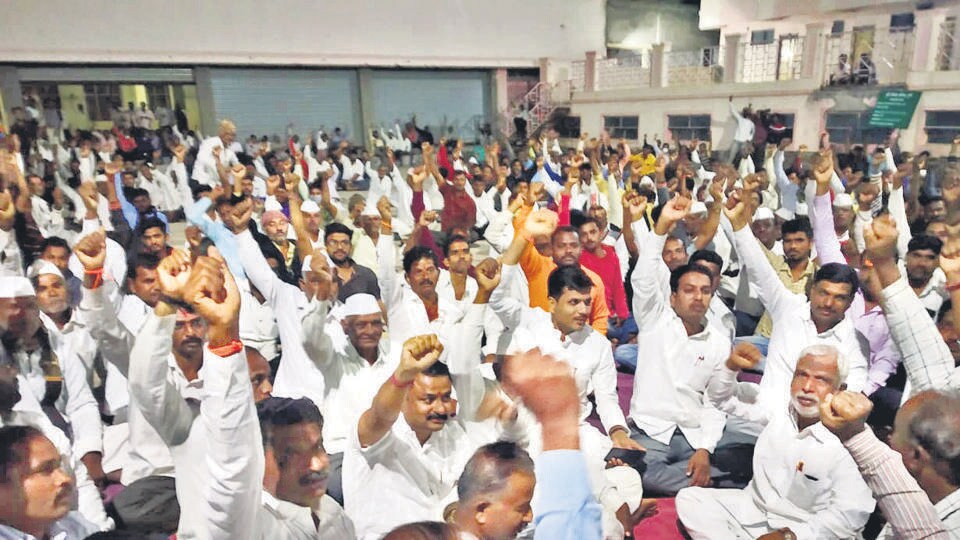
In early May, what began as a drone survey for Pune’s long-delayed Purandar International Airport ended in chaos. At Kumbharvalan, one of the seven villages impacted by the project, angry farmers clashed with police. By the end of the day, more than two dozen officers were injured — and the fault lines between development and displacement were laid bare.
The Maharashtra Airport Development Company has identified 2,873 hectares in seven villages in Purandar tehsil for the Purandar airport project.
“This is our ancestral land. We grow figs, custard apples, rice — and we are not prepared to lose it for a project that does not involve us,” said Umesh Khaladkar of Pargaon, whose family has lived in the village for three generations.
The drone survey was part of the process to begin land measurement. But the administration now faces over 800 formal objections, concerns ranging from inadequate compensation to fear of becoming landless.
Sharad Jamadar, 58, of Kumbharvalan says he only owns two acres. “If that goes, I will have nothing. I will be landless and helpless.”
The seven villages — Pargaon, Khanwadi, Ekhatpur, Munjwadi, Udachiwadi, Vanpuri and Kumbharvalan — have emerged as the epicenter of defiance. Farmers there say that promises made in 2016, when the project was first announced, remain unfulfilled.
“They said we would get five times the market rate for our land, a job for one family member, and a share in airport services,” said a local farmer. “None of that is on paper.”
Purandar Sub-Divisional Officer Varsha Landge, who oversees land acquisition, told Hindustan Times, “We are verifying each objection carefully. Compensation concerns, orchard losses, and loss of ancestral land are being documented. A final proposal will be shared with the farmers.”
State revenue minister Chandrashekhar Bawankule has assured locals of dialogue. “No development happens without some land acquisition. But we will resolve compensation issues,” Bawankule had said during a visit in the first week of May.
Urban planners argue that Pune needs a second airport to meet rising demand. The existing Lohegaon airport — a civil enclave in an Air Force base — has severe limitations on timing, cargo and expansion. “Without Purandar, Pune’s growth will be limited,” said a senior official with the Maharashtra Industrial Development Corporation.
But villagers aren’t convinced. “We’ve seen what happened in Navi Mumbai. Decades passed before the displaced got homes,” said a teacher in Vanpuri.
In 2023, the project gained fresh traction with GMR Airports winning the bid. Yet, the state has walked a tightrope. Local leaders in Purandar claim the BJP’s underperformance in the region during the Lok Sabha polls last year is partly due to the unrest.
“There is a trust deficit. Villagers are not opposing the airport. They are opposing the way it’s being done,” said a former sarpanch.
For now, the drone survey is on hold and the district administration plans to restart hearings next month.
Shaktipeeth Expressway
Pravin Patil’s onion farm in Sangli’s Budhgaon village is a slushy mess, battered and flooded by an unseasonal downpour. But the real storm, he says, is not natural — it’s political.
The hurricane sweeping through Maharashtra is the Shaktipeeth Expressway, a spiritual and economic corridor that has split farmers down the middle, in two regions in the state. The ₹20,787-crore project, approved by the cabinet on Tuesday, will extend all the way from Pawanar in Wardha district, in north-eastern Maharashtra, to Patra Devi in Sindhudurg, at the southern tip of the state.
One of many flagship projects of the BJP-led Mahayuti government, the 802-km expressway will sweep through 12 districts, linking key spiritual sites, or Shaktipeeths. It also aims to cut Nagpur-Goa travel time from 18 to 8 hours.
But to achieve the government’s stated goals of boosting tourism, transport and rural development, the expressway will require the acquisition of 8,419 hectares of land – of which 8,100 hectares are privately owned agricultural plots.
In Western Maharashtra, in the sugarcane- and grape-growing belt of Sangli and Kolhapur, farmers would have to surrender fertile land that supports cash crops, triggering fierce resistance to the project. On the other hand, in drought-prone regions of Vidarbha and Marathwada, farmers believe the expressway will usher in the fruits of economic development.
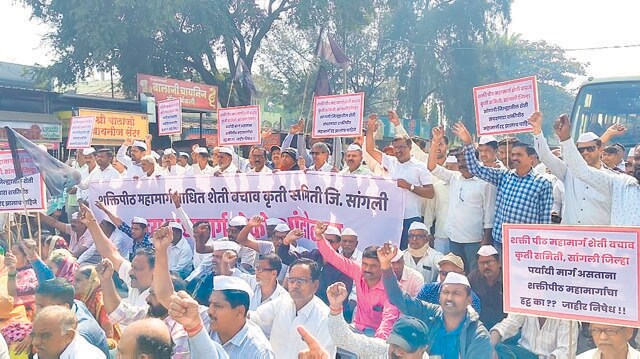
Resistance from farmers, traders and opposition parties in Western Maharashtra has grown stronger in recent months, prompting the state to alter the expressway’s alignment. However, 19 villages in Sangli and 59 in Kolhapur may still face partial land acquisition.
“We spent ₹20 lakh on irrigation recently. Now they want our land,” says Patil, standing ankle-deep in muddy water, surrounded by rotting onions. He stands to lose eight acres of ancestral land to the Shaktipeeth Expressway.
“There’s already a Ratnagiri-Nagpur road nearby,” says Umesh Deshmukh of the Shaktipeeth Highway Sheti Bachao Kruti Samiti. “Why not upgrade it instead of building a new road just a few kilometres away?”
In Kolhapur’s Sangawade village, Prakash Patil has a solid argument. “We lost land to a canal project in 2004. Compensation came only in 2018 — some haven’t got it yet. Now they want more land.”
In Sangli’s grape-producing villages like Manerajuri, the economic stakes are equally high. “I bought three acres for grape farming. Two acres will go,” says Sunil Pawar. “We export to the UK and Russia. What will happen to that?”
Chief minister Devendra Fadnavis has repeatedly defended the expressway as necessary for eastern Maharashtra’s development. “It will benefit five districts in Marathwada,” he said during the budget session. “And farmers are being offered five times the ready reckoner rate.”
But former MP and farmer leader Raju Shetti disagrees. “In 2022, the compensation multiplier was reduced from four times to double the ready reckoner rate. Moreover, this isn’t development — it’s a racket. MSRDC spends ₹100 crore per km while NHAI builds roads for ₹35 crore per km,” Shetti said.
In Vidarbha and parts of Marathwada, two regions battling drought and economic backwardness, have hailed the project. Collectively, nine districts in the region will be impacted by the project. “Eight major investments are lined up for Vidarbha,” said Sanjay Dhole, a farmer from Yavatmal. “We want this expressway. Just pay us fairly.” The Shaktipeeth Mahamarg Samarthan Kruti Samiti too is backing the project but is insisting on fair compensation.
Dhole said the highway would power development in the region. “Big-ticket projects in Vidarbha will create jobs,” he said. “Improved connectivity would also make it easier to reach markets in Western Maharashtra, Konkan, Goa and Karnataka.”
Pandharpur corridor
In Pandharpur, in Solapur district, residents of this temple town lined up at a polling booth on June 14. Volunteers of the Pandharpur Tirth Kshetra Bachao Samiti had placed a ballot box and printed slips here, inviting residents to vote — on whether or not they wanted the state to go ahead with its ₹2,000-crore plan to redevelop the corridor around the Vitthal-Rukmini temple, to be remodeled on the lines of Ujjain’s Mahankal corridor.
Over 485 people participated in the symbolic ballot out of which 458 had opposed the corridor. The response, according to organisers, was a resounding “No”.
“This was the voice of Pandharpur and we plan to include it in our petition in court to oppose the project,” said Abhaysihh Ichganokar-Kulkarni, who heads the samiti. “If the government claims the people want development, count these votes too.”
The corridor would see the widening of access roads, a new Bhakta Niwas, toilets, parking facilities, and the demolition of over 700 structures including homes, shops and historic wadas.
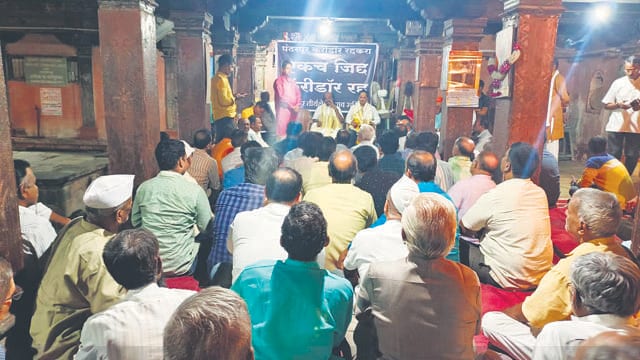
Among the buildings marked for demolition is the Gopal Tukaram Badave wada, where Sant Tukaram is believed to have stayed during his visits to Pandharpur, and the samadhi sthals of several Warkari saints. “This is live heritage, not an abandoned ruin,” said Ichganokar-Kulkarni.
The state government says the corridor is necessary to accommodate the growing number of pilgrims. Officials say that over 1 million devotees crowd into the town during Ashadhi and Kartiki Ekadashis. “Our focus is hygiene, safety and crowd management,” said a senior official in the Solapur district collectorate.
However, residents argue, the plan ignores the town’s spiritual ecology. “The geography of Pandharpur is not like that of Kashi or Ujjain. We have the Chandrabhaga riverbank, where saints walked barefoot on the sand. The corridor would replace that with tiles and barricades,” said Vyankatesh Galgalkar, a local resident and fourth-generation host to Warkaris.
Ganesh Lanke, whose 750-sq ft structure is among those marked for demolition, said, “In 1982, I lost 800sq ft to the Chauphala road widening. I received ₹1,700 as compensation and had to pay ₹1,800 to the municipality in return. To date, I haven’t received the plot I was promised.”
While there are locals who believe the new corridor is needed, they say there is no clarity on compensation and resettlement. “The government is offering cash compensation,” said Galgalkar. “But where do we go? What happens to families like ours who earn by hosting Warkaris?”
For now, the symbolic vote has energised the resistance. “We are not against the project, per se,” says Ichganokar-Kulkarni. “We are against turning Pandharpur into a concrete pilgrimage park.”
During his visit to Pandharpur on March 29, Chief Minister Devendra Fadnavis had said, “The plan has been approved by the government but we will not force the project on the people. It will be implemented after taking them into confidence.”
The symbolic ballot in Pandharpur has done what months of petitions and meetings could not — it has made resistance visible. Whether or not the government counts those votes is a test of its moral credibility, not just its electoral one.


