
 E-Paper



Govt’s band-aid solutions make onions politically sensitive
Farmers and traders in a fix over onion-related issues in Maharashtra as both blame state and centre for lack of political will to find solutions


Every year, in November, onions hit the headlines either due to an increase in price or a drop. This year though, the key kitchen staple has been in the news since August after centre imposed 40 per cent export duty on onions in order to arrest the rising prices home and ensure enough supply in domestic market.
Even as the intervention of Maharashtra government and centre helped resume the functioning of wholesale markets amid strike undertaken by traders and farmers in the third week of August, their efforts have been short-lived. Within a month, traders are once again up in arms with another round of strike by halting auction at India’s largest wholesale market in Lasalgaon and other mandis since September 20.
Onion has now become a politically sensitive vegetable as the issues have given an opportunity to opposition parties to corner the state and central government, with Nationalist Congress Party (NCP- Sharad Pawar faction), Congress, and farmers outfit Swabhimani Shetkari Sanghatana pressing for waiver in export duty.
With Lok Sabha and state assembly polls only months away, Bharatiya Janata Party (BJP) and its allies – Shiv Sena and NCP (Ajit Pawar faction) - cannot afford to allow onion growers, traders, and consumers to be unhappy ver the favourite kitchen staple especially when onions have always been a critical part of state and country’s political economy. Over the years, the rise and drop in prices of onion indicates it is far more than just a demand supply issue.
Farmers in a fix
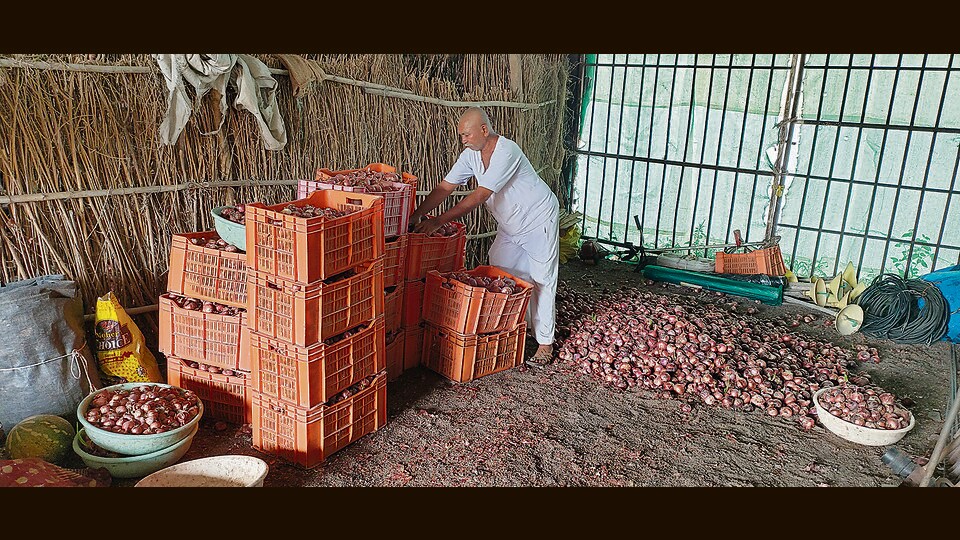
On ground, farmers are worried due to the ongoing heavy rains in the state and their onions, being perishable, are getting damaged as traders have been adamant not to start auctions. In Nashik, most wholesale markets have remained shut despite government efforts to convince traders to commence auctions. There are around 600 registered traders operating through over 15 different wholesale markets across Nashik district. These traders, want government to scrap 40 per cent export duty decision and are also agitated with selling of onion by government agencies such as National Agricultural Cooperative Marketing Federation of India (NAFED), and National Cooperative Consumers Federation of India (NCCF). The traders have given another ultimatum to state and centre to accept their demand within two days.
“If no positive decision is taken in the September 26 meeting by the state government, onion traders from across the state will also participate in this strike. In earlier meeting, traders had decided to intensify the agitation if the state and central governments do not take a positive step,” said Khandu Kaka Deore, Nashik District Onion Traders’ Association president.
While onion auction has been shut in Nashik district prices in retail markets of Pune, Nashik so far have remained stable at around ₹30 per kg, mainly because supply hasn’t affected much. This is because NAFED and NCCF have been bringing their buffer stock which they had procured last month, in the market. This has however rung alarm bells for farmers in Maharashtra who feel the steps by government agencies will further lead to drop in prices of their produce.
Political conundrum
Maharashtra accounts for 35% of onion exports from India. A senior official of the agriculture department said that the farmers in the state have harvested onions on 210,344 hectares of land during Rabi season. They are cultivating onions on 27,609 hectares of land in Kharif season and 51,321 hectares in late Kharif season. Most of the onions are grown in Nashik and Ahmednagar belt, which has till recently been under the influence of NCP when BJP wrested the region in 2014.
The latest issue surrounding 40 per cent export duty has pushed BJP and its allies on backfoot even as one of the party leaders and minister of state for public health and family welfare from Dindori, Nashik, Dr Bharati Pawar tentatively resolved the issue last month by chairing a series of meetings with farmers and traders. This time though, Dr Pawar is on backfoot, not seen engaging with traders so far with only representative holding meetings with agitators is Abdul Sattar, a Shiv Sena leader and minister for marketing in state government. Despite repeated attempts, Sattar was not available for comment.
Besides Dindori, Shirdi and Ahmednagar Lok Sabha seat are also with National Democratic Alliance (NDA) since 2019 and being represented by Shiv Sena lader Sadashiv Lokhande and BJP’s Sujay Vikhe Patil respectively.
The Dindori, Shirdi and Ahmednagar Lok Sabha seats cover 18 assembly segments of which 15 are dominated by onion growers. Of these, four are represented by NCP (Ajit Pawar faction), five with BJP, three with Shiv Sena (Eknath Shinde faction), two with NCP (Sharad Pawar faction), and four represented by Congress.
If parties in power are trying to resolve the latest issue at the earliest, those in opposition would prefer it lingers a little longer in order to draw political mileage in polls. “The onion has always been a sensitive issue in polls and we have seen previously how governments such as one in Delhi during 1990s, have been toppled during elections. Those in power have often seen cautious that consumers, who form larger constituency, are not unsettled while opposition parties in Maharashtra would want to draw political mileage either way whether rates go up or fall drastically, pinching farmers,” said Chitra Lele, a political science professor.
Like farmers, among the onion traders too, there is a mix-up of all the political parties having their affiliations A senior onion trader from Lasalgaon market requesting anonymity said, “This is the first time we have seen a large number of onion traders gathering at Yeola meeting on September 22 protesting the government’s decision. Some of these traders are close to BJP or other parties sharing power.”
Distressed by strike
According to Vijay Bhorkade onion grower from Pimpalgaon Jalan village in Yeola tehsil, farmers in the Nashik district are distressed by this strike and they do not believe in any of the political parties. “Every time when the Agriculture Produce Market Committee (APMC) stops functioning, the major impact is on farmers more than any of the traders, who are financially strong. We only want good rates, as for last 3 to 4 years on average we are getting ₹1,800 to ₹2,200 per quintal at the local wholesale markets.”
Talking about the issue and its impact on farmers, Bharat Dighole, president of the Maharashtra State Onion Growers’ Association said, farmers association was formed in 2015 with the motive that all political parties wooing onion growers during polls should be made answerable to issues faced by farmers.
“Parties use farmers’ issue for their own political benefits, but the ground-level issues that farmers face right from the unseasonal rains, damage to crops, increased rates of raw material. We are in support of traders about the demand to remove 40 per cent export duty, but at the same time state and centre should also understand the difficulties of common farmers who are the cultivators of onion,” said Dighole.


