
 E-Paper



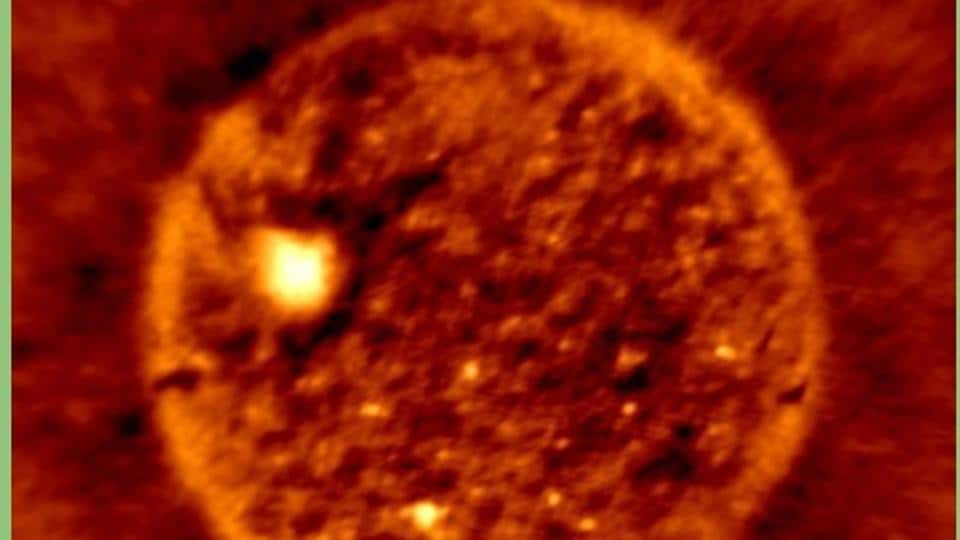
Indian scientists make exceptionally detailed radio images of Sun using MeerKAT
Dr Kansabanik, the lead author of this study, said, the Sun is, in fact, a surprisingly challenging source to study, especially at radio wavelengths

 Prefer HTon Google


A team of solar physicists, led by researchers from the National Centre for Radio Astrophysics (NCRA), Pune, has used the MeerKAT radio telescope in South Africa to observe the Sun and made exceptionally detailed radio images of the Sun, enabling them to see unprecedentedly faint and small features.
Dr Devojyoti Kansabanik led the research along with Dr Surajit Mondal; both of them having completed their PhD from National Centre for Radio Astrophysics, Tata Institute of Fundamental Research (NCRA-TIFR), Pune, under the supervision of professor Divya Oberoi from NCRA. Dr Kansabanik has recently taken up the NASA Jack Eddy postdoctoral fellowship at the Applied Physics Laboratory of the Johns Hopkins University, USA and Dr Mondal is now a postdoctoral fellow at the Centre for Solar Terrestrial Research of the New Jersey Institute of Technology, USA.
It may seem surprising that despite being the brightest object in the sky and being studied since the earliest of times, the Sun still hides many secrets. Dr Kansabanik, the lead author of this study, said, “The Sun is, in fact, a surprisingly challenging source to study, especially at radio wavelengths.” The radio emissions arise from the tenuous atmosphere of the Sun - a region known as the corona and visible to the naked eye only during times of total eclipse. The corona is the birthplace of the phenomena that impact the Earth’s environment; something we now refer to as Space weather.”
Dr Mondal said, “For imaging the Sun, there are several complications. One is that not only does the emission change very quickly in time, but it can also change dramatically from one wavelength to a nearby wavelength. For the Sun, this results in the images being blurry, much like a fast-moving car appears blurry in typical photos. To deal with this, one not only has to make movies with a large frame rate, but also do it for a large number of wavelengths to build a detailed picture of what is happening in the solar atmosphere.”
To observe this brightest of sources, the researchers developed a non-standard observing strategy, where instead of pointing the telescope directly at the Sun, they pointed the telescope at a small distance from the Sun. This situation is very much like seeing an object using our peripheral vision. While the vision is slightly blurry, we can easily see bright objects. Although this allowed researchers to observe the Sun with MeerKAT, it led to additional problems in making the high-fidelity images.
Dr Kansabanik further said, “We put in lot of effort into understanding the effects of the instrument and the peripheral vision due to unconventional observing mode. We developed algorithms to estimate and correct the effects of both the instrument and peripheral vision.”
After correcting all these effects accurately, the researchers finally made the high-fidelity solar images. “To evaluate the fidelity of the images, we compared them with simulations and found excellent similarities” Dr Kansabanik said.
Professor Oberoi said, “The high fidelity of the images we obtained in this study demonstrated that MeerKAT can provide unprecedentedly detailed solar images and will open a new frontier in solar physics.”
Located in the Karoo desert of South Africa, MeerKAT is a precursor to the mid-frequency telescope of the Square Kilometre Array Observatory (SKAO) and consists of 64 radio dishes, each with a diameter of 13.5 m, distributed across an eight km radius. Although by design, it is currently the best-suited telescope anywhere in the world for making spectroscopic and snapshot images of the Sun with high fidelity at GHz frequencies, there are several challenges that astronomers need to overcome to make these high-fidelity spectroscopic solar images using MeerKAT.


