E-Paper



Javed Akhtar flags ‘knowledge gap’, warns against losing cultural roots
Speaking at the inaugural session of the Symbiosis Literary Festival 2026 at Symbiosis Ishanya Bhavan in Viman Nagar, Akhtar called for a more holistic approach to education that enables students to look beyond their chosen disciplines

 Prefer HTon Google


India’s education system may be producing competent engineers, doctors and chartered accountants, but it is failing to adequately equip people with a broader understanding of history, science, literature and culture, poet and lyricist Javed Akhtar said on Saturday, warning that the ‘widening gap’ between professional education and general knowledge was being filled by misinformation, regressive ideas and misplaced beliefs.
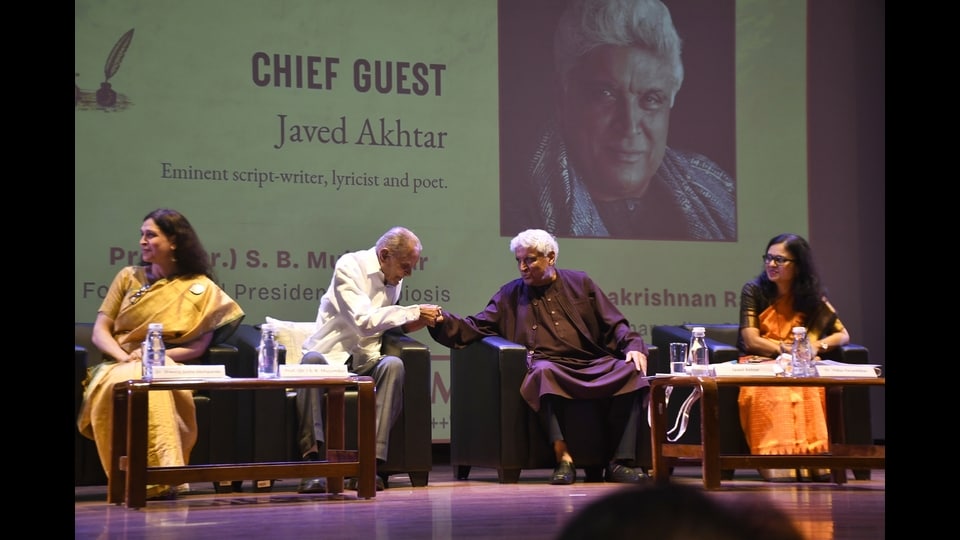
Speaking at the inaugural session of the Symbiosis Literary Festival 2026 at Symbiosis Ishanya Bhavan in Viman Nagar, Akhtar called for a more holistic approach to education that enables students to look beyond their chosen disciplines. He also raised concerns over shrinking vocabulary, weakening engagement with literature and the arts, and a growing disconnect from India’s cultural and intellectual heritage.
“There is a battle of education, knowledge and understanding, and there is a big fall. It’s a huge cliff,” he said, pointing to the disparity between professional competence and a broader understanding of the world.
Akhtar argued that students specialising in science should be exposed to literature, history and folk arts, while those studying the humanities should have a basic understanding of developments in genetics, space research and the human brain. Universities, he suggested, should introduce a general education course to bridge this divide.
“You can’t become an expert in everything, but you should not be too ignorant about that aspect,” he said, stressing the need for education that builds intellectual curiosity across disciplines.
Questioning the priority successive governments had accorded to education, Akhtar referred to the Kothari Commission’s recommendation in the 1960s that at least 6% of the budget be allocated to education. He said education spending had consistently fallen short of the importance it deserved, regardless of which political party was in power.
Akhtar also warned that the pursuit of rapid economic and technological progress was coming at the cost of cultural depth, with younger generations increasingly losing touch with language, history and traditional art forms.
Akhtar also pointed to what he described as a decline in vocabulary among younger people compared with earlier generations. Words, he said, were not thoughts themselves, but were essential tools for expressing and developing them.
“Words are not thought. But how do you build thoughts clearly? You have to have enough words,” he said, comparing vocabulary to the bricks required to build a house.
His remarks came as he reflected on the relationship between language, learning and the ability to communicate with clarity.
The themes of language and cultural memory continued during an interaction centred on “Hindustan Hamara,” an anthology of Urdu poetry compiled and edited by his father, poet Jan Nisar Akhtar in 1965.
During the question-and-answer session, Akhtar addressed whether art was inherently political, arguing that it could be political or entirely independent of politics, depending on the artist’s choice.
“Artists should be free,” he said, adding that a healthy society should have the confidence to allow writers and poets to express their ideas.
“Banning poems, banning books, is not a healthy thing to do,” he said.
Asked by an aspiring poet how to make poetry more accessible, Akhtar offered a simple prescription: read before writing. He said aspiring poets needed to immerse themselves in poetry, read widely and memorise poems to develop a feel for rhythm and language.
“What is poetry? It is the music of language,” he said, emphasising that talent needed to be refined through sustained reading and practice.