
 E-Paper



Monday Musings: Pune’s latest fire incident exposes unpreparedness
Pune fire department is facing a shortage of 510 men and requires 12 more fire stations to provide better services


Last week, when 17 workers were charred to death in a blaze at a mid-sized firm in Pirangut near Pune, it hit the headlines before becoming part of history as yet another tragic incident.
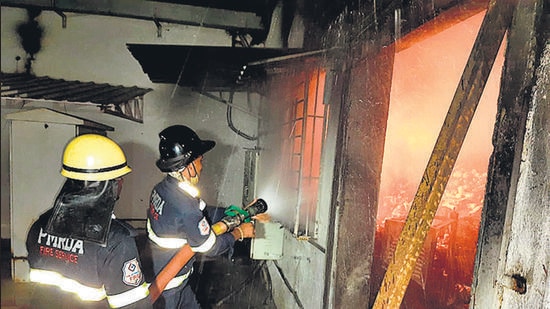
Scores of people have lost their lives in similar incidents in the past; another recent incident being a fire engulfing the entire floor of a newly developed facility at the Serum Institute of India in January this year, when five workers lost their lives.
Saving lives – and property too – has always been at the heart of fire fighter’s job. The significance of emergency response in fire incidents is the most crucial element if lives are to be saved.
This was underlined when the fire broke out inside SVS Aqua Technologies, a chemical unit in Pirangut, and spread rapidly. The tragedy exposed negligence on the part of those running the unit, as several norms were found to be violated, including storage of inflammable material like sanitisers without permission, a lack of space and poor entry-exit points.
At the same time, a severe lack of fire safety measures in the industrial zone of Pirangut, where more than 200 industries including 10 chemical units are located, was also brought to fore.
Despite being a key industrial estate, the area does not have its own fire station. According to locals, fire tenders had to be called in from other stations in the absence of a locally situated one.
This, according to relatives of victims and others, delayed the dousing exercise.
As reported in HT Pune in its June 9 edition, six fire brigade vehicles helped in the rescue operation, including units sourced from Hinjewadi Phase 3, Wagholi, Marunji, and MIDC. Around 50 officials were involved in the four-hour operation to douse the fire.
Yet, the blaze could have been controlled after only two hours. The Pune Metropolitan Region Development Authority (PMRDA), a state government agency responsible for planning and development of the region, has its own fire station, but in other locations.
The PMRDA depends on three fire stations, with the latest one being Wagholi, and two others at Marunji and Nanded City. The PMRDA fire station nearest to the Pirangut-located SVS Aqua Technologies is the Life Republic fire station in Marunji.
However, geographically, the nearest fire station is the one at Hinjewadi Phase 3, under the Pimpri-Chinchwad fire department.
Since every moment counts in a fire-fighting exercise, the time of over 45 minutes for fire tenders to reach the spot was not short of an immense delay. As recounted by one of the survivors, on that fateful day of June 7, the fire broke out at around 3:30pm, while fire fighters reached by 4:15pm.
The National Disaster Management Authority under the Ministry of Home Affairs, in its 2012 report, has stated that as per norms set by Standing Fire Advisory Committee, the standard response time for fire fighting in urban parts should be three-five minutes, while for the rural parts it is 20 minutes. India is vast country with resources often in short supply, while roads in big cities are crowded and structures catching fire are cramped in bylanes, where access is a major problem. This often delays the response time, leading to a loss of lives. The Pirangut incident has once again underlined this.
This isn’t the only issue Pune’s fire-fighting mechanism is grappling with. The fire department has seen over 750 small and big fires and natural hazard incidents in 2020, as against 650 during the previous year. Despite growing incidents, its capacity hasn’t been increased.
The department is facing a shortage of over 510 men and requires 12 more fire stations to provide better services to citizens, as highlighted by Vivek Velankar through an RTI query.
During a recent fire incident at Lohiyanagar in the Bhavani peth slums on November 23, the response time was delayed by more than 25 minutes as trained drivers were unavailable. The shortage of firemen delayed the control of fire by men on the ground.
If the loss of lives is to be prevented, there is a strong need to increase fire stations and manpower.


