
 E-Paper



Monday Musings: Tanker economy - Pune’s parallel water market is no longer seasonal
Somewhere along the way, the water tanker stopped being a stopgap and became part of the system.If there was any doubt about how central this system has become, last week offered a reminder. A brief strike by tanker operators was enough to throw routine into disarray.

 Prefer HTon Google


Pune: There was a time when water tankers in Pune announced the arrival of summer. You would spot them in March-April, grumble about them in May-June, and by July, with the first spell of rain, they would recede into the background again, even as their service continued without noise.
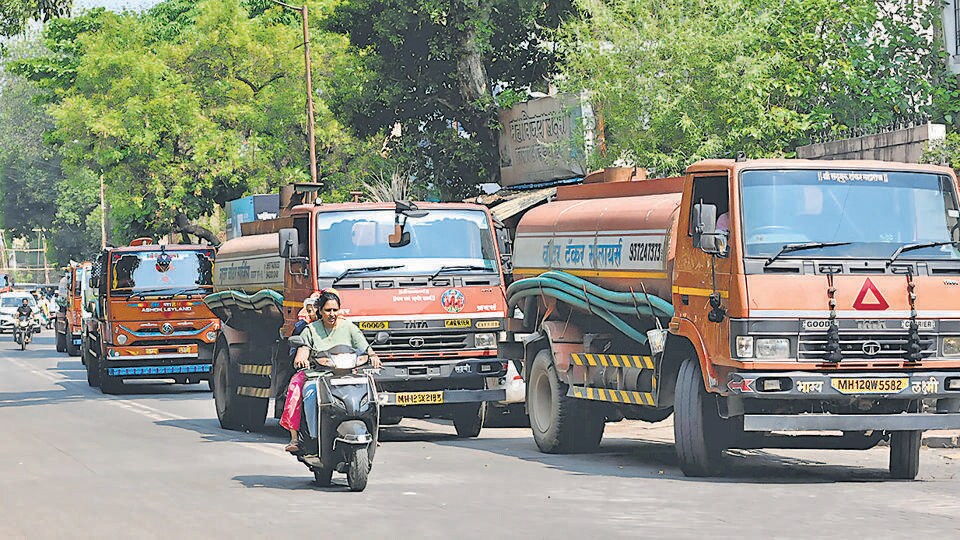
That rhythm has quietly broken.
Drive through NIBM, Undri, Mohammadwadi or the stretches around Sus and Bavdhan today, and the tankers are not a seasonal sight anymore. They line up outside housing societies through the year, engines idling, hoses coiled like routine equipment rather than emergency gear. Security guards no longer ask who called the tanker; they wave it in as if it were an emergency service. Many housing societies in these suburbs have, in fact, laid dedicated pipelines up to their entrances so tankers can simply connect hoses and pump water directly into storage tanks.
Somewhere along the way, the tanker stopped being a stopgap and became part of the system.
If there was any doubt about how central this system has become, last week offered a reminder. A brief strike by tanker operators was enough to throw routine into disarray. Societies scrambled, residents tracked suppliers, and within hours, the dependence was evident. When services resumed the next day, the rates had inched up—and the tankers kept coming. The adjustment was quiet, almost matter-of-fact.
The city, officially, runs on pipelines managed by the Pune Municipal Corporation (PMC). Unofficially, large parts of it seem to run on a parallel network that operates on phone calls, WhatsApp groups and a rate that changes depending on the week. Residents know the drill: check the overhead tank level, message the society group, someone calls the supplier, and a few hours later, a tanker appears. Payment follows, often in cash, always with a quiet acceptance that this is now a fixed monthly expense.
No one announces this shift. It just settles in.
What is striking is how normal it feels. In conversations with residents, there is little outrage left—only calculation. Water has moved from being a civic entitlement to a managed commodity.
The geography of this system is also telling. It is most visible in the city’s expanding edges—places that have grown faster than the pipes could reach or keep up with. Buildings have come up, families have moved in, but the promise of regular municipal supply remains uneven. The gap between what is planned and what is delivered is quietly filled by the tanker.
And in that gap, a full-fledged economy has taken shape.
It has its own logistics, its own timing, its own informal rules. Tankers arrive at odd hours to avoid traffic. There are preferred suppliers, negotiated rates, and the occasional scramble when demand spikes. In peak summer, the same tanker that was available at short notice in February suddenly becomes hard to find in May.
From the outside, it looks chaotic. From within, it runs with surprising efficiency.
What it also runs on, though, is something less discussed: access. In most cases, tankers draw water from filling stations operated or regulated by the PMC. The water is already within the city’s system; it just doesn’t always reach through pipelines. The tanker steps into that gap—carrying the same supply across neighbourhoods, but turning delivery into a paid service.
The city rarely pauses to ask how sustainable that is. Perhaps because the system works—at least in the immediate sense. Water arrives. Tanks get filled. Life goes on.
There is also a certain quiet rearrangement of roles. The municipality continues to supply water where it can, expand infrastructure where it manages to, and announce projects that promise more in the future. Alongside, the tanker network ensures that the present keeps moving. One does not replace the other; they coexist, sometimes uneasily, often seamlessly.
For residents, the distinction matters less with each passing year. What matters is whether the tap runs in the morning, whether the storage tank lasts the day, and whether the next tanker is booked in time.
In older parts of Pune, memories of a more predictable supply still surface in conversation. In the newer neighbourhoods, there is no such reference point. For many who have moved into these areas in the last decade, tankers have always been part of urban living. There is nothing temporary about them.
Perhaps that is the real shift. Not just in how water is supplied, but in how it is understood.
The summer, of course, will still come. Tanker numbers will still rise with the heat. But the more interesting story is what happens when the rains arrive. If the tankers continue to line up outside gates in July and August, as they increasingly do, then the season has little to do with it anymore.
What remains is a city that has, almost without noticing, built itself a second water system—one that does not feature on official maps, but is present on nearly every street where a blue-and-white tanker waits its turn.


