
 E-Paper



Monday Musings: The risks and trade-offs of an unlock paradigm
The latest order on one hand is bound to create confusion among people and traders, who have seen series of decisions in the past few days with different guidelines for weekdays and weekends. It is also likely to lead to further uncertainty where businessmen may find it difficult to take risks given the unpredictability


This column had earlier argued that the state government had taken a risk by linking incentives with responsibility while unlocking Maharashtra earlier this month.
The smart men in the corridors of power thought they can stay away from being in the lock-unlock picture every week, through just one order during the ongoing fight against Covid. It also reflected a shift from the scenario of a guardian-like-government where the onus is vested with individuals.
Three weeks later, the government has had to revise its order by reducing the five-level relaxation plan to three, citing an emergence of cases of the Delta-Plus variants in Maharashtra. The latest diktat removes the first two levels, which offered maximum relaxations, even if the local positivity rate is below five per cent, as mandated under the mechanism. The government has also restructured ways to calculate the positivity rate by considering positive cases only against RT-PCR tests done.
This means some of the old curbs are back in cities like Pune, Nashik and Nagpur, where restrictions were eased at a pace that prompted health experts to express worry and advise caution.
If the original order passed the responsibilities on to people when they wanted to avail of incentives by way of restarting activities, restructuring it meant an admission that the number of cases could increase fast with people violating norms pertaining to Covid- appropriate behaviour.
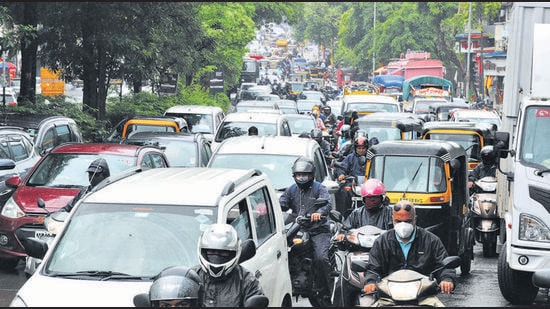
Soon after the unlock process started, most cities were witnesses to crowding. Markets were back to normal and people looked oblivious to a virus that thrives on crowds.
How does it reflect on citizens? In one of his articles that appeared in Mint Lounge, journalist Aakar Patel wrote: “Policing in India is less about law than about order. This is how it has always been in a nation whose population tends to anarchy, even when under self-rule.”
In a country of 1.3 billion people, order is something is often missing and has to be forced using mandate.
This is exactly why police here are trained primarily to control crowds rather than pursue scientific investigation, a reflection often seen in the lower conviction rate. Policing, as Patel argued, is carried out through “bandobast” when people are supposed to behave on their own. It’s also possibly because human behaviour in reality is not as rational, which means when people during unlock are offered wide degree of liberty on the economic front, and movement, they are unlikely to stick to habits inculcated during lockdown.
So how could the state government have struck the right balance in its plan to reopen Maharashtra after the second wave? There are no easy answers: One way could have been to take baby steps by easing limited curbs, that too, at a slower pace, or to offer incentives on activities that would encourage people not to step out and yet spend money to boost trade and accelerate economy.
The latest order on one hand is bound to create confusion among people and traders, who have seen series of decisions in the past few days with different guidelines for weekdays and weekends. It is also likely to lead to further uncertainty where businessmen may find it difficult to take risks given the unpredictability.
But then, Maharashtra has already paid a heavy price during the second wave. With local body elections lined up early next year in 10 major cities of the state, the government needs to carefully reopen sectors based on needs and priorities.
If abolishing the e-pass for inter-district travel has resulted in indiscriminate travel, there can be a rethink on bringing it back.


