
 E-Paper



Pashan lake cleanup underway in Pune
The PMC has to also check sewage connections and repair them to ensure no sewage enters Pashan lake, say volunteers


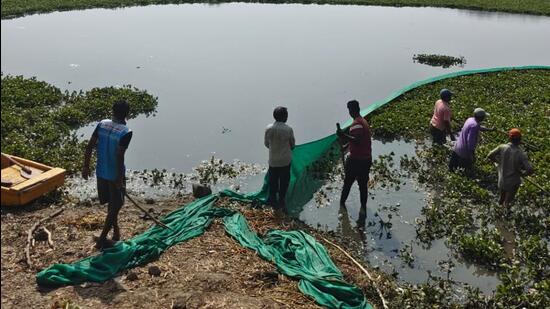
With the Pune Municipal Corporation (PMC) constituting a 16-member Pashan Lake Development and Restoration committee on March 7, 2022, work is going on in full swing on clearing water hyacinth and debris choking the entrances of Pune’s once famous Pashan lake that was originally built to provide drinking water to the viceroy’s bungalow which is now the Savitribai Phule Pune University (SPPU) campus.
Sandeep Khalate, ward officer, said, “The team is working with the PMC to bring back the old glory of Pashan lake, which includes making the lake free of water hyacinth, carrying out de-sedimentation and working on preventing the entry of polluted water into the lake.”
The Pashan Lake Development and Restoration committee is headed by Asha Raut from the environment department of the PMC and has garden superintendent Ashok Ghorpade; resident volunteers Vaishali Patkar, captain Surendra Birje, Deepak Shrotri and Hema Chari; environment experts Sanskriti Menon, Anil Gaikwad and Gurudas Nulkar; Ram nadi Restoration Mission’s Virendra Chitrav; Ground Water Mission’s Ravindra Sinha; ornithologist Pankaj Koparde; and ward officer Khalate. While PMC workers are busy manually clearing the thick hyacinth cover over the lake, other workers with JCBs are tackling the huge debris from a construction site dumped at one of the entrances to the lake.
“As of now, we are clearing the lake of the water hyacinth. It is important to reduce water hyacinth growth in Pashan lake to a level where native aquatic floral diversity can bounce back. As we are dealing with a situation where hyacinth has infested the lake for many years now, it needs to be cleaned manually without using any pesticides like glyphosate. Once the clean-up is carried out, develop an approach for hyacinth management and address the root causes. It is of the utmost importance to stop major inflows of untreated sewage with efficient STPs,” said Chari.
Once a major draw for tourists and bird watchers, Pashan lake has now been reduced to a ‘dead lake’. Khalate said, “This lake is spread over 144 acre, was built in the British era and has a catchment area of 40 square km. It used to attract migratory birds, and has two inlets and two outlets.” It is now filled with effluents flowing in from nearby drainages and is filled with sewage.
Chitrav said, “We have been working on the restoration of Ram nadi for the last three years and during these studies, Pashan lake was of prime importance as the water from Ram nadi flows into it. We did a three-phase study with the first phase being the condition of the lake before 2008; the second phase its condition from 2008 to 2013 when the PMC restored the lake only to practically kill all the biodiversity within; and the third phase from 2013 till now which tells us that the condition of the lake is at its worst. We have lost 80% of its bio diversity. If the restoration work is taken up now, we will be able to see positive results after 15 years.”
Patkar who is also a member of the Climate Collective Pune Environmental Foundation said, “We have proposed an in-depth survey of the upstream rivers to identify the effluent flow into the lake. Besides this, there is a lot of encroachment around the lake which is reducing the depth of the lake.”
The PMC has to also check sewage connections and repair them to ensure no sewage enters Pashan lake, she said.


