
 E-Paper



PMC accused of inaction on conservation of Bavdhan spring
Residents and environmentalists allege PMC has not taken enough steps to conserve the natural springs in Bavdhan


PUNE Even as various agencies have directed the Pune Municipal Corporation (PMC) to conserve the natural springs in Bavdhan, the civic body has not acted, allege local residents and environmentalists.
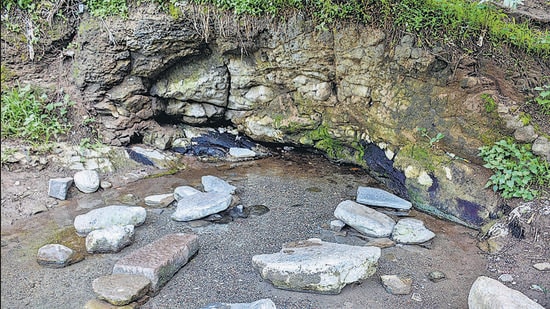
The Maharashtra Water Resources Regulatory Authority (MWRRA) had in December 2020 directed the PMC to not allow any construction in the vicinity of the spring.
Ramnath Sonawane, secretary, MWRRA said, “Following the Section 20 of Groundwater Act (2009), and after a visit to the site, we requested the district SDO to declare the Bavdhan natural spring as a protective stream. This visit was done upon the complaint from Shailendra Patel, and we called the PMC officials for a meeting in December 2020. The authority has taken cognizance and issued directives six months ago to PMC. The authority will look into the matter if PMC does not take adequate steps and will intervene if required.”
Anirudha Pawaskar, head, Water department PMC. “The tehsildar has already put out the notification and declared the area as protected area. We have informed the building department to not give any permissions for any kind of development and following the notification, we are deliberating on retaining the spring as it, or putting the water to use depending on its potability as a tanker point, or using it for gardens.”
Hindustan Times had highlighted the issue of the natural springs in 2018.
In its notification dated December 17, 2020, MWRRA asked for a committee of five members to prepare an action plan within 15 days on ways to conserve the spring.
According to Bavdhan resident and member of Jal-Devata Seva Abhiyan, Shailendra Patel, citizens were trying to persuade the municipal officials to preserve this “heritage site”.
“If the PMC does not reserve the area around spring in the development plan and conserve it, we will go to NGT,” said Patel, who was joined by Sunil Joshi (Samagra Nadi Parivar), Virendra Chitrav (Ramnadi restoration mission), Sachin Punekar (BioSpehere), Pushar Kulkarni (Vasundhara Abhiyan) and others during a press conference on Wednesday.
The activists said that despite repeated follow up with PMC, there has been no response.
“In absence of any action, we plan to move to NGT,” said the members.
For the past five years, Patel corresponded with several authorities, officials, ecologists, geologists, historians to help protect the natural spring from destruction.
Patel claimed that from its origin in Bhukum till Someshwarwadi, there are 147 ‘live’ streams feeding water to the Ramnadi throughout the year.
Earlier, in a letter written to PMC Commissioner Vikram Kumar on July 6, 2021, GSDA deputy director Milind Deshpande said, “The Bavdhan spring needs to be conserved as per sections 21-24 of Maharashtra Groundwater (development and Management) Act.” Deshpande’s letter was in response to submissions made by Patel.
The PMC development plan showed this area under a Yellow Zone or residential zone and as privately owned.
According to a paper released by the Deccan College Post graduate and Research Institute, “This is a spring formed between two hard rock flows of upper vesicular (porous) and lower compact Basalt (non-porous). Occurrence of water-yielding contact spring in Deccan traps is a rare phenomenon. This is an endangered natural feature in Pune city. The spring currently yields water enough to run a 5hp motor continuously. This can be an important drinking water source for the community and reduce the burden on the corporation. Bavdhan spring must be protected and conserved. Water can be stored in a storage tank and supplied for drinking.”
In a report from the Central Groundwater Board, official Dr Upendra Dhonde said, “The yield of Bavdhan spring monitored during May 2017 was 90 lpm i.e. more than 0.1 million litres per day, but shows a declining trend due to land use change and excessive pumping. The region needs urgent protection.”
The Ecological Society, a Pune-based ecological restoration NGO created a detailed inventory of the flora and fauna of the spring region as well as a restoration plan
Under the Groundwater Act (2009), MWRRA is the Groundwater Authority of Maharashtra, and visited the site in December 2018, and immediately directed the sub-divisional officer (Revenue) as the district authority under the Groundwater Act 2009, to notify the spring as a public drinking water source.


