
 E-Paper



PMC conducts ‘Walking Survey’ to improve road quality & walkability
The survey found that many footpaths are not continuous, and some don’t have blocks. In some places, the pavement rises above the ground


Under the ‘Walking Survey’ conducted by the Pune Municipal Corporation (PMC) road department from January, obstacles on 356 roads have been identified to improve road quality and walkability. The department decided to carry out a physical survey of 378 roads in the city which are more than 12 metres in width of which, 356 roads have been surveyed so far. Forty-one engineers of the PMC road department have carried out the survey by walking on the roads and it has taken around one-and-a-half months.
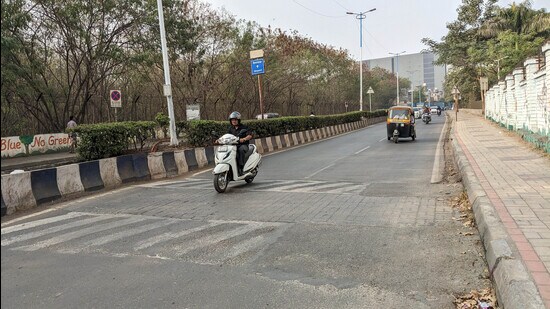
The survey found that many footpaths are not continuous, and some don’t have blocks. In some places, the pavement rises above the ground. Also, issues such as encroachment by electric poles, obstruction from feeder pillars, and branches of trees hanging on the footpaths were seen. Additionally, the survey revealed serious problems with the roads, such as caving storm water drains resembling potholes, bent iron bars in the drainage cover mesh, broken drainage covers, roads worn out due to improper repair after excavation, and sub-standard and unnecessary speed breakers.
During the survey, a total 627 speed breakers were found on the roads. The PMC had formed a speed breaker policy in 2022, which follows specific rules set by the Indian Road Congress (IRC). The PMC has decided to consult with the traffic police and review the existing speed breakers. It has also decided to upgrade the existing speed breakers as per standards. Besides that, if the PMC finds some speed breakers inessential, it will remove them.
Vikas Dhakane, additional municipal commissioner, stated, “We’ve decided to finish minor road repairs identified in the survey before the rainy season. The physical survey helped us understand the real problems and conditions of the roads. Now, we can pinpoint issues with each road. The survey helped diagnose road problems and find a solution.”
Sahebrao Dandge, superintendent engineer, PMC road department, said, “Inspection of roads which are more than 12 metres’ wide was conducted, and their punctures and repairs were identified. A report has been submitted which details the potholes, broken dividers, uprooted pavement blocks, tree branches on footpaths, electric cables, encroachments on the roadside, and broken chambers. After compiling the data, we will be allocated a budget for major work. At present, we have started minor repair work under the road maintenance allocation.”
Dandge said, “Basically, the ‘Walking Survey’ is a physical survey. Besides this survey, we are carrying out a technical survey of major roads under the Road Asset Management System (RAMS) to prioritise repair and maintenance efforts. The RAMS survey is carried out with the help of vehicles equipped with network survey vehicle (NSV), differential global positioning system (DGPS), and state-of-the-art cameras, lasers, profilograph gyroscopes etc. Both surveys are important to maintain the quality and condition of roads in the short and long term. The RAMS survey findings are incorporated in the major road work budget”.
According to the PMC road department, there is a network of 1,400 km of roads in the city out of which, 500 km of roads are more than 12 metres in width. The road department is divided into seven zones, and has 40 junior- and 20 deputy- engineers.
Outcome of the RAMS Survey
In October 2023, the PMC initiated a comprehensive survey of 15 major roads under the Road Asset Management System (RAMS) to prioritise repair and maintenance efforts. However, despite utilising engineering parameters such as the international roughness index (IRI) and pavement condition index (PCI), no tangible outcome has been reported from this survey. Roads surveyed include well-known ones like Ahmednagar Road, Solapur Road, and Sinhagad Road, among others.


