E-Paper



Protected in 1909, ‘untraceable’ for decades, 200-year-old Pune burial ground traced back by ASI
The ASI’s July inspection followed archival records brought to its attention by Pune-based civil engineer Rahul Ajmera

 Prefer HTon Google


The Archaeological Survey of India (ASI) has traced a 200-year-old European burial ground behind the District Collector Office in Camp that had been listed among Pune’s protected monuments in 1909 but was later categorised as “untraceable”.
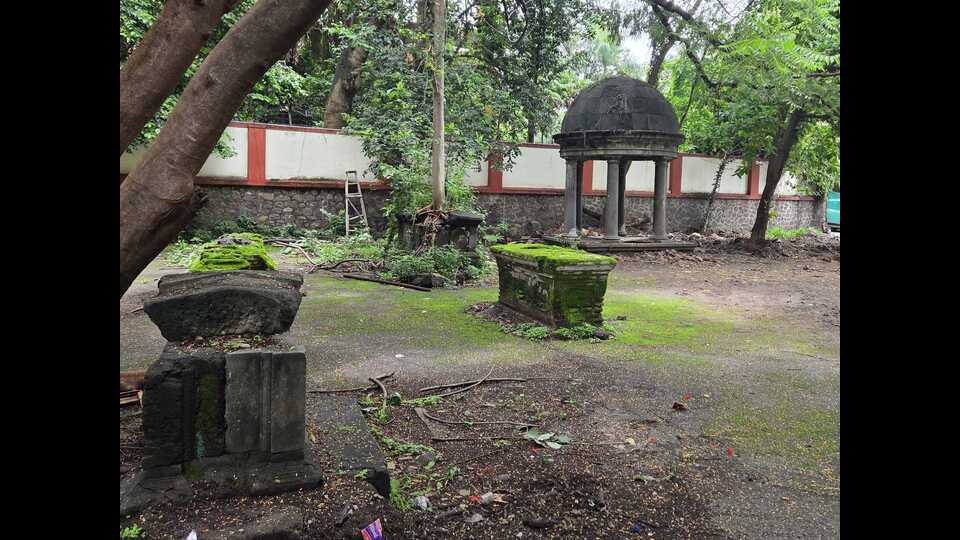
The cemetery, which contains several old graves and a distinctive stone canopy supported by six pillars, had lost its historical identity over the decades. It has been variously described as French, German or Jewish, while the site was used for parking, garbage dumping and, more recently, gatherings.
The ASI’s July inspection followed archival records brought to its attention by Pune-based civil engineer Rahul Ajmera. The agency has confirmed that the site corresponds to one of the European burial grounds recorded in historical documents and has issued instructions for further action. However, the ASI has not independently established the specific identity or nationality of those buried there.
Abhijit Ambekar, superintending archaeologist, Mumbai Circle, ASI, said the key development was that a monument earlier considered untraceable had now been located.
“The monument was earlier listed among the protected monuments that were untraceable, and it has now been traced,” Ambekar told HT. He said instructions had been issued to the site and sub-circle incharges to take further action. Ambekar said he had not personally inspected the site and therefore would not comment further on its historical attribution, but added that Ajmera’s archival research could be cited in this regard.
Ajmera’s research seeks to establish a documentary link between the surviving cemetery and the “Old European Tombs” referred to in historical records. The 1885 Gazetteer of the Bombay Presidency describes a cemetery with 17 graves inside a walled enclosure, while an 1884 map marks an old graveyard at the same location.
Ajmera also traced names associated with the cemetery through death records and wills preserved in the India Office Records at the British Library. He claims these records point to British East India Company officials, military personnel and their families who died in Poona in the early 19th century.
The earliest surviving legible inscriptions at the cemetery date to 1819, while the latest date to 1822. Among the names Ajmera has identified from archival records are Joseph Cunningham, a four-year-old boy who died in 1821; Henry Forbes Shubrick, an 11-month-old child whose father was the Collector of Broach; Elizabeth Mayne, who died at 19 months; and military officers Samuel Hallifax and John Lewis.
Ajmera said records show that Cunningham, the son of a corporal in the Bombay Foot Artillery, died in Pune on February 24, 1821, aged four years and six months, following an accidental rocket discharge.
The cemetery’s most prominent structure is a stone canopy supported by six pillars. The absence of a clearly legible inscription identifying the structure appears to have contributed to speculation about its origins. An 1863 account attributed the structure to a woman identified as Mrs Virges, while another long-standing local account has associated it with a French officer or his wife.
Ajmera disputes the French connection based on his reading of historical records, pointing out that French burial sites were documented at other locations in Pune, including Ghorpadi and the area now known as Shankarsheth Road. The ASI, however, has not independently confirmed or rejected these historical claims.
The confusion over the cemetery’s identity can partly be traced to the manner in which European burial sites were documented. An Archaeological Survey publication of 1897 grouped Pune’s European cemeteries under the broad description “Old European Tombs”. Although the sites were protected under the Ancient Monuments Preservation Act in 1909, the records did not provide sufficiently detailed addresses or location references to easily identify each site.
As a result, the Camp cemetery was subsequently among the monuments that came to be regarded as “untraceable” by the ASI.
Ajmera said the cemetery had not actually disappeared but had remained largely unnoticed in the heart of the city.
“It was never missing. It has stood in plain sight the whole time,” he said.
According to Ajmera, the ASI also examined the locations of all five European burial sites historically recorded in Pune. Of these, he said, only two survive—the Camp cemetery and the French cemetery in Ghorpadi. The other three, including the former East Street Cemetery, have disappeared. The East Street site, now occupied by Fashion Street, is believed to have contained more than 200 burials.
The ASI’s tracing of the site could now pave the way for its cleaning, documentation and better protection. Ajmera has suggested installing signage, improving the surroundings and displaying information about the people buried at the cemetery to restore its historical context.