
 E-Paper



Pune astronomers make vital space discovery: Galactic wind around tiny galaxy
This tiny galaxy lies at a distance of 170 million light years from Earth and is forming new stars at a very fast rate

 Prefer HTon Google


In what could be an important step towards the study of space and exploration of its depths, two astronomers from the Inter-University Centre for Astronomy and Astrophysics (IUCAA) in Pune and a collaborator from the University of Tokyo in Japan have captured an image that shows a rare and powerful phenomenon called ‘galactic wind’ around a tiny but extremely active galaxy. They chanced upon it during the course of their research and captured it for posterity.
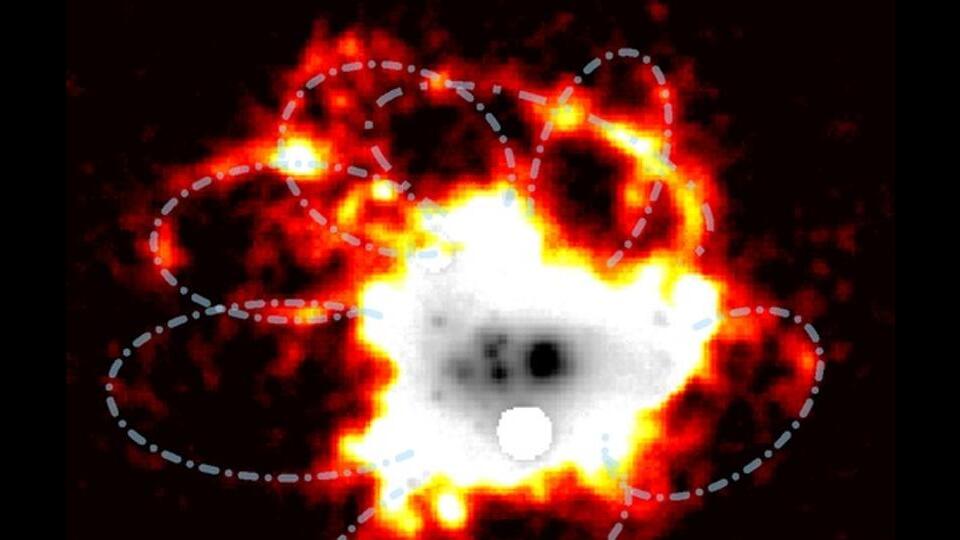
Sharing about this discovery with Hindustan Times on Thursday, the astronomers from IUCAA, Dr Edmund Christian Herenz (Vaidya-Raychaudhuri Fellow) and Soumil Maulick, said that this galaxy, named J1044+0354, is only about 7,100 light-years wide, which is very small as the Milky Way is over 100,000 light-years wide. This tiny galaxy lies at a distance of 170 million light years from Earth and is forming new stars at a very fast rate.
But, what surprised the astronomers most was that this galaxy is surrounded by seven huge gas bubbles. According to them, some of the bubbles appear to have burst, but others are still whole and clearly visible, and each one is about 23,000 light-years wide, which is nearly equivalent to the distance from Earth to the supermassive black hole at the centre of the Milky Way.
Soumil Maulick said that these giant bubbles are believed to have been caused by explosions of massive stars. He explained: “Stars that are 25 to 100 times heavier than the Sun do not live long - only about 3 to 5 million years. When they die, they explode in powerful events called supernovae, throwing out huge amounts of gas and energy. In large galaxies like the Milky Way, such explosions happen about three times every century, but the galaxy’s strong gravity keeps most of the gas from escaping farther into space.”
He further said that in small galaxies like J1044+0354, the gravity is much weaker. “So, when many such supernovae occur, the gas escapes easily, creating what scientists call a ‘galactic wind’. This wind is made of hot, fast-moving gas blowing out from the galaxy. Observing this wind directly is difficult because the gas is very thin and faint, even when using the biggest telescopes,” he explained.
According to the two astronomers, large gas bubbles created by such galactic winds have been known for about 20 years. But the bubbles seen around J1044+0354 are two to three times larger than any bubble seen before. “In fact, existing scientific models that explain how these bubbles form from supernova explosions cannot fully explain what has been observed around this galaxy,” Maulick added.
Dr Edmund Christian Herenz said that studying galactic winds in star-forming galaxies like J1044+0354 is very important as these kinds of galaxies were common in the early universe. So, understanding them helps scientists learn how galaxies formed and evolved over time. “However, to fully understand these winds, astronomers need to find and study more examples of small galaxies with similar bubbles. Right now, they do not know if J1044+0354 is a rare case or if many other small galaxies might also be blowing out such enormous bubbles,” he added.


