
 E-Paper



Pune Startup Mantra: Busting the menstrual hygiene barriers
A customer’s quote is rarely the go-to kickoff in this weekly startup space


A customer’s quote is rarely the go-to kickoff in this weekly startup space.
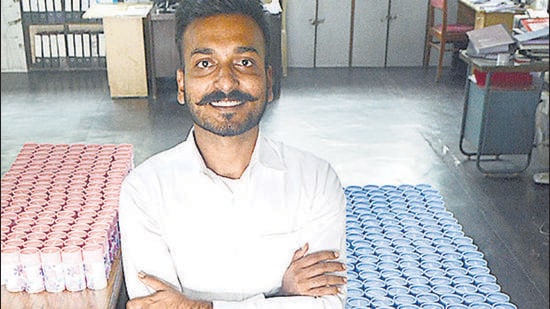
However, given the product in question and the “taboo” surrounding the topics of “women’s sexual health” and “menstrual well-being” in India, this customer’s quote best captures the breakthroughs that the startup in question, Safecup, is making in the Indian women’s health market.
Mansi Salunkhe, a 21-year-old BTech final year student from Katraj in Pune, and a Safecup user and customer says, “Around a year ago I started reading and looking at videos of menstrual cups. Yet after learning almost everything about the cups, the idea of inserting something inside my vagina was scary. I was seeking a skin treatment for having extra sensitive skin. For years I went through hell due to irritation from sanitary napkins. Finally, I decided to order a menstrual cup. First time insertion and removal can seem daunting, but I was finally successful. I wasn’t able to feel it at all. As a result, I was in love with the cup!”
Akarsh Tekriwal is a third-generation entrepreneur who founded Safecup Impact Lab, the company that imports and sells Safecup, in 2019.
No IIM or IIT or even terms like “incubation” fit this startup story. Just the hustle-and-flow of a Patna-born Marwadi, with some serious on-the-ground experience in terms of sales, distribution and processes.
And, a commitment to, and understanding of women’s sexual health that bodes well for a generation of “woke” entrepreneurs in India.
Tekriwal’s Safecup is branded as a “premium menstrual care” product that has 75,000 customers as of today.
Tekriwal drops the pithy phrases like “Gynocare revolution” and “The Shameless Company”, all offering an insight into the long game he is attempting to play to become, in his words, “the new-age Unilever.”
That means Tekriwal has to convince menstruating women to stop using pads and start using a Safecup, the pitch for which, encompasses not just health benefits, but also environment concerns, given that, according to Tekriwal, not all pads are biodegradble.
But first, a change of behaviour for his target customer - a woman on her period.
Cue Safecup user Mansi Salunkhe’s closing quote, “You will find people saying it may cause cramps and it may destroy the hymen. Choose your comfort and your body before anything else. I say stop caring about what people will say and start living life to the fullest!”
“Opting for a menstrual cup instead of sanitary pads requires a behavioural change. It takes a lot of effort to convince and convert one person into a customer,” says Tekriwal, explaining how he gained the trust and confidence of his customers.
“The product needs support. So we have a digital manual along with the product. Any person who wants to understand how to use it, can visit our website and read, or watch videos. We have offered lifetime text-chat support on WhatsApp. We don’t have voice support, as women might be uncomfortable with it,” he adds.
Menstrual facts
Says Tekriwal, “I did my research before getting into the business of period-hygiene and sexual wellness products. A woman uses between 12 to 20 sanitary pads every month and these are mostly non-biodegradable. With more and more women using non-biodegradable pads, the problem of collection and disposal will get worse. Also, a pad is an external protection which irritates women due to moisture and itchiness.”
“Menstrual cup, on the other side, solves all problems – distribution, hygiene and disposal. A woman bleeds about 80ml in the whole period cycle and the menstrual cup can hold between 25ml to 30ml of blood. Even during a heavy flow day, the menstrual cup can suffice. It is also cost-effective as it can be re-used for 60 months. Since it is an internal protection, it is made from medical-grade silicon which can be sterilised and washed with hot water and reused. After understanding the sterilising and washing requirement, we also launched the steriliser product,” Tekriwal added.
Because of a taboo, period care product development and awareness is lacking in India, says Tekriwal.
“In India, menstrual cups penetration will be a maximum of 20 per cent to 30 per cent, as it requires a behavioural change. It is not related to anyone’s income, but is more personality driven. The outgoing, risk-takers will go for it. Today, the product exists, but is not mainstream. Lifestyle sells and design is a very important aspect. It will take another 20 years for sexual wellness to become mainstream,” he added.
In the beginning
Tekriwal had seen what the fast moving consumer goods (FMCG) market is, thanks to his father’s business as a distributor. He learnt his business lessons - number crunching, managing cash flow – from childhood. Says Tekriwal, “The most important thing I learnt was how the distribution channel worked for FMCG products. A brand which is visible to customers, will sell. And to stay alive in the business, one needs to manage the positives and negatives. We stay in the game only if our cash-flow is positive. I learnt these two lessons while growing up.”
Tekriwal’s family shifted to Mumbai and then to Pune when his father acquired a small pharma company. Tekriwal, while pursuing his education, started working at the age of 17 to help his father.
Says Tekriwal, “My learning started as a salesperson. I visited almost all villages in Pune district and the doctors there. I wanted to learn on the ground and in the process gained communication skills. I did this for almost four years. Then I opted for CA and did my articleship in internal audit. Since, businesses are run on processes and with people, an internal audit is very crucial even, though it is not mandated by law, for companies. I got to work with Quick Heal when they were going in for their IPO initial public offering).”
In 2019, Tekriwal then dropped out of formal education and decided to start his own firm.
“I wanted to contribute to the society in some way. I had seen rural India and interacted with lots of women and thought I could do something in that domain,” Tekriwal recalls.
Tekriwal started distribution of iron tablets to rural women. “In the process, I got to know and understand women’s health issues. We were running a campaign called ‘Red Revolution’ to create awareness on the issue of anaemia. I also understood how periods, sex, and menopause are taboo and societal issues and how they have a real, tangible impact on women’s health. I started looking for an entry point and the right product or service to launch,” said Tekriwal.
“I decided to start a ‘for-profit’ social enterprise. Then I found this product called ‘menstrual cup’ to enter into the space.”
Bootstrapping
Says Tekriwal, “I had no clue that I would have a D2C brand and sell it online. My plan was to setup stalls. The money I had was over and I was looking for funding. I to raise ₹30,000. My sister noticed my campaign and told my mother about it. She, in turn, asked my father to help me. But I didn’t want to take money from him. I accepted his money only on the condition I would return it. I got ₹3 lakh and with that I ordered inventory. I was anxious over the first import order, but finally it all went well.”
After the inventory landed, Tekriwal did the packaging of the product and decided to setup a stall in Pune Camp. He then drove down to Bengaluru in March 2019 for a women’s event. Tekriwal recalls, “Not a single cup was sold on first day. While I was sitting in a café, I came across an event organiser and asked him to help me. He allowed me to put up a stall at a farmers’ market organised by him in Pune and Bengaluru. Since I could not pay him charges, we decided to revenue share. The first sale happened in Bengaluru.”
“Women would inquire about the product, but were unsure about the quality and utility. One of them asked me if I could give her money back if she did not like the product. I assured her on that front and she purchased the cup for ₹1,299. The money-back guarantee changed the game. I was able to sell about 20 menstrual cups at the event and total of 50 in that month. Then I came back to Pune and explored other options to scale up the business. It was then I listed the product on Amazon,” Tekriwal explained.
Trust and confidence
“Considering the unavailability of raw materials and lack of advanced machinery, medical device manufacturing in India is not easy. So, we decided to opt for US-based manufacturers. User safety is our priority. Our next priority was the sizing guarantee. If a cup does not fit a customer, we send them another cup of different size for free. However, we can’t take the first cup back. So, we ask the customers to cut that cup and send us the images of that product. We need to trust our customers and hence, we offer them no-questions asked replacement and money-back guarantee,” says Tekriwal.
From periods to the complete package
Apart from offering Period Underwear, Period Cup Steriliser and Washer to its customers, Safecup will now launch sexual wellness products for women.
Says Tekriwal, “We have made the product available in 150 stores across Kerala since July this year. In other states, we are available only through our website and Amazon. We would soon launch our first store in Pune, in December this year.”


