
 E-Paper



Pune’s Civic Sanskriti: Why your ‘handprint’ could help offset the growing ecological footprint
Examining one’s own life and lifestyle, engaging with the neighbourhood, a community, a school or college or a workplace, and working with the local government offer many opportunities for Handprint actions. All of us need to become Handprint Action Heroes


The Earth Overshoot Day for 2021 was on July 29. Calculated every year by the Global Footprint Network, the Earth Overshoot Date is the date by when humanity’s demand for ecological resources and services in a given year, its Ecological Footprint, exceeds what the Earth can regenerate in that year, its biocapacity.
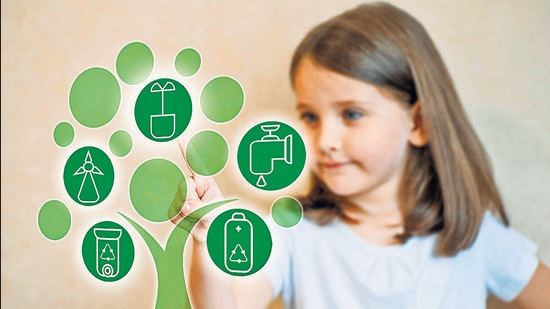
The Footprint is the demand for food from farms, fisheries, and pastures, for shelter, clothing, and infrastructure. It also includes the land area needed to absorb the carbon dioxide emissions from fossil fuels.
The biocapacity of a state or country refers to the biologically productive lands and seas, such as forest areas, grazing areas, farms, and fishing areas. A significant component of the Ecological Footprint is the Carbon Footprint, which is the land area needed to sequester carbon dioxide emitted from fossil fuel burning and cement production.
Since the 1970s, humanity’s Ecological Footprint has been exceeding the earth’s biocapacity. Worse, the yearly date by which we collectively consume all of the biocapacity has been steadily decreasing. It was in November in the 1970s, October in the 1980s, and September, by the turn of the century.
Now, we need 1.7 Earths to meet our needs and wants. Trips to space will not solve our problem; we need to live lighter on our own planet!
The Ecological Footprint may be calculated at different levels, such as for an individual, an organisation, a city or a country. The Footprint or impact of all countries is not the same. It is influenced by the climate of a place (necessitating heating or cooling of buildings), the nature of the economy, production and consumption systems, and people’s lifestyles.
India’s Ecological Footprint does not exceed its biocapacity currently, but it may soon do so. However, there is a huge variation in the consumption levels and the well-being of different people. There is a large proportion of the population whose essential nutrition, healthcare, and decent housing needs are not met. Decent living standards have been achieved for a smaller number. However, many people, especially in urban areas, are now over-consuming – some by choice, others thoughtlessly, and yet others by compulsion because low-carbon options are not yet well-developed (e.g. in public transport or cycling).
This presents a few different challenges.
First, how should production, consumption, and especially economic and governance systems be organised to enhance people’s living standards and well-being? These may include, for example, strengthening public distribution systems for rations, housing up-gradation, access to education, public transport, etc. A second challenge is to promote the shift to renewable energy and move to a circular economy with sustainable
materials and recycling. Such changes can help to bring down consumption levels at a systemic level.
Yet another is how individuals can think about and change their lifestyles, behaviour to tread a bit lighter on the planet. Individual and collective action is called for.
I want to share the concept of the “Handprint”. The Handprint is the symbol of, measure for, and commitment to positive action towards sustainability. Handprint also stands for caring and working together towards a sustainable future.
While the Footprint is a measure of human pressure on earth’s resources, the Handprint measures what we can do individually and together to restore the balance between consumption and the planet’s carrying capacity.
The Handprint concept was evolved and adopted at a conference on Education for Sustainable Development at CEE in 2007. It was inspired by a 10-year old student Srija, who participated in an environmental project at her school in Hyderabad.
There is much to be done in everyday activities such as avoiding food waste, promoting organics, waste recycling, composting, walking, cycling facilities, greening, plantation, water management, and solar water heating. While technologies and solutions are generally known in these familiar topics, getting them underway often needs creativity and perseverance.
Examining one’s own life and lifestyle, engaging with the neighbourhood, a community, a school or college or a workplace, and working with the local government offer many opportunities for Handprint actions. All of us need to become Handprint Action Heroes.


