
 E-Paper



Samruddhi Mahamarg Expressway accidents mainly due to ‘human error’: VNIT study
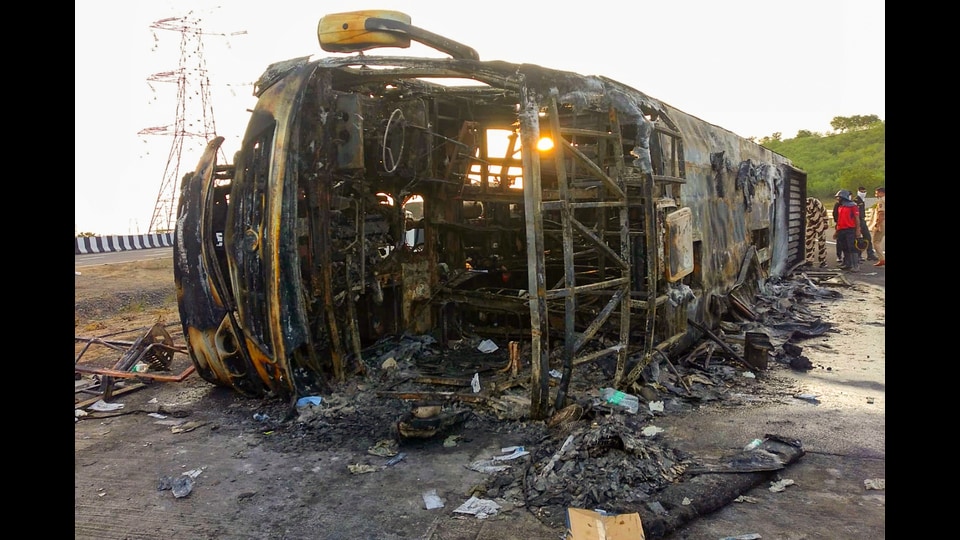
The accident which occurred on the Samruddhi Mahamarg Expressway on Friday wherein 25 people lost their lives is but the latest in a series of mishaps that have been taking place on this e-way almost daily since it was opened for public use


Pune - The accident which occurred on the Samruddhi Mahamarg Expressway on Friday wherein 25 people lost their lives is but the latest in a series of mishaps that have been taking place on this e-way almost daily since it was opened for public use. A recent survey conducted by a team of professors and students from the Visvesvaraya National Institute of Technology (VNIT) Nagpur found four major reasons behind the accidents – which are mainly due to ‘human error’ – including tyre burst, changing of lanes, monotonous driving and animal crossings.
Prof Vishrut Landge of the department of civil engineering, VNIT Nagpur, said, “The goal of the study is to evaluate the Samruddhi Mahamarg Expressway’s existing road infrastructure for safety and to identify any potential dangers or hazards. In order to assess the safety performance of expressways, interchanges, and other transportation facilities and pinpoint areas for improvement, the study involves conducting thorough safety audits of those infrastructures.”
“The purpose of the study was to audit the deficiencies in road infrastructure which include improper visibility of signage, risk factors for accidents such as speeding, driver hypnosis which is caused by monotonous driving, poor enforcement of safety regulations in enforcing measures such as effectiveness of speed limits and inadequate public awareness campaigns (counselling). The findings of a road safety audit can help stakeholders to identify areas of concern and develop targeted interventions to improve road safety,” Landge said.
“The engineering is very well done and there are no shortcomings in it. The speed of the operation is too high (about 120kmph). Hence, the reaction time available is too less (about 0.7 seconds). The tyres get heated up and the air expands and hence, they burst. There should be a tyre bath at every 100 km. The driver goes through highway hypnosis and his mind gets stuck or fatigued, rendering him unconscious during driving. Also, animal crossings need to be addressed and in no case should there be a speed breaker on the highway which will add to accidents,” Landge said.
The study was carried out from December 2022 to March 2023 by Landge along with VNIT Nagpur’s first year M Tech students of transportation and engineering: Prajwal Madghe, Ayush Dudhbhawre, Prateek Gajallewar and Vinay Rajput.
Madghe said, “Through this study, stakeholders may increase the safety of roads for all users by better understanding the safety hazards associated with current road infrastructure and making data-driven decisions. The overall goal of this study is to offer a thorough assessment of the security of the road network, to identify possible risks, and to develop suggestions for enhancing safety for all users. The ultimate goal of this study is to improve the safety of the road infrastructure for all users.”
The VNIT Nagpur team studied the reasons behind the accidents, offered solutions and submitted its report to the state transport department for implementation.
Landge said, “The detailed safety audit is carried out through the site inspection in day hours and night time also in accordance with IRC-SP-88-2019. The concerned audit findings are summarised and presented in a standard format. The layout of these audit reports, including the tabular representation of the audit findings, is also given. After that all the changes and recommendations are provided to minimise the risk of accidents in future. Recommendations for all the findings are then given in a separate section of recommendation which includes guidelines for drivers, recommended infrastructure, and implementation of CCTV and speed cameras to avoid speeding. Recreational places are recommended to give travellers a break from monotonous driving. Overall, the road safety audit project serves as a roadmap for improving road safety in the area under review and should be used as a basis for future policy decisions and infrastructure investments.”


