
 E-Paper



Pune’s uGMRT captures rare revival of sleeping black hole
The find was made using powerful radio telescopes, including India’s upgraded Giant Metrewave Radio Telescope (uGMRT) located at Khodad in Pune district. The study was published in the journal Monthly Notices of the Royal Astronomical Society.


Pune: Astronomers have discovered that the black hole has “woken up” after remaining silent for nearly 100 million years.
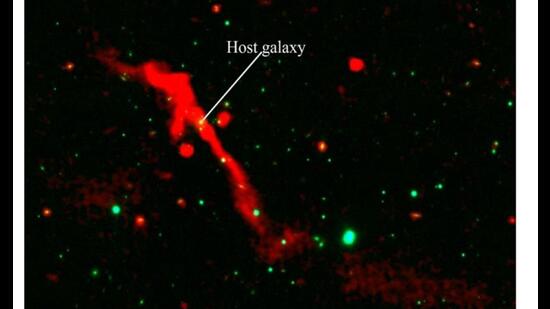
Sabyasachi Pal, associate professor and head of department of pure and applied sciences at Midnapore City College in West Bengal and doctorate student Shobha Kumari, along with scientists in India and Poland have found the activity in radio galaxy J1007+3540 located more than three million light-years across, making it about 50 times larger than the Milky Way.
The find was made using powerful radio telescopes, including India’s upgraded Giant Metrewave Radio Telescope (uGMRT) located at Khodad in Pune district. The study was published in the journal Monthly Notices of the Royal Astronomical Society.
According to the researchers, unlike normal galaxies, J1007+3540 exists inside a dense galaxy cluster, an environment filled with extremely hot gas. The gas produces enormous pressure, creating hostile conditions that strongly affect the shape and behaviour of the galaxy. By studying radio waves emitted from the galaxy, scientists observed a rare “double-double” jet structure, fresh, bright jets of energy emerging from the galaxy’s centre inside much older and weaker jets, confirming that the black hole has restarted its activity after a long pause.
“The galaxy is not just growing quietly in space. It is constantly struggling against extreme pressure from its surroundings. What we are seeing is a black hole that has turned back on and is now fighting against the crushing environment of its galaxy cluster,” Pal said, adding that J1007+3540 is like a natural laboratory that helps understand how black holes switch on and off, and how they influence the evolution of galaxies over millions of years.
Pressure from surrounding hot gas is bending the newly formed jets sideways, creating curved and distorted shapes. Scientists also found that the galaxy is losing material as it moves through the cluster, leaving behind a faint, ancient trail called a galactic wake.
Shobha, who is the lead author of the study, said, “The low-frequency images from uGMRT allowed us to clearly see the extended tail and the inner jets at the same time. Data shows clear signs of ageing in different parts of the galaxy, confirming multiple phases of black hole activity.”
“Studies like this help us understand the full life cycle of supermassive black holes. Observing a black hole that has restarted after millions of years gives us vital clues about how galaxies evolve across cosmic time,” said senior scientist Ishwara Chandra from National Centre for Radio Astrophysics–Tata Institute of Fundamental Research, Pune (NCRA–TIFR) and part of the research team.


