
 E-Paper



Second tigress translocated to Sahyadri Tiger Reserve under Operation TARA
T7-S2 was soft-released into the Sonarli enclosure on December 9. The soft-release method allows a translocated tiger to familiarise itself with the local terrain, prey base, and climate in a controlled setting before moving into the wider forest


Nearly a month after the successful relocation of the first tigress, Chanda, the Maharashtra forest department has moved a second tigress to the Sahyadri Tiger Reserve (STR) as part of ‘Operation TARA (Tiger Augmentation and Range Expansion)’, a focused programme to revive the almost vanished tiger population in the Sahyadri landscape. The tigress, identified as T7-S2, was shifted from the Tadoba-Andhari Tiger Reserve (TATR) to the Sonarli acclimatisation enclosure inside Chandoli national park, which is a part of the STR in western Maharashtra. The union ministry has approved the translocation of up to eight tigers to the STR to support recovery of the tiger population and strengthen genetic diversity.
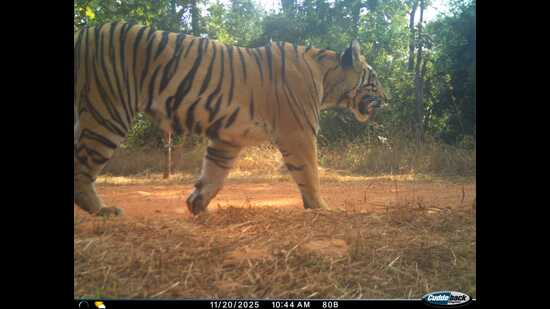
Prabhunath Shukla, field director, TATR, said, “T7-S2 is a young, dispersing female with healthy behaviour suitable for translocation. Her relocation is another meaningful step towards strengthening tiger presence in the Sahyadri landscape.”
Field director of the STR, Tushar Chavan, said, “The soft release of T7-S2 is an important milestone under Operation TARA. Chandoli offers secure habitat and adequate prey for her settlement. Our teams, along with scientific experts, are fully prepared to ensure her safety and smooth acclimatisation.”
T7-S2 was soft-released into the Sonarli enclosure on December 9. The soft-release method allows a translocated tiger to familiarise itself with the local terrain, prey base, and climate in a controlled setting before moving into the wider forest. The staged approach is known to improve post-release success rates, helping the animal settle into its new habitat and reduce dispersal-related risks. A two-year-old tigress, T7-S2, was captured on December 8 from the Korala core range of the TATR, specifically the Pandharpauni area. After her capture, she underwent a comprehensive medical examination with Dr Ravikant Khobragade, veterinary officer (wildlife) and head of the rapid rescue team at the TATR, certifying her to be in excellent health and fit for relocation.
The operation is being carried out under the scientific supervision of the Wildlife Institute of India (WII). Senior scientist K Ramesh and field biologist Akash Patil are monitoring T7-S2’s behaviour, movement and stress levels inside the enclosure. The National Tiger Conservation Authority (NTCA) is overseeing the process through its representatives: Nandkishor Kale, assistant inspector general (Project Tiger); and Rohan Bhate.
The first tigress, Chanda—translocated to the STR from Tadoba on November 13—completed a week of acclimatisation before being released into the wild. She continues to be tracked closely through field teams and technology-based monitoring.
With two tigresses now introduced into the STR, officials say that the Sahyadri Tiger Recovery Programme has gained momentum, offering renewed hope for rebuilding a viable tiger population in the western ghats.


