
 E-Paper



Shivajinagar sees particulate matter level 4 times higher than permissible limit
Air quality in Pune improves slightly from poor to moderate category, but still harmful for human health. PM 2.5 levels in Shivajinagar nearly four times higher than permissible limit. Transport sector contributes 20% of PM 2.5 emissions. Pashan area indicated as having satisfactory air quality.


Air quality in Pune which had hit the ‘poor’ category with an overall Air Quality Index (AQI) of 180 on November 5 has improved slightly to reach the ‘moderate’ category in the last 24 hours. On November 6, an AQI of 146 was recorded at 6 pm by the SAFAR-IITM real-time monitoring system. However, Shivajinagar recorded the highest air pollution in the Pune Municipal Corporation (PMC) limits with the major pollutant being PM 2.5 at 283 µg/m3 (micrograms per cubic metre).
As per the SAFAR-IITM – a central government project to provide real-time updates on the air quality of Pune and Pimpri-Chinchwad cities – the data revealed that the air quality in the city improved slightly in the last 24 hours from poor to moderate level. However, this is still harmful for human health. The level of pollutants in the city was beyond the Central Pollution Control Board’s (CPCB’s) permissible limit. The major contributor to air pollution was PM 2.5 and in Shivajinagar, it was nearly four times higher than the permissible limit. The standard limit for this pollutant is 60 however the actual level was recorded as 283 on November 6. In other areas too, PM 2.5 was a major contributor to air pollution. The pollutant level was recorded between 90 and 135. This apart, nitrogen oxide was the other major contributor to air pollution.
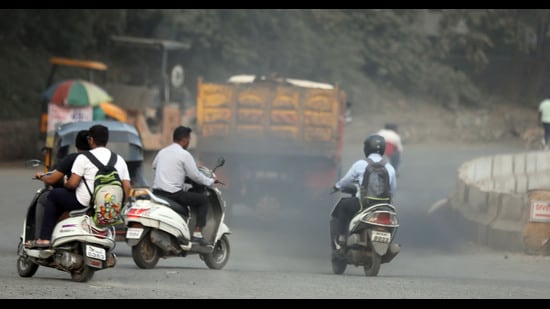
As per the air pollution inventory by the Automotive Research Association of India (ARAI), the transport sector or vehicle emissions contribute as much as 20% of the PM 2.5. Road dust contributes 19%, industries 19%, agriculture waste 10%, construction activities 12%, and the diesel generator set 4% in the generation of PM 2.5.
Mangesh Dighe, environment officer from the PMC, said, “Shivajinagar is where traffic converges from all directions. At the same time, metro work is going on there, resulting in traffic congestion due to the unavailability of enough space for vehicles to pass, especially during peak hours. Moreover, the festive season is approaching and many citizens are visiting the marketplaces in this area.”
“We believe that once the metro work is completed, it will have a good impact and will help improve public transportation and ultimately have a positive impact on air quality not only in Shivajinagar but in other areas as well. However, it will take some time for the metro work to be completed,” Dighe said.
Box:
Pashan the only area indicated in green for satisfactory air quality
While the majority of areas in the PMC limits are experiencing ‘moderate’ air quality due to which they have got yellow colour coding, Pashan is the only area indicated in green (satisfactory air quality) by SAFAR-IITM. Although the pollutant levels in Pashan are also higher than the permissible limit, they are at the borderline. While PM 10 and PM 2.5 were recorded as 94 and 90, respectively. The other pollutants range between 18 and 50 which is much below the permissible limit, said experts.


