
 E-Paper



Someshwar temple gets a unique ‘Reed bed’ for clean water
The moon-shaped semicircular bed is made of coal, pieces of bricks, fine sand and soil as its base. The breadth of these bunds are minimum five feet. There are around 10 local species of plants planted on this which includes Duck Weed, Cyperus, Cana India, Typha, Colocasia, Water lily


With an aim to clean the water at the Someshwar temple at Pashan, Kirloskar Vasundhara Ram Nadi restoration mission along with Shri Kshetra Someshwar Devasthan Trust, recently completed building an innovative 100 metre long ‘Reed Bed’.
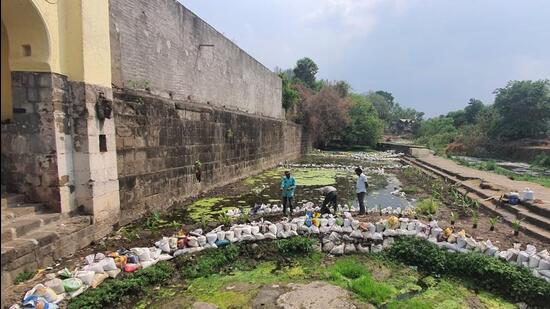
The moon-shaped semicircular bed is made of coal, pieces of bricks, fine sand and soil as its base. The breadth of these bunds are minimum five feet. There are around 10 local species of plants planted on this which includes Duck Weed, Cyperus, Cana India, Typha, Colocasia, Water lily and Indian lotus.
Built around 900- years ago, Someshwar temple is a unique temple made of black stones in Hemadpanti style on the river basin of Ram Nadi river. The temple which is spread over 3.5 acres attracts a lot of devotees from in and around Pune. Most of the people, post their Devdarshan visit the Rajmata Jijau Kund near the temple for natural water.
Virendra Chitrav, president of Kirloskar Vasundhara Ramnadi Restoration mission said, “We have created a three layer process of purification. According to its structure, the polluted water will first get filtered through bund and then the plants will naturally absorb the dirt and balance the hydrogen level. The filtered and biologically proceeded water will then enter the pond. In the end, there is a stone inlet already in place. We have constructed a filter mesh net, there, to purify water in the last stage before entering into the pond.”
The project which began on March 13 has Modern college as the knowledge partner. Chitrav added: “The role of knowledge partner was crucial. Initially, a month before we began the work, a number of studies and tests were conducted to analyse the water, soil and biodiversity. The tests were done to maintain the biodiversity of the area. All these studies were done by the modern college. Now, post the construction, the water reading will be done by them.”
The Botany and Microbiology departments of modern college were involved in this project. Dr. Prachi Kshirsagar, assistant professor of Botany said: “In the last one month the water quality has improved considerably. The dissolved oxygen level which was 1 mg/litre when we began the experiment has now improved to 5.7 mg/litre. The pH level has increased from 6.5 to 7.6 making the water potable.”
The project is an experiment towards using eco-friendly methods to make the rivers clean. Chitrav concluded: “The government spends crores for the restoration of the river. Instead, we would suggest they use such simple and cost-effective methods to clear the water. India has thousands of holy shrines. Such reed beds can be replicated at various locations.”


