
 E-Paper



Startup Mantra: Brining millets back to our plates
Deodhar couple started ‘Sonkan’ with the idea of making life better for villagers in Konkan. And built a successful company along the way


In Tetavali village, a five-hour drive 180 km from Pune, where traditional millets were once grown in every field, change had quietly crept in. Most of the youths in the village had migrated to nearby cities for jobs, and those who stayed back were cultivating only rice and had forgotten about the legacy of millet farming. Nitin Deodhar, 59, and his wife Meenakshi, 58, who visited the village quite often, saw both a crisis and an opportunity here. This gave birth to Sonkan in 2021, a startup that sells nutritious and wholesome millet-based foods, and other products of Konkan.
How it started
Nitin, who was at the time running a very successful MEP (Mechanical, Electrical Plumbing) Consultancy offering services across the globe, said, “Our family roots are in Konkan and we’d go there regularly, and, on our trips, we saw that the locals were leaving the village to work in cities. The bright students would go to the cities to get jobs as clerks, and delivery men while the not-so-bright students would stay back to tend to the farm. In addition to this, their dietary habits were changing. Instead of eating what was over generations produced by their farms, they were switching to government-provided rice and wheat that came from ration shops and came with its own economic pitfalls.”
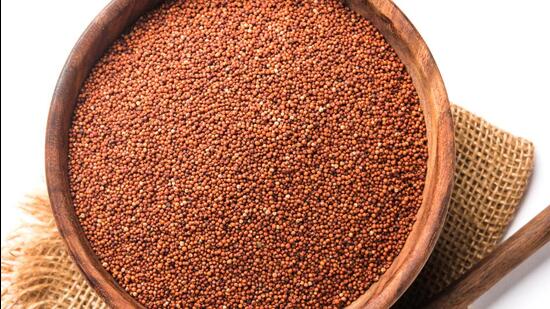
Nitin and Meenakshi found this very disturbing. Says Nitin, “The area traditionally would grow millets – the hardy crop. Hardy because it could withstand a drought as well as flood excess rainfall situations. Besides being a hardy crop, it was grown in the sloping wastelands of Konkan. However, falling prey to the ongoing trends, the villagers of Konkan shifted to growing only rice and giving up ragi (finger millet) and varai (barnyard millet) which need very little tending. This was also changing their food habits. This not only affected their earnings but also impacted their health.”
Initial steps
The situation of the villagers of Tetavali had a deep impact on the Deodhars. Nitin thought that he should lead by example and bought 15 acres of land in the area (self-invested) to grow their traditional crops – ragi and varai along with cashew. He employed some locals to do the job hoping that it would spur the others to get back to the crops their land could bear.
However, in 2020 Covid hit the country. Says Nitin, “We put the 300 kgs of ragi in our car and came back to our home in Pune.” Not knowing what to do with the ragi, Meenakshi sprouted a few kilos, dried it and after roasting ground it in her kitchen grinder. “We put it into 200 gms packets and distributed it to family and friends.” Soon those same people were asking for more and Meenakshi made some more. After all, she had 300 kgs of ragi at home.
Says Nitin, “Our friends said why don’t you keep this ragi satva in a local store, so we won’t have to nag you for it.” And Nitin did just that. He went to the local grocer near his house at Swargate and kept a few packets there. Soon they were sold. The grocer then said, “Why don’t you get a Food Safety and Standards Authority of India (FSSAI) licence and Nitin followed that advice. “My daughter who’s done her architecture offered to design the label, logo and other such marketing collateral. After the FSSAI registration, you need to have a trademark. We first thought of the name Deodhar’s Konkan Sampanna. However, this was not possible because Deodhar being a proper name, Konkan was a geographic area and Sampanna was a brand owned by the Tatas. So, we coined the name Sonkan. In 2021 we had it registered.
Learning the ropes
What started with an effort to help their family village was soon turning out to be a small company. Nitin started by distributing his ragi satva for free and when the demand kept increasing, he got into the commercial and legal mandates required. He now had to charge for the satva. How did he figure out how much it costs? Says Nitin, “I simply saw what was the price of the other satva products. They sold for ₹50 generally for 200 gms. I priced ours at ₹55/- because our process was more demanding and the product more nutritious.”
Sonkan satva is made by sprouting, roasting and then milling the ragi. This meant that the fibre was available as the ragi was semi-cooked whilst roasting, making it easier to digest. Something that hooked his customers who kept repeating their orders.
The 300 kgs of ragi would soon get over and be depleted. What next? At that time the couple invested in a flour mill and a weighing machine. However, grinding large amounts of ragi made the machine too noisy in the house. “So, we bought a professional flour mill and shifted operations to our village where the ragi was being grown. At first, we employed a local lady who would grind the flour, weigh it and pack it. Once a week we drove down to our village and picked up the stock for sale.”
Growing organically
Local men work the Sonkan farm and local women operate the mill. “We didn’t know the first thing about marketing a product such as this. We simply followed the demand. Friends wanted it in a shop so as to not disturb us at home, so we approached our first retailer. We moved there. Then more people wanted it, so we approached more stores.” At that time, they were selling about 100 packets per day. But the demand kept egging them on to more growth. By 2022 we needed to source more ragi than what was being grown on our farm.” By then Nitin understood clearly how rural markets worked. “If you go to the wholesaler to sell your produce you have to accept the price he gives you. But if the wholesaler comes to your farm, then you can dictate the price. And that can happen only if you are producing a viable quantity in hundreds of tons.”
This pushed Nitin to procure the ragi from local aggregator agents. “The village economy is different. A small farmer may approach an agent with the produce of his farm which may be a few 100 kilos. Instead of money he may need dal or rice or some such and do a barter. This is something I cannot offer. So, I procure the ragi but from our village only. The aggregator does agents do the settling of their dues.”
But has this succeeded in increment of areas growing millets in the Konkan district? Says Nitin, “It most certainly has. While I would not have the acreage of land, I now required that when we started when we had just one farmer, i.e. me, growing millets, but now 30 farmers are growing growing millets.”
Finding opportunities
Meenakshi, who has a deep knowledge of medicines, knew very well that eating right can keep you away from pharmaceutical products. So, she kept experimenting with the millets as the customers wanted more. “They wanted to know if they could make idlis and cakes with millets.”
With her PhD in pharmacy and study in psychology and nutrition, Meenakshi knew that people were getting health conscious, but also did not have the time or the inclination to slog over cooking. They wanted quick, easy-to-make nutritious foods.“Says she, “No one would spend time and effort to make a jowari bhakri but would very easily flip it on a tawa to make a pancake or chila in minutes.”
She started by making a ragi cake mix. But realisation dawned. “Who would want to eat a healthy cake on their child’s birthday? Celebrations are meant to be cheat days when the occasion overrides all health issues. So, I abandoned the cake mix and created a pancake mix that also doubles up as a cake mix” says Meenakshi. She took ragi and dal, and added soda bicarb to make a ready-to-cook idli mix. Added dals to make a chila. “All healthy and tasty.”
Growth compulsions
Understanding that as a business grows one needs to prepare professionally for it, the couple has now hired a sales manager, four salesmen, and a brand consultant to help them. Says Nitin, “Our brand consultant told us that we should position ourselves as “the first meal of the day” largely because people may eat early or late but generally stay true to their ‘breakfast.’ So, we have added that as our positioning statement. Also, we are in talks with retailers to display our products as ‘the first meal of the day’ be it pancakes, chilas, breakfast cereals, satva, thalipeeth bhajanis and so on.”
Future plan
So far, the Deodhars have invested ₹40 lakh in this venture and Sonkan has grown 3X. Sonkan now has a total of 22 products consuming 800 kgs of millet per month with revenues of ₹90 lakh projected for this year. Last year his revenue was ₹36 lakh and the year before that ₹11 lakh. They started with three people and today they are employing 22 people. They aspire to become an international brand selling nutritious and wholesome millet-based foods, and other produce of Konkan.


