
 E-Paper



Startup Mantra: Guiding little ones climb the learning steps
Entrepreneur-sister duo launched “Shark Brains” in April 2022 with a vision to imbibe Indian culture and generate curiosity in kids


For an infant, toddler, or any kid up to seven years, the pre-school years are foundational years in which the brain gets developed and the child explores, wonders, and grows. Parents of children of this age group are most focussed and many wish that they had access to educational tools which would help their kids also understand the Indian culture.
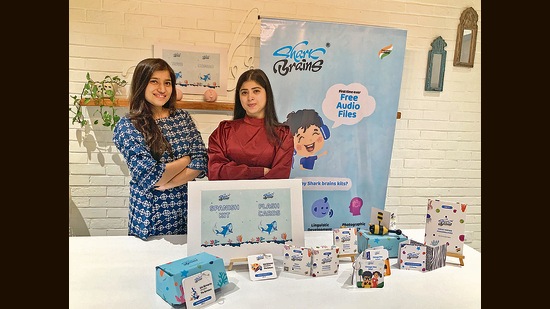
Entrepreneur-sister duo Pranali Shende-Kotkar and Mayuri Shende-Kankariya founded “Shark Brain” in April 2022 with a vision to imbibe Indian culture and generate curiosity in young Indians. An initiative by mothers, researchers, and educators to promote screen-free time, “Shark Brains” is focussed on professionally designed brain development kits for infants and toddlers, and the kits are validated by child educators and researchers.
In the beginning…
Mayuri comes from product design education background and is running a design agency for more than seven years. She has also completed her “Entrepreneurship for Creatives” course from the University of the Arts, London. Her elder sister, Pranali, is an interior designer who has delivered around 30 projects till date. Interestingly, both sisters came together after their marriage, and discussions on problems faced by parents while raising their children drove them to start their venture.
Mayuri said, “When my son was three-month-old, I came across the concept of high-contrast cards for vision development of kids. I looked for such products online, but found mixed reviews about the quality of products and delivery time. Since I am a product designer, I thought why not go ahead and design my own product in this category. I did a kit of high-contrast vision flash cards and tried it out with my son and kids of other close friends. They also recorded their infants transferring vision from left to right and vice versa while looking at the high-contrast cards. These cards also helped kids to calm down in an overwhelming surrounding. This gave me a boost to share the product with other mothers, followed by competitor research.”
Pranali said, “I used different tricks to teach shlokas (verses) and mantras (words or phrases) to my six-year-old daughter. It was the way we two sisters were also brought up. It was a part of our daily routine and never forced on us. What I realised was that due to these activities at home, my daughter could pronounce words and sentences clearly, she had become an avid reader and could read big story books. As a result, parents requested me to teach or take classes for their kids. I did not have any specific format to teach these Sanskrit shlokas. Mayuri and I discussed about the benefits of shlokas and decided to convert it into playful cards. We thought about various options like videos, but we wanted a product which would be screen-free and battery-free.”
Flash cards
Mayuri said, “We saw that there is a lot of demand for flash cards and something that keeps the child engaged. So, we decided to make cards and translated the shlokas and mantras high-vision content into flash cards. While designing the cards, we thought of putting meaning of the Sanskrit shlokas in English language. That was something we missed out as children, but we thought of giving something better to our kids. So, the English meaning of shlokas was printed on the back side of every card.”
“Since I had a design agency with team comprising illustrator, designer, design thinker, strategist, our kits were carefully curated keeping in mind the most effective ways of self-learning and having fun,” she said.
Shark Brain
While considering a name for their new startup, Mayuri and Pranali delved into a lot of aspects. “We wanted a name that would be easy to understand for kids and their parents, and also remembered by the kids when they grow up. We initially thought cognitive brains, because cognitive development is what parents focus during early days of their children, but we thought it would be a slightly heavier name to recall. We were targeting Indian audiences, and we went through some nursery rhymes which kids were fascinated with. After much deliberation, we came up with Shark Brains.”
Expanding product range ‘A to Z’
Buoyed by the initial success, Mayuri and Pranali also realised early that they have a very short product range.
Says Mayuri, “While we were thinking of introducing new products, I came across young children of about 8 to 10-year-old. Most kids in their teen, do not believe that India is a land of opportunity. They think that they should leave our country at the very first moment they get an opportunity abroad. Also, during vacations and planning family trips, most kids are fascinated with foreign destinations like Paris, Malaysia, etc. However, we felt that India is such a great country that it would take two lifetimes to explore its natural, cultural, and linguistic diversity. Kids are unaware of the handmade products made in India. Once we get older, we realise the importance of all these things. In order to change the kids’ mindset, we decided to come up with an expanded product range. It was an ‘A to Z’ kit where each letter would describe a domestic location and whatever is popular at that location.”
“We did a trial too. Pranali had taken two sets of cards during her travel. On the flight, she gave those cards to three children and for 30 minutes they were engrossed with it. Our products kept those kids away from mobile games and screen time. It generated curiosity, calmness, and focus in those kids. Our vision is two years down the line, kids will ask parents about domestic tourist destinations like Darjeeling, etc. instead of demanding trip to foreign destinations,” Mayuri said.
“The cards are available in English, Marathi, Hindi, and Sanskrit languages. If the shloka is in Sanskrit, its meaning is written in English. ‘A to Z’ kit has location described in English and Hindi. We want to promote regional languages also,” Mayuri said.
Foreign language kits
With products getting popular in the infant and toddler range, Mayuri and Pranali then focussed on designing and developing products for children up to seven years of age.
Mayuri said, “We understood there is a lot of demand in preschool kids for learning foreign language. We are becoming global citizens and are no more limited to one location. We interact daily with multilingual people. So, we decided that our focus should not be only on Sanskrit, but also on something that will probably interest children and parents. With some research in association with preschools, we found that Spanish and French were the most sought-after languages by parents. We worked with some child educators, did research and innovation, and came up with a new product.”
Explaining the importance of technology in scaling up her startup, Mayuri said, “Successful companies are scalable because they use technology. We too, did not want to lack behind. We did not just want to make games, but a product which parents, grandparents or babysitters at home would be comfortable to use. Also, we wanted to ensure that they should not pronounce words incorrectly while teaching kids. Hence, we came up with an idea to record every shloka, mantra, and words or letters and make it available to users who would be teaching kids. We took help of seasoned adult voices for shlokas and mantras, and for languages we have teachers and best-performing students’ voice.”
“We generated a quick response (QR) code on our product packaging, which would be scanned by the user purchasing our products. Scanning the code redirects the user to a website where the audio files can be accessed. Users can also share this link with their friends or family. We did not put any access-barrier here because in any case we would get the mobile number of users accessing the data,” Mayuri said.
Design element
Mayuri and Pranali wanted the cards to be travel and transport-friendly. “Parents should have ease-of-use and it should also be convenient for the child to hold it in their hand. We did some trials with large and small-size cards, but later finalised 4x4 inch size. For font size too, we did a sampling in our vicinity and decided the font size which would be legible for grandparents and kids.”
Sharing her experience and feedback received from users, Mayuri said, “India has moved quickly to adopt technology. Parents are active on ecommerce marketplaces. We are exploring those avenues and have so far got good response on it. We are interacting with customers, noting first-hand feedback, and understanding their emotions after they use our products. We have received a lot of videos of children exploring the cards, singing shlokas and testimonials through social media.”
The cards, made with matte finish and double layered paper, carry colourful hand-drawn illustrations and have smooth edges.
Mayuri said, “We have a website which is an e-commerce platform to enable users make the purchase. The site itself will redirect users to audio files. After logging in through QR code scan, parents will play the audio files. We do not want children to touch mobiles and hence recommend to keep devices away from children. Content is available on cards for kids and parent can listen to audio and pronounce it correctly. Our language kit has translations recorded in English, Spanish etc. With the mobile numbers and details of current users, we would be promoting our future products to them.”
“We do not have any plans to raise venture capital for minimum two years. We are looking at marketing equity, wherein renowned publications, academic performers discover our brand and associate with us,” she said.
Futures plans
Mayuri and Pranali shared their growth strategy for “Shark Brain”. Mayuri said, “Till now, we were focussed on the innovation aspect of the product. With a wide range of products designed, now we are approaching schools. They want to use our products and distribute it to kids. We are in discussion with three International Baccalaureate (IB) schools and preschools. For children beyond 7-years of age, we will be introducing revised language kits with advanced levels of foreign languages.”
“We have also launched a combo kit where cards and wooden rocket stacker is provided. Motor skills are developed in kids when they are in 0 to 7 years of age. We are planning to launch subscription box model so that the business becomes scalable,” Pranali said.
Addressable market
Mayuri claims there are 3,000 preschools in Pune city and if “Shark Brains” team targets 100 students from each preschool, then they have 30,000 potential users (parents of those kids). Other urban centres like Mumbai would add to these numbers, according to her. “If we consider the market size for preschool products (for infants and toddlers only) or the toy industry overall, that itself is ₹26,000 crore market by 2025,” Mayuri said.


