
 E-Paper



Taste of Life: Shooting parties in Colonial Poona
Individual meat pies could be served and, for dessert, individual fruit pies or slices of plum cake. If the shooting parties were organised around Christmas, slices of plum pudding could be taken along


In mid-nineteenth-century Britain, field sports were considered an important source of individual character-building and national and imperial well-being. Shooting was an integral part of the project, used to assert masculinity. It also offered “well-regulated enjoyment” and was connected with “all that is manly, energetic, and healthful”, as the writer–academic Robert Blakey put it.
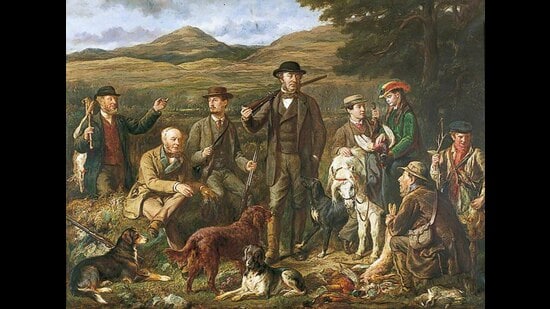
The young British soldiers and officers coming to India in the nineteenth century found themselves in an exotic world where they wielded power and, compared to the native population, immense riches. They came to look upon India as a place where they might be able to indulge in shooting, and they were not disappointed. Opportunities of big and small game shooting, pigsticking, hunting, fishing, racing, and polo were bounteously offered – and as gratefully and appreciatively taken.
Wildlife abounded, and conservation was never an issue, only the sport.
Officers returning to their motherland sold their tents, horses, ponies, guns, rifles, and other equipment needed for hunting, and soldiers were able to fit themselves out with much that they required, at a cost small in comparison with what they would have had to pay to dealers.
The hunting season in the Bombay Presidency was from November to the end of January. In Poona, shooting and hunting were also practised between July and November.
Nineteenth-century Poona was a great centre of hog-hunting, or, as it was more generally called, pig-sticking, and the “Poona Hunt” was next only to the “Calcutta Hunt”, the oldest sporting institution in India.
Fox hunting was popular too. The Poona and Kirkee foxhounds did not confine their attention to the fox and had most of their best runs after jackal. The Indian fox was small and very fast, and in rocky country could laugh at a pack of English fox-hounds. The Poona season opened with cubbing in June, and continued until early October, when the growing crops, principally “jowari”, impeded both hounds and riders.
However, what the keepers of the Raj, especially those with connections to aristocracy in their homeland, missed immensely in India was hosting and attending shooting parties.
A Victorian shooting party was a large-scale social event, often a “house party”, where wealthy guests would stay at an estate for a hunting event. These parties featured traditional shooting etiquette, elaborate clothing for both men and women, and a significant logistical effort to accommodate guests, their staff, and equipment. The events were highly structured, with specific clothing requirements for the different parts of the day and a strict adherence to safety rules, including a particular dress code for the evening.
Guests would arrive the evening before, have a casual dinner, and then rise early for breakfast before the day’s shoot began. The shoot was often a “driven” shoot, where birds were flushed out by beaters for the guns to shoot.
There were large shooting parties and small shooting parties, shooting parties to which royalty was invited and shooting parties restricted to intimate friends or relations, but in either case, the period was the same: three days’ shooting.
It was a very general custom to give shooting parties the third week in September, harvest permitting. If the harvest was late on account of unfavourable weather, the shooting parties were postponed until the first week in the ensuing month.
Shooting parties were usually clubbed with house parties. The success of shooting parties depended upon people knowing each other, or fraternising when they were introduced to each other. The ladies of a country-house party were expected to amuse themselves during the day.
The hostess and the ladies of the party invariably joined the shooters at luncheon, and some of the ladies went out with the shooters in the morning to watch their prowess in the field.
The guests, or at least the crack guns, were usually invited for partridge driving, which was what partridge shooting actually amounted to in mid-nineteenth-century Britain. At the close of a visit, game was offered to those of the shooters to whom it was known it would be acceptable.
The head gamekeeper was usually instructed to put up a couple of brace of pheasants and a hare. But in some houses, this custom was not followed, and the whole of the game killed, except what was required for the house, found its way into the local market.
During the shooting season, game pies used to be made and allowed to mature for three weeks before serving; some were always ready for an occasion.
Hot pies and stews in their casseroles and tightly covered pots were wrapped in flannel and packed in hay boxes with lids.
Hunting in India was a field dominated by men. The presence of young ladies in the hunting field was advised against by fathers and husbands. A lady was not to go to a hunt-breakfast at the house of a gentleman if unacquainted with him, or some of his family, unless asked to do so by a mutual acquaintance.
Hence, there are only a handful of references to shooting parties hosted and attended by women in India. The “Poona Advocate”, on August 12, 1867, reported on a shooting party held near the village of Wai.
An article published in a Bombay newspaper on September 14, 1889, mentioned a shooting party hosted by Mrs Agatha Rosalie Rees at a village near Poona. Guests were served “finger lunches” while they were on the field. These were cold meals and were popular for serving at English shooting party picnics. The newspaper mentioned that the “traditional” game-pie dishes and stews were not practical in India, and hence, native cooks should be taught and encouraged to cook dishes that could be served during shooting parties in India.
The newspaper suggested that since most men preferred their rolls buttered and the meat served separately, the native cooks should be trained in serving exactly that. Sandwiches were disliked for shooting parties.
On October 24, 1899, the same newspaper published a small article advising a menu for shooting parties in the Bombay Presidency. It started by lamenting the fact that such parties were very rare, even though hunting and shooting were practised on a large scale in India. It suggested cold breaded cutlets, rolls filled with smoked haddock mixed with minced fried bacon and sliced hard-boiled eggs. Individual meat pies could be served and, for dessert, individual fruit pies or slices of plum cake. If the shooting parties were organised around Christmas, slices of plum pudding could be taken along.
The families of British officers arriving in India in the early nineteenth century were shocked to know that Sundays were not regarded as a holy day of rest and that the day was considered no more than any other day with respect to shooting, playing billiards, or cricket. It was generally pitched as an excursion day. Most hunting and shooting expeditions were carried out on a Sunday.
Another British event, related to the sport of hunting, was the “hunting breakfast”. It included, as the name suggested, visiting a country house for hunting and breakfast. All gentlemen riding to hounds, whether strangers to the host or not, had the privilege of entering any house where a hunt-breakfast was given and accepting the hospitality offered.
More about this some other time.


