
 E-Paper



Taste of Life: The unsung Punekar and his mechanical sugarcane mill
A young man from Poona, in 1881, manufactured a mechanical sugarcane mill. His name was Subrao Raoji Chowhan, and he owned a foundry in Raviwar Peth


The process of interaction between European technology and the traditional system of agriculture in India was quite an interesting one. While the early British officers examined the resources of their new colony and studied their prospects for “development”, the natives were skeptical of their motives. Many officers treated the natives and their indigenous way of life and farming with contempt. Their effort was not directed at improving Indian agriculture, but was chiefly meant to obtain for themselves in the form of land revenue, all surpluses available in agriculture, and force the Indian farmer to play their assigned role in the colonial economy. Fortunately, pragmatic officers like EC Ozanne were among the notable exceptions who worked towards bringing a radical change in Indian agriculture and strived hard to ensure the welfare and prosperity of the Indian agriculturist.
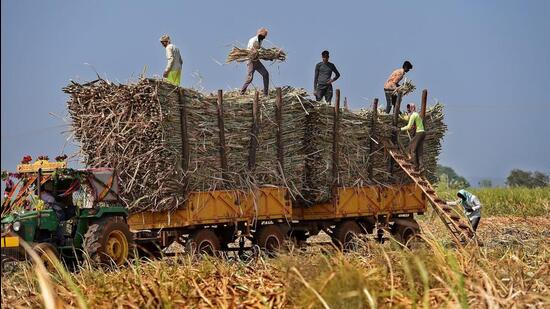
India had been a traditional producer of sugar for several centuries. Jaggery and “khandesari” (unrefined sugar) were produced all over the country. The East India Company looked at sugar as an important product, but made it a policy to import it to India from the Caribbean and Java.
The Indian farmer had traditionally relied upon the bullock cart and the wooden wheel to squeeze out the juice from sugarcane. Many private lenders and landowners had amassed wealth by lending the animal and the wheel to poor farmers. The rent, and the subsequent rate of interest, were quite high and would make many farmers give up their sugarcane farms and the little land they owned.
Mechanical mills for extracting sugarcane juice were imported from Europe after the 1850s, initially for the benefit of European farmers, and later by well-to-do Indian landowners. Manchester and Glasgow had established themselves as important centres for the manufacture of sugarcane mills. But these mills were affordable to a few. Others used the wooden “charak” which was not very efficient.
Some Europeans, meanwhile, had started manufacturing sugarcane mills in India. The Nicol mills were made by Messrs Nicol & Co of Bombay and were popular in the Khandesh district, so much so, that they were bespoken a year before the cane-crushing season (November to March). The government farm in Khandesh would rent out these mills and earn up to ₹150 every year. Efforts were made to introduce the mill in Surat, but though the people appreciated the benefits of the machine, they could not be persuaded to throw over their wooden mills all at once.
The Nicol mills were reasonably popular in Poona, Ahmednagar, Satara, and Kolhapur. In 1875, 125 mills were sold chiefly to purchasers from Satara and the Kolhapur state.
The Bihia mill, manufactured and patented by Thomson and Mylne, became popular in the late 1870s in Punjab and Bengal, though it rendered the refuse cane unfit for rope-making and the mill could not be repaired by village blacksmiths. The farmers had to travel to Roorkee to get the mills repaired.
In the United Provinces with thin canes, the best iron mills in ordinary use gave about 65 per cent of extraction, while the inferior mills gave about 45 per cent. In Mysore, with thick canes, the local three-roller iron vertical mill gave 67 per cent of extraction. These mills were working at their highest efficiency.
Officers like Ozanne believed that innovation was required to increase the efficiency of mills and make them more affordable to farmers. He sent several letters to European colleges and universities urging young engineers to travel to India and work towards innovating farming equipment.
I assume Ozanne must have been elated, when, a young man from Poona, in 1881, manufactured a mechanical sugarcane mill. His name was Subrao Raoji Chowhan, and he owned a foundry in Raviwar Peth.
In May 1884, an experimental trial of several cane-crushing machines was held in Poona. The trial was a part of the Poona Industrial and Agricultural Exhibition and was arranged by Ozanne, who was then the director of the land records and agricultural department of the Bombay Presidency.
Ozanne conducted the trial with the ordinary two-roller traditional Indian wooden mill; an improved three-roller cast iron mill with an iron frame, known as the Poona mill, invented by Subrao; the single-squeeze Bihia mill with two rollers, and the double-squeeze Bihia mill, with two rollers and one break roll.
The Poona mill had an iron frame, whereas the Bihia mills had a wooden one. The rollers of the latter were slightly grooved. Those of the Poona mill was quite smooth.
According to Ozanne, the Poona mill was vastly superior to the wooden “charak” and had to a great extent superseded it in the close vicinity of Poona where the makers were at hand to repair the iron mill.
Two pairs of ordinary bullocks were needed for the Poona mill, with a driver for each pair. Two men fed the machine, one inserted the cane between two of the rollers, and the other received the half-pressed cane and pushed it back between the middle and third roller. The mill was placed on the ground, and to receive the expressed juice, a hole was dug in the ground, into which a large iron or earthenware receiver was placed. This was covered with boards, and the feeders sat on the boards.
The cane was cut into lengths of about two-and-a-half to three feet, and the cut was made in a slanting direction to leave a pointed end for insertion between the rollers.
After the trials, Ozanne concluded that the Bihia mills, as regards portability, cost of setting up, and cost of working, possessed a great advantage over the Poona mill. But the Poona mill had greater efficiency.
Ozanne’s official correspondence indicates that he advised Subrao to work on the design to make his mill lighter and more cost-effective. The mill was sold at ₹200 and Subrao would rent it at Re 1 per day. The Bihia mill, on the other hand, cost ₹145 and was rented at ₹2 per day in Poona.
Subrao’s mill turned out to be very popular in Gujarat. A trial was made at the Nadiad Agricultural Show in 1885 and was a great success. In Ahmedabad, it was hired at ₹2 per day.
However, according to a report by Ozanne, the popularity of the mill was largely in Poona and its neighbourhood, and was chiefly due to the “energy of its patentee, Mr Subrao”. In Ahmednagar, farmers complained that its bearings of cast iron were liable to break. In Thana, it was not succeeding well with the people, and in Bassein (Vasai), the chief sugarcane-producing taluka of the district, the collector reported that “the ryots said that the juice came out black and the trash fell into it”.
Subrao worked on these shortcomings and kept improving his design till 1888 at least. I do not know what happened to him and his mill after that.
The name Subrao Ramji Chouhan is largely missing from the annals of Indian agricultural and entrepreneurial history. In the late nineteenth century, several Maharashtrian men ventured into manufacturing and trading. Their activities were mostly centred in Bombay and Poona. Their businesses were driven by the nationalist urge to make the country self-reliant, which would help them gain independence.
Several vernacular newspapers and Indian leaders often encouraged them and lauded their efforts. I wonder why Subrao’s name is missing from the list of Indian manufacturers in the nineteenth century. After all, his innovation and entrepreneurship benefitted many.
Chinmay Damle is a research scientist and food enthusiast. He writes here on Pune’s food culture. He can be contacted at chinmay.damle@gmail.com


