
 E-Paper



Taste of Life: When women followed rituals to ‘purify’ themselves
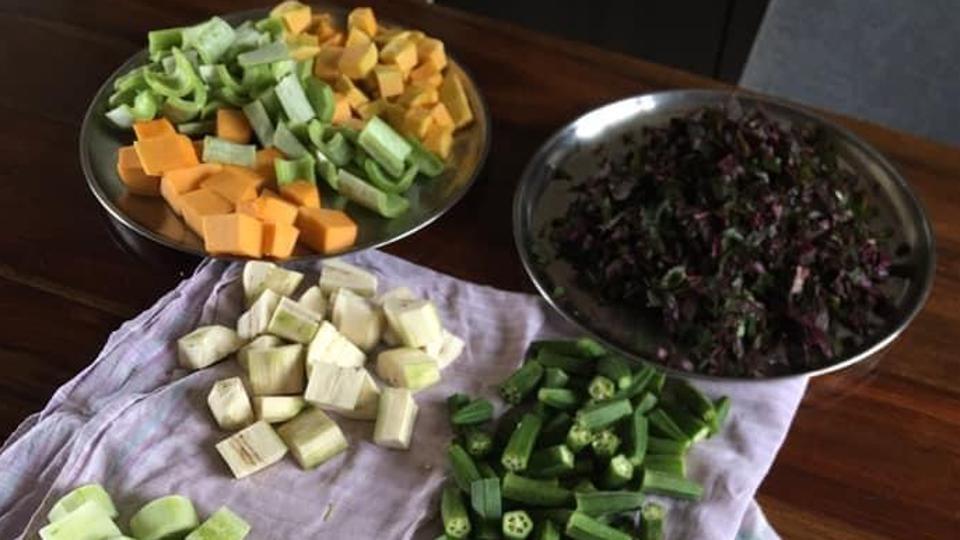
“Rushichi bhaaji”, a special dish that Maharashtrians cook on Rushi Panchami, the day after Ganesh Chaturthi


Every year before important festivals like Ganesh Chaturthi and Diwali, the sale of hormonal pills which women use to delay their natural menstrual cycle shoots up. The deeply ingrained belief of “impurity” around menstruation forces women to ostracise themselves from various social and religious functions. Their participation is contingent upon them remaining “pure” for which, many women delay their menstrual cycles by popping hormonal pills. These pills are mostly bought over the counter and without consulting a gynaecologist.
Three years ago, while working on a project to revive the first Marathi cookbook “Soopashastra”, written by Ramchandra Sakharam Gupte in 1875, I met Saroj Gupte, who was married to one of the author’s descendants. She was then 94 and lived in an apartment where once the Gupte wada stood.
While Gupte knew little about her ancestor Ramchandra Sakharam and his cookbook, she gave me a great insight into the traditional CKP kitchen and cuisine. She had painstakingly noted down several recipes in a diary and was generous enough to let me go through the heirloom recipes that were shared with her by the elder women of her family.
One of those recipes, that of “rushichi bhaaji”, though, belonged to one Sudha Joshi, a friend of hers. Joshi, born and brought in Amravati in Vidarbha, came to Pune after her marriage. Her husband had come to the city from a village in Konkan and worked in a printing press.
Since Joshi had a different style of cooking, her mother-in-law made her learn how to cook her way. Among the many dishes, Joshi learned from her mother-in-law were “tandulache modak” (sweet dumplings, which later came to be known as ukadiche modak) and “rushichi bhaaji”.
“Rushichi bhaaji”, a special dish that Maharashtrians cook on Rushi Panchami, the day after Ganesh Chaturthi, is essentially a mix of various green and other vegetables. It usually comprises colocasia leaves, amaranth leaves, sponge gourd, snake gourd, ridge gourd, corn, yams, pumpkin, and whatever vegetables one could find. The vegetables that are used are the ones where the oxen are not used for farming. Each family has its own variation of “rushichi bhaaji”.
On Rushi Panchami, stars, other than the planets, are worshipped. In Vedic times, the spirits of certain departed great seers of the earth were believed to inhabit certain of the stars, the most famous being the Seven of the North, the seven brightest stars of the constellation Ursa Major. Later, the seers became identified with the stars they inhabited.
The seven sages worshipped on Rushi Panchami are Kashyapa, Atri, Bharadvaja, Vishwaitra, Gautama, Jamadagni, and Vasishtha; or Kratu, Pulaha, Pulastya, Atri, Angirasa, Vasishtha, and Marichi; with whom is usually associated Arundhati, the wife of Vasishtha (the fainter star close to the middle one of the “bear’s tail”).
Rushi Panchami was, and is, considered to be a “women’s festival”, and worship is offered “to atone for an unwitting sin committed by reason of impurity”, as stated by MM Underhill in his book “The Hindu Religious Year” published in 1921.
Underhill narrates the legend of Rushi Panchami: A woman, through neglecting the laws regarding impurity, became reborn as a dog, her husband as an ox, for he had also sinned, although unconsciously, through having eaten food cooked by her. They lived in the home of their married son. The day on which the son was to perform “sraddha” (the ritual that one performs to pay homage to one’s ancestors) arrived, and the daughter-in-law was cooking the food to be offered to the Brahmin guests. While she was out of the room, a snake on the roof dropped poison in the cooking pot, and the “dog”, to save her son from the charge of murder which would attach to him if his guests ate the food and were poisoned, defiled the food. When the daughter-in-law returned and saw the dog with its head in the dish, she was very angry and drove it from the house with blows and curses.
The dog took refuge in the ox’s stall, and, the cup of their suffering now full, their plea to the gods for the gift of speech was granted, and they told their story to their son. He consulted a priest to find a way for releasing his parents from their “degraded condition”. The priest explained the rites to be performed by the daughter-in-law, upon the observance of which the parents, becoming released, repaired to heaven. The daughter-in-law, fearful of incurring a similar fate, continued the rite annually, and the custom became established.
There are several other legends associated with Rushi Panchami, all of which urge women to follow the rituals to “purify” themselves. Women and men believed the superstition about menstrual ostracisation and willingly followed the practice, thinking the food they cooked would rot, cows would not give milk, or their husbands and fathers would die if they “polluted” them during their periods. Women were cast out to spend four days every month in sheds, or in rooms specially assigned for menstruating women. They were not allowed to cook or eat in the kitchen, could not touch wells, water tanks, or taps, and were supposed to keep off places of worship.
Rushi Panchami offered the women a chance to apologize for all the “sins” they might have committed, even unintentionally, during menstruation
When her husband lost his job after a freak accident, Joshi had no other option but to use her expertise in cooking to run her household. Her husband did not want her to step out of the house, so she started cooking Maharashtrian snacks at home and found regular clientele with some restaurants nearby. There were several women in Pune then who were earning their livelihood the same way.
These women were not expected to cook while they were menstruating. That meant they could not earn on those days. Joshi too followed the rules for several years. In the 1960s, she started making ukadiche modak and “rushichi bhaaji” during Ganeshotsav. While there were very few buyers for the modaks in those days, since everybody preferred cooking them at home.
She decided to break the taboo when once, in the late 1970s, she was asked to cater a small order for modaks and “rushichi bhaaji” for a renowned industrialist in Pune. She went to meet them, and explained that she would be menstruating during the festival, but was still willing to cook for them.
The family, after some deliberation, agreed.
Joshi fulfilled her order and decided never to “sit aside” while she was menstruating. Her granddaughter who now lives in Canada told me that Joshi continued to cook “rushichi bhaaji” till her very end, but the reason was never to “purify” herself. She cooked and ate it because she liked it.
Chinmay Damle is a research scientist and food enthusiast. He writes here on Pune’s food culture. He can be contacted at chinmay.damle@gmail.com


