
 E-Paper



The tradition of baking hot cross buns on Good Friday
Many of our foods embody potent symbols, and the rituals of food preparation enhance our religious experience

 Prefer HTon Google


Human life largely centres on networks of interpersonal relationships that food strengthens and sacralises. We see our identity, traditions, laws, and holidays in terms of the food we eat. Many of our foods embody potent symbols, and the rituals of food preparation enhance our religious experience.
Lonavla was the chosen destination for the annual camp of the American missionaries in 1896. In an account of the camp written for the “Woman’s Missionary Friend”, Mary R Carroll who was visiting India from the US for the first time, mentioned how hot cross buns made an interesting appearance at the campsite on Good Friday.
The camp was annually held at Easter time, because Good Friday and Easter Monday, with the intervening days, were government holidays, and people were free to attend the meetings.
Among those attending the camp was Pundita Ramabai and fifty of her students, most of them widows. Less than half of them were Christians. For Carroll, it was a beautiful sight to see Pundita, in her snow-white robes, sitting in the shade of the trees, amid the company of women, teaching them from God’s book.
Five of the schools run by the American Marathi Mission were there too. And then there were the Bhimjibhoys – father, mother, one daughter, and two sons. The family was one of the first Parsee converts in India.
The meetings were conducted by an American evangelist and a native Christian from Ceylon, known as Tamil David.
Good Friday was the first day of the camp. At around 11 in the morning, when the first meeting had just gotten over, everyone was startled by a loud shout – “Hot Cross Buns!”It was the butler of the Bhimjibhoy family who had come from Bombay with baskets full of hot cross buns for Good Friday.
As the presumed anniversary of the day of the Crucifixion, Good Friday had for ages been solemnly observed throughout Christian Europe. It was the only one besides Christmas which was honoured by a general suspension of business. All of England ate hot cross buns on this day.
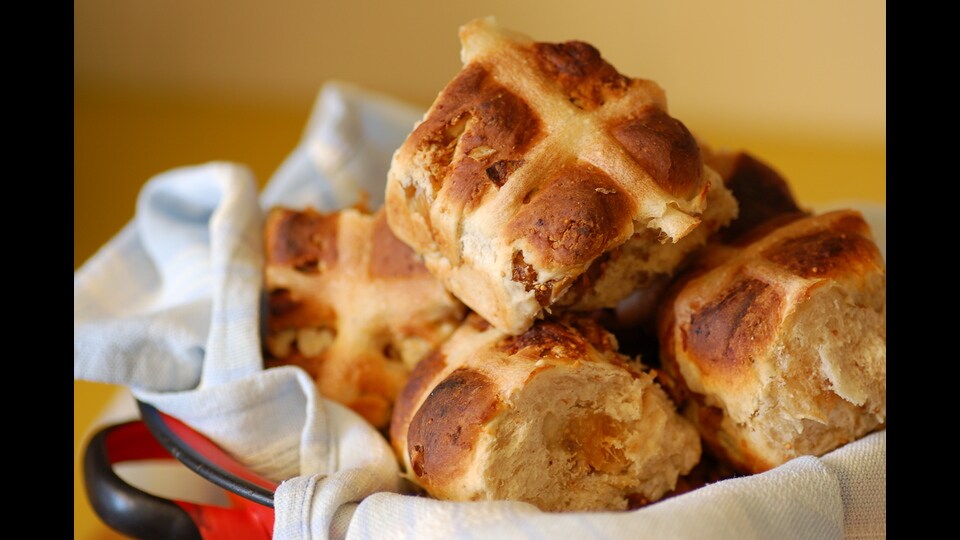
Hot cross buns were small cakes, slightly spiced, sometimes of a round shape, and sometimes long and tapering at both ends, but always marked on the top with an indentation in the form of a cross. In nineteenth-century London, as well as in almost every other considerable town in England, the first sound heard on the morning of Good Friday was the cry of “Hot Cross Buns!” uttered by men of lesser means, who paraded the streets with baskets containing a plentiful stock of the article, wrapped up in flannel and linen to keep it warm.
According to the Berkeley “Daily Gazette” (March 31, 1949), the ancient Greeks, not Christians, deserved credit for baking the first buns marked with crosses. To the Greeks, the crosses cut in the bread symbolised the four-quarters of the moon, and they ate the buns to honour their goddess of nocturnal light. The custom was centuries old when the Christian Church adopted it, translating the meaning of the cross into their terms, and distributing the buns after mass on Easter Sunday.
The hot cross buns of Good Friday and the dyed eggs of Pasch or Easter Sunday figured in the Chaldean rites. The buns were used in the worship of the queen of heaven, the goddess Easter, as early as the days of Cecrops, the founder of Athens – that is, 1500 years before the Christian Era. The Prophet Jeremiah took notice of this kind of offering when he said, “The children gather wood, the fathers kindle the fire, and the women knead their dough, to make cakes to the queen of heaven”.
Like many other time-honoured observances, some believed that the custom of eating hot cross buns on Good Friday dated back to the days of Pagan England when the early Britons ate cakes in honour of the goddess of spring. The Christmas missionaries, finding that, even after conversion, these “primitive people” could not be persuaded to give up the custom of eating these cakes at this season, caused the buns to be marked with a cross, and decreed that they should be used exclusively during Holy Week and especially on Good Friday.
Some believed that the sign of the cross was made with the idea not only of consecrating the bread to be eaten on so holy a day as Good Friday but also in commemoration of the miracle of the feeding of the multitude, as Christ signed the cross upon the bread before He broke it.
In some parts of Spain, the cross was symbolic of charity bread. All loaves intended for distribution among the poor were so marked.
Another explanation was given by several clergies of the Church of England in the nineteenth century. At the beginning of the Christian era, when the religious observances of Holy Week were far stricter, only a certain amount of bread was allowed to be eaten on Holy Friday, and that was marked off in the dough to show its length and breadth. These loaves were sold in some churches and were carried from place to place by pilgrims. But bakers continued to cross their dough long after the occasion for measuring bread had passed, and thus the custom of marking with a cross, buns to be used on Good Friday, stayed in vogue.
There were many quaint and curious beliefs regarding hot cross buns. For instance, it was believed that the small bread baked on Good Friday would never grow mouldy, also that if it were reverently preserved throughout the year, it would serve as a protection against many evils. Others believed that the sign of the cross was made with the idea not only of consecrating the bread to be eaten on so holy a day as Good Friday but also in commemoration of the miracle of the feeding of the multitude, as Christ signed the cross upon the bread before He broke it.
Among the customs peculiar to the English peasants was that of taking a bit of bread on Christmas Eve, crushing it and mixing it with the dough on Good Friday. They believed that by doing so, they combined the protective qualities of the two days’ baking. The Christmas Eve bread acted as a talisman to protect from danger from storms; the Good Friday loaf was believed to ward off temptations from those who ate it.
In India, like England, all places of business, even bakeries, owned by Europeans were closed on Good Friday, but the air was made vocal by the cries of “Hot Cross Buns!” uttered by vendors who carried baskets filled with these wares through the streets.
In Poona, hot cross buns were on sale the day before Good Friday. Newspapers published recipes for the buns, and most European bakeries made and sold them.
These buns were mildly spiced. The London flavouring was quite popular in the Bombay Presidency, as mentioned by a Bombay newspaper in 1872. It consisted of nutmeg (6 oz), mace (1 oz), capsicum (2 oz), cinnamon (4 oz) and ginger (8 oz). The ingredients were mixed lightly and sifted. The Scotch flavouring had ginger, coriander, caraway, pimento, cassia, cloves, and nutmeg.
At the camp in Lonavla, many were pleasantly surprised to have hot cross buns on Good Friday. The buns were eaten by all – Christians and non-Christians. They wholeheartedly blessed Mrs Bhimjibhoy, who had been ostracised by many from her religion.
Carroll and many others saved hot cross buns from Good Friday to the next for good luck.


