
 E-Paper



Three generations of Chand Book Store in Kolhapur preserve rare literary treasures
The journey began on a footpath in Laxmipuri, where Chand Lad started buying and selling books.

 Prefer HTon Google


In the cultural city of Kolhapur—known for its rich literary tradition—stories are not preserved only in libraries or universities. Some are quietly protected inside a modest bookshop tucked away on a busy street: Chand Book Store.
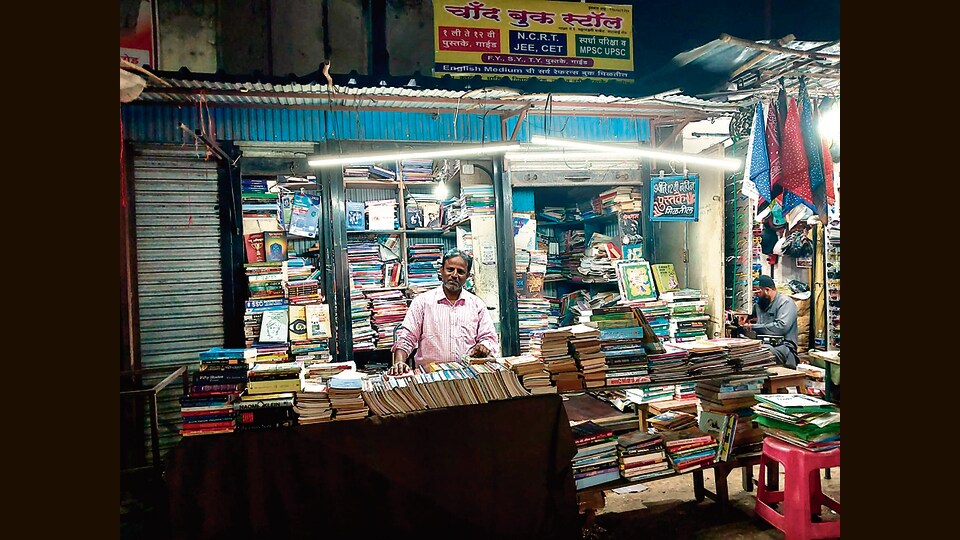
For more than three generations, the Lad family has been devoted to preserving Maharashtra’s rare literary and historical heritage—often without fanfare, and frequently at personal cost.
The journey began on a footpath in Laxmipuri, where Chand Lad, fondly remembered as Chandbaba, started buying and selling books. What began as a small roadside setup soon evolved into a meeting point for writers, historians and scholars. Renowned literary figures such as GD Madgulkar, RC Dhere and Ranjit Desai were regular visitors, often searching for rare reference material.
In 1978, the store moved into a permanent shop on Tarabai Road. Over the years, it earned a reputation as one of Maharashtra’s most reliable destinations for rare and out-of-print books.
Today, the store is run by Iqbal Lad and his 22-year-old son Aaqib—the third generation to carry forward the family’s legacy.
In an era dominated by online marketplaces and declining footfall in physical bookstores, Chand Book Store stands apart for one reason: its uncompromising focus on rare and historically significant works.
Iqbal is widely respected for his understanding of what truly qualifies as a rare book. At a time when old books are often casually labelled “rare” to justify inflated prices, he follows strict criteria—historical relevance, first editions, discontinued publications and scholarly value.
Several writers note that the Lad family places knowledge above profit. Rare books are often sold at reasonable prices, ensuring that research scholars and serious readers can afford them.
As Iqba often says, the greatest reward is seeing a reader’s joy when they finally find a book they have been searching for years.
Aaqib grew up surrounded by stacks of old magazines, first editions and fragile manuscripts. He began helping at the shop when he was just 10. By 12, he had already developed a sharp eye for books.
Now 22, Aaqib traces the family’s journey. “This is the third generation of our family running this shop. My grandfather started the bookstore in 1970 near Mahalaxmi Temple.”
“After 1980, my father took over and continued focusing on rare books. I joined him in 2014, when I was just 10,” said Aaqib.
“During the Covid-19 pandemic, book sales stopped completely. In 2020, we even thought of shutting the shop. A friend then suggested selling rare books online. Through social media, we slowly expanded our reach. Today, authors and readers from outside Maharashtra also contact us. I run a WhatsApp group with over 100 members where I post available books daily with prices, and buyers contact me directly.”
What could have marked the end of a decades-old shop during the pandemic instead became a turning point. Through WhatsApp groups and Facebook, Chand Book Store found readers beyond Kolhapur—and even beyond Maharashtra.
The shop houses rare works by authors such as DG Godse and Sarojini Babar. It also preserves vintage entertainment magazines from the 1990s and discontinued publications such as Vividh Dnyan Vistar (founded in 1867 by Ramchandra Bhikaji Gunjikar), Nibandhmala (started in 1874 by Vishnushastri Chiplunkar), Shalapatrika and Balbodh.
Many books are sourced from scrap dealers, closed libraries, old book depots and private collections. In an unusual twist, some books sold decades ago by Aaqib’s grandfather have found their way back to the shop to be resold.
Historians, professors and researchers frequently approach the store for reference material unavailable elsewhere.
Ramesh Jadhav, a renowned historian and author, best known for his extensive work on the life and legacy of Rajarshi Shahu Maharaj said “ I have been visiting Chand Book Store for the past 50 years, continuously buying books for my research I was searching for books by Thomas Penn for many years, and finally, I found one here and it was a huge help for my research. Many authors visit this store; for instance, I even found the rare autobiography of Anand Sadhale, who translated and adapted famous Sanskrit plays like Shakuntala, Malvika, and Chanakya into Marathi. The book was available for just ₹20. I sincerely hope Chand Book Store continues to nurture our hunger for knowledge.”
Sunilkumar Lavate, a towering figure in Marathi and Hindi literature, recalled Chand saheb, who started the store, sharing his memories, he said, “Back in 1972, he used to sell books on a simple wooden cart on the road. He understood who truly needed a book and would sell it to them without worrying about his profit.”
“For instance, I had been searching for Khalil Gibran’s Jivan Darshan, a translated edition of The Prophet, and I finally found it at Chand Book Store.”
Author Umesh Suryawanshi says, “Whenever I need a very rare book, the first name that comes to mind is Chand Book Store. Even if I don’t have enough money, they give me the book because they understand my need. They value knowledge more than money.”
“Being there feels like being inside an enriched library. The books are well arranged by genre, and they always provide additional information.”
Writer Pankaj Bhosale adds that Chand Book Store has become one of the last remaining hubs for rare books from the 1960s and 1970s. “Rare book markets once thrived in Mumbai’s Fort area, but most sellers were removed between 2005 and 2011. Pune was another centre, but today Kolhapur’s Chand Book Store has a far richer collection,” he says.
Researcher Irshad Vadgaonkar, who also worked at the store, describes it as far more than a shop. Books like Dharmashastracha Itihas, Nibandhmala, Lalit Sahitya, Katha, Kadambari and Diwali Ank editions from the 1960s and 1970s are available only here. Every day, new rare books emerge.
For research students, this place is a hub for discussion. Working here shaped me into a literature researcher.”
Historian and writer Indrajeet Sawant calls Chand Book Store a movement rather than a business. “They don’t just trade in books—they understand their historical value. We found the English version of the first biography of Shahu Maharaj here, and even the 1920s Shivsamadhi magazine published before the samadhi’s renovation. Such material brings hidden history to light.”
In an age of instant downloads and disappearing bookstores, Chand Book Store represents something increasingly rare—a place where history is handled with care, knowledge is valued above profit, and a young bookseller is ensuring that printed memory survives the digital age.
For readers, it is not merely a shop, it is a living archive.


