
 E-Paper



Turning fear into courage: Women and youth lead Solapur’s flood rescue mission
The drive, led by the District Disaster Management Authority, aims to ensure that trained local responders are ready to act immediately if flood-like conditions arise anywhere in the district

 Prefer HTon Google


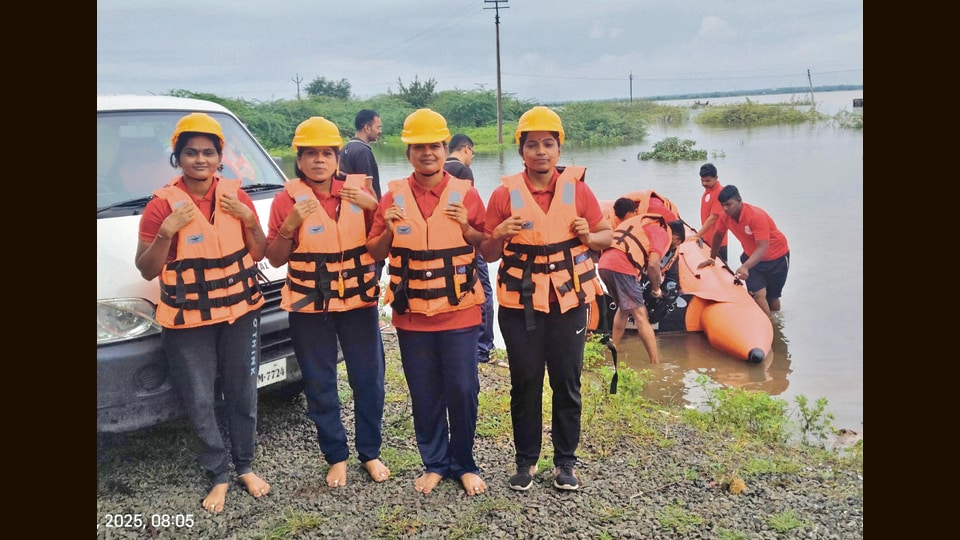
As part of early preparations for the 2026 monsoon, the Solapur district administration has stepped up flood response training, with nearly 500 ‘Aapda Mitra’ and ‘Aapda Sakhi’ volunteers currently undergoing intensive boat-driving practice at Siddheshwar Lake. The drive, led by the District Disaster Management Authority, aims to ensure that trained local responders are ready to act immediately if flood-like conditions arise anywhere in the district.
“For 2026, we began our flood preparedness planning well before the monsoon,” said Shaktisagar Dhole, disaster management officer, Solapur district. “Based on pre-monsoon rainfall trends and IMD projections, we are closely monitoring developments and strengthening our response capacity. We may not be weather experts, but we prepare for worst-case scenarios. Our goal is to expand our trained volunteer base. While the official target is 300, we are working towards preparing at least 500 fully capable volunteers.”
Dhole said around 1,000 people across the district have already undergone basic disaster orientation, and advanced training in flood response and boating is being expanded. Over the past few days, volunteers equipped with life jackets and safety gear have been practising boat handling and rescue manoeuvres at Siddheshwar Lake under expert supervision. Though the government provides limited fuel for drills, additional practice sessions are being supported through donations from local philanthropists, including assistance from a petrol pump owner.
“During floods, the first responders are always local residents. That is why we decided to train people from every section of society — tehsildars, talathis, gram sevaks, NCC and NSS students, social workers, police patils and village youth,” Dhole said. “We have consciously involved women and young students. When children and youth are trained early, they grow up with awareness and confidence. This is not just skill-building; it is about strengthening the community.”
He stressed that practical training forms the core of the programme. “We are conducting hands-on sessions on boat handling, live rescue simulations and CPR. I strongly emphasise CPR because in many flood and Wari-related incidents, victims suffer water inhalation and reduced heartbeat. Even if someone knows how to swim, post-rescue cardiac complications are a serious risk. Immediate CPR can mean the difference between life and death,” he said.
Solapur district collector Kumar Ashirwad described the inclusion of women lifeguards as a significant step. “For the first time, we deliberately included women as lifeguards. We received feedback that many women devotees were also at risk during Wari and flood situations. Having trained female lifeguards makes women more comfortable and sets a strong social example. Flood rescue has traditionally been seen as a male-dominated field, and we wanted to change that perception,” he said.
Ashirwad pointed out that flood risk in the district is shaped not only by local rainfall but also by upstream conditions. “Flooding during Wari is one challenge, but monsoon flooding is another major concern. Last year’s flood was largely due to heavy rainfall in Dharashiv and Beed districts. The dams there have small capacities — around 4 to 5 TMC — and cannot hold large volumes of water. The Sina river is narrow and does not have the capacity to absorb sudden heavy inflows. When intense rainfall occurs, flooding becomes almost inevitable unless larger structural solutions are developed,” he said.
At present, the department has 11 boats and has sought three additional boats equipped with propeller guards to prevent blockages caused by clothes, debris or tree branches during rescue operations. “Deployment planning is done according to each volunteer’s skill level and confidence, which we assess during drills. The collector has clearly instructed us to focus entirely on rescue work, assuring full administrative backing whenever required,” Dhole said.
Recalling last year’s preparations, Dhole said the administration intensified training in mid-April 2025 after rainfall indicators pointed to a severe monsoon. “Pre-monsoon rainfall had already reached about 40 per cent of the average, and forecasts suggested it could touch 160 per cent. We anticipated serious flooding and trained 300 volunteers. Of them, 84 practised boating and around 50 became fully flood-capable, including several women. When floods hit in September, our rescue teams worked continuously for 10 to 11 days,” he said.
He added that the impact of structured training was visible during the Ashadhi Wari. “Earlier, drowning deaths during Wari averaged 14 to 15 every year. In the last two seasons, that number has come down to zero. That is the result of systematic training, coordination and preparedness,” Dhole said.
For many volunteers, the programme has been transformative. Sunita Patil, a homemaker from a village in Pandharpur taluka, said she had always feared deep water. “Earlier, even during family outings, I would stay away from water. I never imagined I would learn to operate a boat. Now I can handle one confidently. My children are proud, and my husband was surprised when he saw my training videos,” she said.
Rahul Jadhav, a college student and NSS volunteer from Solapur city, said the training gave him a new sense of responsibility. “We used to read about floods in newspapers. Now we are learning how to respond in real emergencies. Boat training is tough, but it feels meaningful to know we can save someone’s life,” he said.
“Since long-term structural solutions like new dams will take time, we are focusing on preparedness and awareness,” Ashirwad said. “We plan to conduct year-round training and awareness drives in flood-prone villages. Last year, many residents were reluctant to evacuate because they believed the situation would not worsen. Now, after experiencing floods firsthand, both citizens and the administration are more alert.”
He added that shelter preparedness is also being strengthened. “Before the monsoon, we will designate proper shelter homes and ensure basic facilities such as drinking water, food, firewood, medicines and other essentials are stocked in advance. This will allow smooth evacuation if the need arises,” Ashirwad said.


