
 E-Paper



Summer scorcher: Newly merged villages bank on water tankers to quench thirst
The merger of 23 villages as well as an increase in real estate activity in the city has led to a significant rise in the city’s water demands


PUNE To keep up with the ever-growing water requirement, many of the 23 merged villages have seen a sharp rise in the number of tanker trips during the summer season.
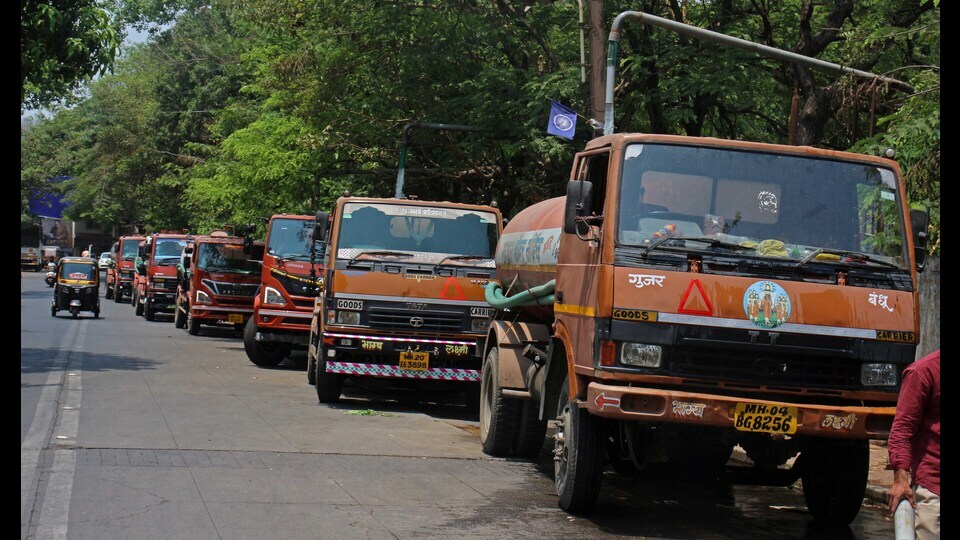
Kharadi, Baner, Balewadi, Bhavdhan, Wagholi and Sus are the major parts of the merged villages where the Pune Municipal Corporation (PMC) is supplying water and most of the residential societies facing water crunch are located in these areas.
As per PMC statistics, the number of trips in April 2021 was 21,247, which has gone up to 33,643 in April 2023.
The majority of the city’s water supply is provided by a network of four dams: Khadakwasla, Panshet, Varasgaon, and Temghar. However, the merger of 23 villages as well as an increase in real estate activity in the city has led to a significant rise in the city’s water demands.
With the rise in the city’s limits, Pune’s population has spiked rather rapidly and has crossed 50 lakh, according to PMC officials.
Though the newly merged areas are within civic limits, the PMC has failed to provide basic facilities such as drinking water, sewage and roads to the newly merged villages.
Wagholi, Sus, Baner, Balewadi, Mhalunge, and Narhe are the most urbanised areas, with more than 1000 housing societies. The majority of the residents are in the IT sector and have migrated from other states and different parts of Maharashtra.
Despite being integrated into a corporation, they are all struggling to receive regular water supply from the PMC.
Sanjivekumar Patil, president of Wagholi housing societies association said, “We have filed a public litigation to get streamlined supply from PMC. Even the Bombay High Court has given directives to PMC to form a committee to solve the problem. Around 400 housing societies in the area are dependent on water tankers.”
Harsh Butalia, a resident of Green Groves society in Wagholi has a similar story to narrate.
“We spent around 3 lakh per month to buy water from private water tankers. We spend 80 per cent of our society’s maintenance to get regular water.”
Naresh Garge, an IT professional from Baner areas said, “It is an annoying situation that residents of smart cities have to buy water for survival.”
Yogesh Jadhav, a resident of Saarrthi Skybay Chambers Mahalunge, said, “We spent roughly ₹60 lakh for the flat and live in a respectable neighbourhood. However, we do not receive any basic water-supply facilities from the corporation. Due to the Commonwealth Youth Games, Balewadi was merged with the PMC in 1997. The area, however, still does not have tap water after more than 25 years. It is completely reliant on tanker water.”
He went on to say that the society had to install the RO plant as many members recently got stomach infections due to contaminated water supply.
Amol Jadhav, a resident of Sukhwani Gracia alleged strong tanker lobby in merged areas has hampered regular water supply.
“Many residential societies are spending more than ₹1 lakh per month on water. The tanker nexus is very strong in fringe areas of the city.”
Aniruddha Pawaskar, chief superintendent engineer of the Water Supply department said, “We are working on the equal water supply plan for the newly merged 23 villages. It will take around 30 years to provide water in these villages through pipelines.”
Prasanna Joshi, superintendent engineer of the Water Supply department said, “PMC will have to lay down a network in merged villages to supply water. It will take time. In the last two years after the merger of 23 villages, the tanker numbers have been raised.”
Vijay Kumbhar, a civic activist said, “There is a lack of willpower of PMC to supply drinking water to the merged areas. I have been pursuing this issue for the last 15 years. But, to date, most of the city is still dependent on water tankers. Now, new villages are added to the list.”
Shrirang Chavan, president of Haveli Taluka Nagari Kruti Samiti who had filed petitioners for the 34 villages’ merger said citizens approaching the judiciary for something as basic as drinking water is a sign of rotten administration.


