
 E-Paper



Jharkhand Congress stages protest over G RAM G; BJP defends renaming and revamp
Protesting against the law, Raju said that, unlike the Mahatma Gandhi National Rural Employment Guarantee Act or the MNREGA, which provided economic security to poor families and was considered a strong foundation for rural development, rural workers do not have the right to demand work under the new law.

 Prefer HTon Google


The Jharkhand unit of the Congress party on Monday marched from Bapu Vatika to Lok Bhavan to protest against the new rural job guarantee law, the Viksit Bharat Guarantee for Rozgar and Aajeevika Mission (Gramin) (VB-GRAMG), launching a sharp attack on the Bharatiya Janata Party (BJP) and the Union government over the move.
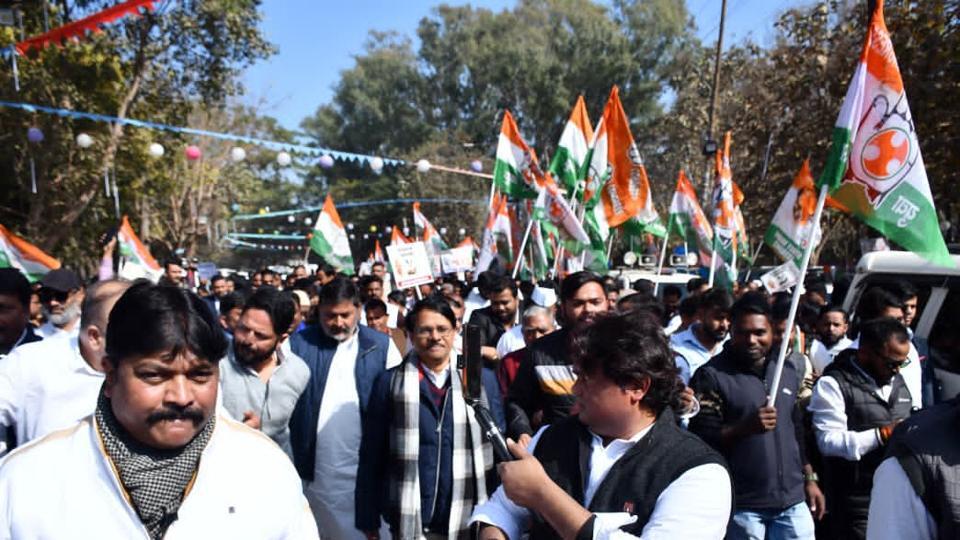
State party president Keshav Mahto Kamlesh led the march, which was also attended by state Congress in-charge K. Raju and co-in-charges Siribela Prasad, Bhupendra Maravi, and Pranav Jha.
Protesting against the law, Raju said that, unlike the Mahatma Gandhi National Rural Employment Guarantee Act or the MNREGA, which provided economic security to poor families and was considered a strong foundation for rural development, rural workers do not have the right to demand work under the new law.
“In the new law, the central government will decide the schemes and locations, workers do not have the right to demand work, and the new law includes a provision for getting work done through contractors, which was not the case in MNREGA,” Raju said.
State Congress president Keshav Mahto Kamlesh expressed concern over the decrease in the budget for the rural job guarantee scheme. “During the UPA government, the MGNREGA budget increased every year, while the BJP government has been cutting the MGNREGA budget. Under the UPA government, the MNREGA scheme had a 90:10 contribution ratio between the central and state governments, which prevented states from facing a heavy financial burden. The current government has set the ratio at 60:40, which will cripple the finances of many states,” Mahto said.
Kamlesh said non-BJP-ruled states will be the worst affected by the new rural job guarantee law.
“Under MNREGA, labourers could demand work at any time, but the current law imposed by the central government restricts work for two months of the year. The development rate in rural areas of non-BJP-ruled states will decline significantly, and these states will be completely neglected due to their dependence on the central government for the selection of schemes,” he said.
Congress Legislature Party chief Pradeep Yadav alleged that the Union government is changing all welfare laws brought in for the people.
“The central government is trying to change all the welfare laws brought in for the people; an attempt was also made to change the Food Security Act. If the three controversial farm laws had not been repealed, the Food Security Act would also have been abolished. The way the BJP is snatching away all rights, one day they will also snatch away the right to vote. (Prime Minister) Narendra Modi wants to eliminate the right to vote, which is the means of keeping democracy alive, through the Aadhaar system,” Yadav said.
Congress Legislature Party deputy leader Rajesh Kachhap said the coming generation of the country will not forgive the Prime Minister “for his divisive politics”.
“Narendra Modi lacks decision-making ability. He takes short-sighted decisions every time and then changes them after protests from Congress. The Congress passed the MNREGA law to strengthen the backbone of the rural economy. The Modi government is working to change every law given by the Congress, which is a blow to the country’s economy. The repeal of the farm laws after protests and the announcement of a caste census are due to the Congress, as the Congress remains connected to public issues. The coming generations of the country will not forgive Narendra Modi for trying to break and divide the country,” Kachhap said.
MP Sukhdev Bhagat expressed concern over the change of a law named after the Father of the Nation, Mahatma Gandhi. He alleged that the Bharatiya Janata Party (BJP) was misusing the name of Lord Ram and warned the party of dire consequences.
“The BJP has strategically brought up the name of Lord Ram; the BJP has a habit of misusing Lord Ram’s name, and it will have to pay the price for it,” Bhagat said.
State finance minister Radhakrishna Kishore said the budget provided by the Union government’s new rural job guarantee scheme did not match its requirements.
“This is not a coincidence, but a name discovered through research by the BJP researchers. This scheme is a conspiracy to weaken the states where the BJP is not in power. There are 12 crore registered labourers across India. If they are given 125 days of employment, the total amount would be ₹3.80 lakh crore. The Indian government’s MGNREGA budget is only ₹80,000 crore. Modi ji should explain where he will get the remaining amount from. This new scheme will fail in smaller states like the northeastern states, Jharkhand, Chhattisgarh, Assam, and Ladakh,” Kishore said.
State health minister Irfan Ansari said that before introducing any law, the Modi government should take the community for whom the law is being brought into confidence.
“Imposing laws by force will lead to their withdrawal, as happened with the farm bills. The BJP has crushed every community. During the BJP’s rule, daughters were raped in Manipur, and the son of a BJP minister crushed farmers, but not a single word of sympathy came from Modi ji’s mouth. The MNREGA has led to the economic upliftment of village labourers and a reduction in migration. The Modi government is preparing to push rural areas to the margins,” Ansari said.
Rural development minister Deepika Pandey Singh said that in the state, several schemes, including watershed management, Birsa Harit Gram Yojana, and Abua Awas, are linked to MNREGA.
“For the past 11 years, people in the country have received an average of 45 to 50 days of work under MGNREGA; the promise of 125 days of work is merely a deception. The attack on MNREGA is like kicking the poor in the stomach, and we will fight against it,” she said.
Agriculture minister Shilpi Neha Tirkey said the change in the rural job guarantee law would cause a rapid increase in migration.
“The original objective of MNREGA was to prevent migration, provide employment to villagers in their own villages, increase income, and strengthen the rural economy. This is not just a matter of changing the name, but rather a complete dismantling of the system through changes in the law, which will certainly affect villages and lead to a rapid increase in migration. When the MGNREGA budget has been reduced, on what basis is Modi ji giving the guarantee of 125 days of work?” Tirkey said.
Jean Drèze, a member of the National Advisory Council, was present as a special guest. Those who addressed the gathering included MPs Kalicharan Munda and former Union minister Subodh Kant Sahay, among others.
Responding to the allegations, BJP state president and Leader of the Opposition Babulal Marandi criticised the Congress party for opposing the new scheme.
“Under the new scheme, every rural family will now be guaranteed 125 days of employment every year instead of 100 days. There is also a provision for unemployment allowance if work is not available, but Congress doesn’t like schemes that benefit the poor,” Marandi said.
He said that the Modi government has spent the most on MNREGA, which the Congress party is talking about. “So far, ₹11.74 lakh crore has been spent on MNREGA in the country, of which the Modi government has spent ₹8.53 lakh crore,” Marandi said.
On changing the names of laws, Marandi said it was not the first time this had happened, and at the time of formulation, the rural job guarantee law was not named after Mahatma Gandhi. He said that the law was named after Mahatma Gandhi during the Manmohan Singh government, after Rajiv Gandhi had named it after Jawaharlal Nehru.
“The scheme whose name the Congress party is making a fuss about was not originally named after Mahatma Gandhi. In 1980, Indira Gandhi combined all the old employment schemes and named it the National Rural Employment Programme. Later, Rajiv Gandhi renamed it the Jawahar Rozgar Yojana. Manmohan Singh’s government renamed it NREGA in 2004 and MNREGA in 2005,” Marandi said.
Marandi said it is Congress which started the culture of changing laws according to the names they prefer.
“Similarly, Congress renamed the rural housing scheme to Indira Awas Yojana. They also renamed the rural electrification scheme to the Rajiv Gandhi Rural Electrification Scheme. In Jharkhand, the Congress-backed government renamed the Atal Clinics, which were named after the architect of Jharkhand, Atal Bihari Vajpayee, after Mother Teresa,” he said.
“The Congress party named nearly 600 institutions, schemes, and awards after the Gandhi family. They made the birth anniversaries of family members national holidays. They created sports awards in the names of people who had no connection to sports. They treated patriotic leaders like Sardar Patel, Netaji Subhash Chandra Bose, and Lal Bahadur Shastri as second-class citizens,” he added.
Marandi said Prime Minister Modi did not name any scheme after himself or his family.
“Prime Minister Narendra Modi has not named any scheme after himself or his family, but has instead linked the names to service,” Marandi said.


