
 E-Paper



Shramik special trains: Harrowing time for migrants as trains continue to run late
Scheduled to leave at 11am, the first train of the day for Purnia, Bihar, left at 2.20pm, with a delay of 3.2 hours


Learning no lesson from the delayed departure of all three Shramik Special trains in the past two days, the government machinery in Ludhiana could not ensure that the four trains planned on Thursday left on time.

Migrants summoned to board the trains were at the receiving end as they hopelessly waited in the scorching heat to be ferried to the railway station from the various bus pick-up points.
Scheduled to leave at 11am, the first train of the day for Purnia, Bihar, with 1,177 passengers, chugged off at 2.20pm, with a delay of 3.2 hours.
This caused the second train – Ludhiana-Gorakhpur Shramik Special – to depart 3.55 hours late at 5.55pm. It had 928 passengers.
Sources in the railways confirmed that boarding for the Gorakhpur train started at 2pm, at its scheduled departure time.
The third train for Gwalior, Madhya Pradesh, with 1,188 passengers, was to leave at 8pm, but was also 90 minutes late.
Around 100 migrants leaving on this train, were seen waiting for the pick-up bus near the Verka Milk Plant since 2pm. While some found shelter under the trees, other braved the sun with luggage on their heads for around four hours till the bus arrived at 6pm.
The last train headed to Amethi, Uttar Pradesh, was planned to leave at 11pm.
MEDICAL SCREENING VENUE CHANGED
A senior official in the district administration, requesting anonymity, said it was an unprecedented situation, so various departments were experimenting different protocols to ensure that maximum trains ran in a day.
“On Wednesday night, it was decided to change the venue for medical screening from the Interstate Bus Terminus to Guru Nanak Stadium, as transporting passengers from pick-up points to the bus stand to the railway station was a time-consuming process,” he said.
However, only five counters were set up at the stadium for medical screening, while the number of passengers was more than a 1,000. Noticing the rush, authorities eventually decided to increase the counters to 14.
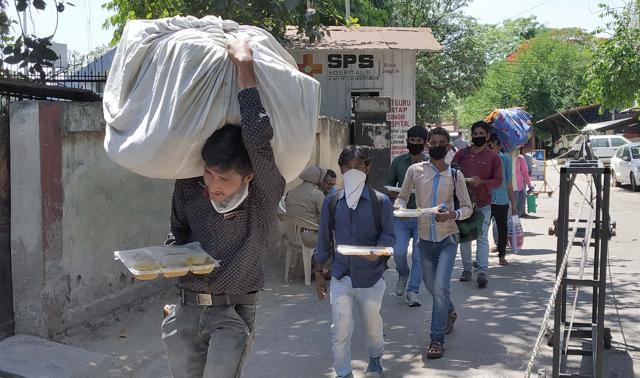
After screening, tickets were provided to the passengers, who then collected packaged food from a separate counter and walked towards the railway station, located a few metres away.
‘PERSONNEL WORKING ROUND-THE-CLOCK’
With the district administration announcing at least 12 trains a day from Friday, the work to transport passengers to medical screening to boarding them in the trains will continue round-the-clock.
Different departments have deployed their staff in shifts of eight hours each to carry out the work smoothly.
MC secretary Jasdev Sekhon said, “It takes at least two hours to screen passengers of one train, and if 12 trains are to run daily from Friday, this will have to be done all day and night.”
“At least 600 police personnel are managing migrants at pick-up points, escorting them to buses and then to the screening centre, besides maintaining law and order,” said additional deputy commissioner of police (ADCP, headquarters) Deepak Pareek, adding that they will be working in three shifts.


