
 E-Paper



By The Way: Chandigarh has a BABU syndrome
This is a conversation with Chandigarh’s Born-And-Brought-Up (BABU) lot that calls this city its own but disowns us, the outsiders who are surely the reason of all problems here.

 Prefer HTon Google


This is not a pleasant conversation. It has the potential to harm or ruin friendships. And it is something I have done before, only to regret it later. But let’s do it again today.

This is a conversation with Chandigarh’s Born-And-Brought-Up (BABU) lot that calls this city its own but disowns us, the outsiders who are surely the reason of all problems here.
In the latest, it has been triggered by a movement asking for Punjabi language to be given a place of prominence on signboards alongside Hindi and English. “What right do these people have over Chandigarh?” chirped a friend over dinner. “We, the ones born and brought up here, have a right over this city — I have spent all 26 years of my life here — and we can read English just fine. Who needs Punjabi then?” And then he chuckled some more, with some confusing rhetoric: “By the way, how many of these people, who came here to protest for Punjabi, can read English?” Nuance is dead, but that’s old news.
What’s important is that we stand up in awe and pay our respects to this specimen who represents the worst of the self-entitled lot of City Beautiful. Despite all the generalisation that we make while writing or speaking, it is rare to find someone so candidly stereotypical. The demeanour is infectious and the honesty is, well, awesome.
True to its essence, this BABU addresses only its opposite stereotype — the outsider — who treats the city as an amusement park. BABU smugly revels in the exclusionary social order that defines Chandigarh for many who come here not to raise hell but to increase their chances of success in life. Simply put, BABU avoids the reality of the aspiring lot that has made a desperate escape from a Punjab that once prospered. He puts that Punjabi in a box. Worse, imagine the size of the box that then houses all others, too, who lend the city its alleged cosmopolitanism.
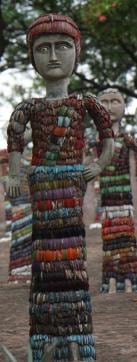
As a result, BABU put himself in a box too. This box is made of exposed concrete, stark and straight in its lines, brutal in stance, and defined by an imposed sensibility that fails miserably in countering the old, feudal order that defined this land before Chandigarh was born. In fact, the brutalism of Corbusier’s architecture only reinforced that feudalism.
And here’s some more bad news for BABU. It comes in the form of double-edged irony.
Dear BABU, if you are from the northern sectors — taking Madhya Marg as the border between two nations — you would do well to trace your lineage back to 1952 and beyond. The road meanders back into feudalism and, congratulations, you are a shameless lord!
However, if you are from the southern sectors — barring some islands in Sector 35 and 36 — you are in our box and just hitting your head against walls that you have built. No, you are not a feudal lord, no matter your illusions.
In this illusionary haze, you miss the fact that many of those calling for Punjabi on the signboards are not seeking to remove the other languages. They want the prime language of the land to have its pride of place.
Yes, indeed, there are proud idiots among these linguistic crusaders who want to obliterate other languages. They are the true soulmates of BABUs.
We, the outsider-insiders, lend Chandigarh its life and breath, its many languages and their deserved places, and its many contradictions. And you, BABU, are just one of us too, no matter that you represent the worst among us.
Writer tweets @aarishc; Email: aarish.chhabra@htlive.com
Views expressed are personal.


