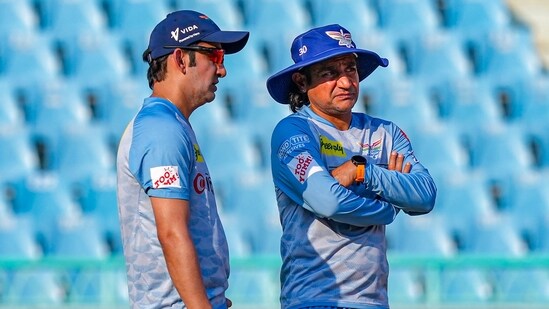
Does a dugout filled with high profile coaches and mentors make a difference? Is the presence of past greats in the dressing room a help or hindrance?
Lucknow: Gautam Gambhir and Vijay Dahiya during LSG's practice session on the eve of IPL 2023 cricket match between Lucknow Super Giants and Chennai Super Kings, at Bharat Ratna Shri Atal Bihari Vajpayee Ekana Cricket Stadium, in Lucknow, Tuesday, May 2, 2023. (PTI Photo/Atul Yadav) (PTI05_02_2023_000264A) (PTI)
Opinion is divided, the verdict isn’t clear, but consider these facts: CSK and MI, IPL’s most successful teams, don’t have superstars in the dugout. Both are led by strong captains, MS Dhoni and Rohit Sharma whose voice counts and everything else is mere background music.
Fact is, the DC dugout has a spectacular cast; prominent among them are champions Ricky Ponting and Sourav Ganguly. Fact is, DC is at the bottom of the IPL league table. The charitable view says coaches are not to blame, players have played badly. What can they do if a bowler delivers a wide under pressure or a sitter is dropped in the deep.
The less charitable view says coaches are overrated, especially in IPL because there is no time to work on skills. It’s a fast-moving circus without a pause button, a turbulent flight on auto pilot where the seat belt sign is always on.
With no time to reflect or reset, the coach can only deliver motivation speeches or make impressive presentations. Sehwag says multiple coaches cause confusion and asks what is it that the players don’t understand or can’t sort out?
Sunil Gavaskar, another critic, points to the ‘package deal’ where foreign coaches bring with them an entourage (physios, trainers, others) to be hired. The system creates jobs for friends, and as a result there are too many people around players. All acting busy to justify their existence.
That star coaches don’t guarantee good results is confirmed by IPL. Top coaches (Gary Kirsten, Mike Hesson) and top players (so many) have failed. Yet, teams hire them to look professional.
Actually the role and utility of coaches must be judged keeping in mind the larger picture. Cricket in its fundamental construct is captain driven because decisions have to be made in the middle every minute, be it moving fielders or making bowling changes. The game can’t be controlled by someone sitting on the sidelines and holding the remote.
That’s why in the past the most successful teams were run by great captains who were dismissive about others encroaching on their turf. Much before T20 cricket it was famously mentioned that coaches are a waste of time, the only use of a coach is to go from the ground to the hotel.
One can’t imagine a coach working with Lloyd, Chappell or Imran. These giants had the authority and the aura to call the shots and nobody dared cross their path. One is not sure how much space Ponting, Lara, Sangakkara, Sourav, Gambhir (IPL coaches/mentors) would have conceded to dominant coaches/mentors during their playing days.
Sourav led the team in his own way and wasn’t led by long time coach John Wright. With him, and with Virat, the power structure was very clear – the captain was boss, he took all crucial calls. Everyone else, including head coach, was basically around to help out.
In India, from Tiger Pataudi through Gavaskar and Kapil Dev, it is the captain who shaped team culture and led by example. This trend peaked with MS Dhoni and Virat. The latter set non-negotiable principles: peak fitness, aggressive intent and a bowling attack based on pace.
But IPL is more complicated; teams have a large leadership group that decides matters because of which the captain loses territory.
This hardly bothers MSD because he is CSK itself. Apparently, CSK have the shortest team meetings in IPL because MSD has little time for the data analyst and Fleming stays in the background.
Rohit and Virat (when he was leading RCB) had a free run but not so the younger Indian captains. It is unlikely that Shreyas Iyer can breathe easy when Ponting and others are around. Same with Nitish Rana and Shikhar.
If the coaching staff overload wasn’t bad enough, the introduction of mentors has added another layer of confusion. The mentor is a big shot, a past legend, but what he does when an army of experts is already at hand is uncertain. He is part of the think tank, contributes to team strategy, has a role in selection and guides players when needed.
Does having a mentor help? Maybe, but there is the risk of creating one more power centre and people stepping on each other’s toes. A few years back, MSD mentored the India team, but that role and experiment was quickly abandoned.


 Live Score
 Cricket Teams
 Cricket Players