


 Live Score
 Cricket Teams
 Cricket Players
CSK's INR 14.20 gamble looks stranger as Prashant Veer stays out despite balance issues hurting campaign
Chennai Super Kings' loss to Gujarat Titans raised questions about Prashant Veer's role.

 Prefer HTon Google


Chennai Super Kings' loss to Gujarat Titans was not only about a sluggish first innings, a crumbling middle order or a bowling attack that failed to defend 158. It also reopened one of the more puzzling questions of their IPL 2026 campaign: what, precisely, is CSK's plan for Prashant Veer?
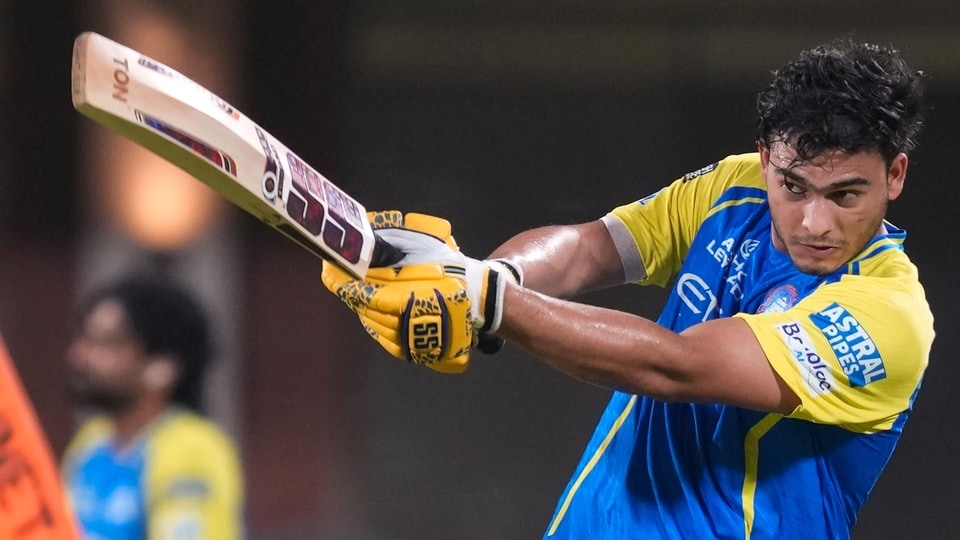
The question carries weight because Prashant was no speculative auction flutter. CSK paid ₹14.20 crore for him, placing him among the headline uncapped acquisitions of the season and signalling that he had been earmarked for a defined squad function. He is a left-handed batting all-rounder who bowls slow left-arm orthodox, the kind of profile that can reconfigure the shape of an XI under the Impact Player rule.
Which is exactly why his absence against GT looked like something more than a routine selection call. It looked like a tactical contradiction.
The injury caveat CSK cannot ignore
The first layer is injury, and it demands careful handling. Prashant had sustained a shoulder injury while representing Uttar Pradesh in January, serious enough to cast doubt over his early-season readiness, particularly as a bowling option.
That gives CSK a plausible explanation for his limited deployment. He has played two IPL matches this season, but has not bowled in either. For a player purchased as a batting all-rounder, that single detail fundamentally alters the reading of his season.
There is, however, a crucial distinction to be made. There is evidence of a prior injury. There is no clear public confirmation that Prashant Veer was still injured or medically unavailable for the CSK vs GT fixture. Declaring him definitively unfit, therefore, would be an overreach. The honest reading is narrower: either CSK still do not trust his bowling workload in the aftermath of the shoulder issue, or they have not identified a tactical role for him despite purchasing him as a two-skill cricketer.
Both explanations invite scrutiny.
If he is not bowling-fit, why was he fielded earlier as a specialist batter? If he is fully fit, why was he omitted against GT, a match where his precise profile could have meaningfully improved CSK's balance?
That is where the mystery begins to sharpen.
Prashant's most recent appearance was not a failure by any measure. Against RCB, he scored 43 off 29 balls, a combative innings in the middle of a heavy CSK defeat. He demonstrated enough with the bat to suggest that CSK had not merely acquired potential on paper. There was match evidence, however limited in sample, pointing towards genuine returns.
CSK, then, did not drop a player after two blank outings. They moved away from a ₹14.20 crore all-rounder immediately after he had shown clear batting promise. That makes the GT selection considerably harder to justify, assuming he was fully fit.
Impact Sub logic makes the call harder to explain
Against Gujarat, CSK began poorly with the bat and subsequently deployed Sarfaraz Khan as the Impact Sub. Sarfaraz Khan was dismissed first ball. The move turned into a dead investment almost the instant it was made.
That is the crux of the tactical problem.
CSK used the Impact Player slot to reinforce the batting. But had Prashant been in the starting XI, he could have already served that purpose. He is a left-handed batting option, had just scored 43 off 29 in his previous appearance, and brings the XI more structural flexibility than a specialist batter. His presence could have freed CSK to hold the Impact Sub for a bowler instead.
That matters, because CSK's bowling innings against GT was crying out for another option.
Gujarat chased down 159 in just 16.4 overs. CSK found some control through Anshul Kamboj and Noor Ahmad, but the remainder of the attack haemorrhaged runs. Akeal Hosein conceded 46 in 3.4 overs, Gurjapneet Singh 36 in three, Jamie Overton 28 in two. GT did not scrape home. They walked through the chase.
This is where the Prashant hypothesis gathers its most persuasive force. A fully fit Prashant would not merely have been one more batter. He could have altered CSK's entire Impact Sub geometry.
With Prashant in the XI, CSK could have batted deep without spending the Impact Sub slot on Sarfaraz. The slot would then have been available for a specialist bowler during the chase, calibrated to conditions and match-ups. And Prashant himself could have contributed left-arm spin if his shoulder permitted it.
That creates three distinct layers of balance. CSK gain an additional left-handed batter. CSK preserve the Impact Sub for a bowling reinforcement. CSK retain Prashant as a possible sixth or seventh bowling resource.
Instead, they fielded a structure that neither fully protected the batting nor deepened the bowling. Sarfaraz contributed nothing with the bat, and once GT launched their chase, CSK had no fresh bowling card remaining. They were even compelled to use Shivam Dube for an over, a visible sign that they were scraping for coverage beyond their core bowlers.
That is the selection contradiction laid bare.
The ₹14.20 crore mystery
CSK paid ₹14.20 crore for a cricketer whose value lies in compression: one player absorbing multiple roles. Yet so far, they have not used that compression. They played him as a batter, declined to bowl him, and then omitted him precisely when the XI needed the flexibility he was recruited to provide.
The injury uncertainty prevents a final verdict. If Prashant remains bowling-unfit, CSK's caution has a defensible basis. A shoulder injury is not a trivial matter for a spinner who must field hard, throw, dive and bowl repeatedly through a long tournament. But even then, the earlier decision to play him without using his bowling retroactively reduces him from an all-round asset to a specialist batting gamble, a considerably less efficient use of ₹14.20 crore.
If he is fully fit, the GT selection becomes far more difficult to rationalise. CSK constructed a narrower XI. They used Sarfaraz as the Impact batter. They lost that gamble immediately. And they entered the defence of 158 without the additional bowling resource that a Prashant-based structure could plausibly have unlocked.
That is why the ₹14.20 crore investment now feels like an open question rather than a settled one.
The issue is not simply that Prashant Veer was absent against GT. The issue is that CSK's selection did not reflect the reason they bought him. A fully fit Prashant offers batting depth, left-hand variety, bowling insurance and Impact Sub flexibility - a combination that, against a Gujarat side which exposed both CSK's batting hesitation and their bowling limitations, had obvious tactical application.
CSK's defining problem this season has been rhythm and clarity. The Prashant Veer case captures both failings in a single frame. They identified a rare profile at the auction, paid a premium to secure him, received an early batting return, and have not yet demonstrated how that profile actually fits their XI.
If injury is still constraining him, CSK are managing a compromised asset. If he is fit, they are squandering a tactical one.
Either way, the mystery has long since outgrown Prashant alone. It is a question about CSK's process. They purchased balance for ₹14.20 crore. Against GT, they played as though they had forgotten where they stored it.


