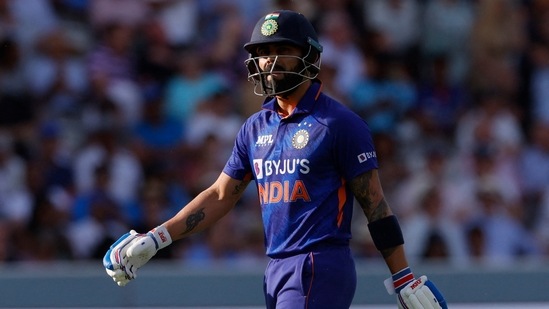
As Virat Kohli began his disconsolate walk back at Lords on Thursday, his gloved hand made a short, sharp swipe at the air. It was shorthand for damn (or words of varying intensity) again. Just when it felt…
India's Virat Kohli walks after being caught out by England's Jos Buttler (Reuters)
The sign of a batsman without the touch, feel and sensory comfort that turn into runs. In his prime, Kohli on the crease was busy, bristling, on the move, belonging in and owning the space he occupied. These days, he is twitchy, with urgency in motion, batting in a fast forward, eager to reach the culmination of this enormous effort in trying to grasp that intangible called ‘form.’
After a couple of boundaries at Lords, the compliments quickly oozed — Ajay Jadeja referred to Kohli’s “calmness” in commentary and Virender Sehwag tweeted “today looks like Virat Kohli’s day.” Not so. To start with, what is being sought for is not Virat Kohli’s day. But rather his seasons, his strings of series, a return to the phase that Indian cricket had got used to. Where Kohli’s presence meant excellence, stability, progress. Runs on the board, money in the bank.
Kohli’s equal-part-intensity and multi-format success prior to the drying up of his century deluge was thought of as the overriding reason for his slump these days. Too much cricket, too much pressure and most recently, too many Covid bio bubbles.
Between 2017 and the start of 2020, he had played in 127 matches for India across formats. In the last five years, he has missed 58 matches for India across formats (6 Tests, 15 ODIs, 37T20Is) either due to injury or rest.
In September 2018, Kohli stepped away from the Asia Cup, in November 2018 he was rested for the three-match T20 series against the West Indies. In Jan 2019, after the ODI series against New Zealand was won, he skipped the remaining two ODIs and three T20Is of their tour. Post-Covid, in November 2021, he missed a home Test vs New Zealand. In Jan 2022, after winning the first two of the three-match T20 series against the West Indies, Kohli and Rishabh Pant left the team bubble and didn’t play in the next four matches — one against the West Indies and three more T20Is in Sri Lanka. After IPL2022, Kohli was not involved in the five-match T20 series against South Africa, the two-match T20I series against Ireland and the first T20I match against England.
Prioritisation and focus on Test cricket is being cited as the reasons, except the benefits do not show in numbers. Since December 2019, it is Kohli’s Test form that is the most worrisome: in 32 innings, he averages 27.25 with six fifties, his career average falling below 50 in March this year. In ODIs, including Lord’s this week, he’s at 807 runs from 22 matches, 10 fifties, avg 36.68, (against a career average of 57.87).
The maximum noise being generated these days around Kohli though is about his strike rate as top-order T20 batsman. This is because the ICC’s T20 World Cup, which India have not won in 15 years, will be played in Australia this Oct-Nov. Besides, a year in T20 cricket is like distance in outer space — understood not in familiar parameters, but in a completely different context, like the speed of light.
When the last ICC T20 World Cup came around — in October-Nov 21, postponed by a year due to Covid — the question of whether Kohli should or should not feature as part of India’s T20 plans for 2022 would have been laughed out of rightsholders commentary boxes. Three months from the next T20 World Cup to not talk about it is to ignore the gorilla at the gate. It is Kohli’s own assessment of his T20 batting that could decide the rest of his days.
While discussing the changes in tempo and the constructions of T20 innings, my statistician friends directed me towards an interesting set of numbers. Since the start of 2021, Kohli averages 47.5 with a strike rate of 131.9 in T20 Internationals which appear to be reasonable figures.
What gives rise to a different picture is if that is compared to what is happening elsewhere in the T20 world. When compared to 24 top order (Nos. 1-4) batters (minimum 40 matches) in T20Is and the top T20 leagues (IPL, PSL, BBL, CPL and Vitality Blast) by strike rate, Kohli’s is at No. 23 (SR122.26) from 24, ahead only of Joe Denly. The average strike rate across these 24 batsmen is 137.5, a third of these score at 140SR. Since the last T20 World Cup, India’s strike rate itself in the first 16 overs is 140.
The argument for retaining Kohli in the T20 World Cup squad is repeatedly cited as being the experience he will bring. In T20 cricket, experience means constant improvisation and adaptation. There is no coaching manual for T20 batting, its playbook itself keeps changing and batters have to keep up. Currently, the role of ‘anchors’ in a T20 innings has become scarce. In India’s case, Rohit Sharma is captain, with the licence to be an anchor and the presence of another, between Kohli and KL Rahul, appears profligate.
All great batsmen find their way back to form, but of the three formats, T20 also happens to be the worst in which to seek fluency. Kohli’s name will turn up again around the Asia Cup selections next month.
Between now and then, Kohli has the time to seize control of the narrative around himself — which at the moment is being manoeuvred by those he may have annoyed in the past. He could also become master again of his own destiny should he decide that T20 Internationals need not be central to his ambitions for the rest of his career. If he decides to push on in T20Is, Kohli hands over the reins of his public life to those already sticking their knives in. His stature and its lustre can run for a season, max two, but Kohli is not India captain anymore and so nothing protects him, except runs.


 Live Score
 Cricket Teams
 Cricket Players