Cricket is alive, thanks to the Ashes. Perhaps more because of Australia, considering an alternate method was begging to be explored in the face of England’s free-spirited brand of cricket. With the Headingley victory it’s evident England won’t curb their instinct, not even when all they need is to just knock off the runs through the gaps. Australia, too, go hard when it suits them but also have the game awareness of digging deep when required. What of India though? What’s their brand of cricket?
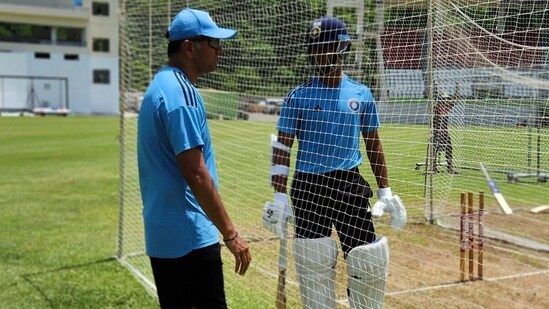
Rahul Dravid (Left) chats with Yashasvi Jaiswal. (BCCI)
What does Rohit Sharma mean when he says that he wants his team to play 'freely' as he did after the World Test Championship final? Does he want them to play like England? Does he want them to play like Australia? Does he want them to play as they did under Kohli? What does playing freely under Rohit Sharma mean? Is there a template that this team would like to adopt and would that help them win more away Tests?
It’s a pertinent query, especially considering the game’s quiet transition. And to be fair, Virat Kohli had given it a fair bit of thought, much earlier than England or any other side. When he took over the Test captaincy, Kohli unabashedly claimed he won’t play without five specialist bowlers. But not until 2018-19 did India really become a bowling force, dismissing Australia seven times in their home to win 2-1. Another series win in Australia in 2020-21, followed up by a squared Test tour of England where India didn’t hesitate from giving it back, invoking a sense of rare achievement.
This was a time Jasprit Bumrah was reverse-swinging the old ball, Mohammed Shami and Mohammed Siraj were coming full throttle at batters and Shardul Thakur was prising out the resilient anchor as Ravindra Jadeja kept wheeling away at the rough to stem the flow of runs.
When India carved out a 157-run win on a flat Oval pitch, Kohli couldn’t have been a prouder captain. “We believed as a team that we could get all ten wickets,” he said. Under Kohli, between 2019 and 2022, India were averaging 24.69 runs per wicket away from home, conceding a 400-plus score only once - 432 against England at Leeds that they had lost by an innings and 76 runs.
But that was the past. Right now, India are adjusting to life without Bumrah–laid low by a back injury since 2022 - and trying to make peace with the resources they have. Shami is an automatic selection. Siraj has cemented his position too, with Navdeep Saini following in his footsteps in the hopes of reviving his Test career. Umran Malik is yet to be tried out. Thakur is the headache selectors would love to carry forward on every tour given their frequent inclination to field an extra batter. Jaydev Unadkat, though immensely experienced, probably is plan B of India’s backup. And Mukesh Kumar is still a greenhorn. Any talk thus of honing a style of playing will have to take into account a much-necessitated bowling recalibration.
At home though, India need not worry. Thirty wins and just three losses - England in 2021, Australia in 2017 and 2023 - out of 40 Tests since the start of 2015 (when Kohli became captain) gives India a win/loss ratio of 10, leagues ahead of the next best Australia (W/L of 4.83) and New Zealand (4.166) during the same phase.
The architects of this robust record are Ravichandran Ashwin and Jadeja who have combined to take 409 of the 736 wickets to fall at home since 2015. The pitches almost always aid turn on Days 4 and 5. And since India tend to bat well in the first innings, winning at home is more or less a foregone conclusion, especially with Ashwin and Jadeja set to operate for at least a couple of years more.
Away from home, however, batting has almost always been less than assuring. If in 2018 India found their bowling chops, their batters averaged just 24.58 - the lowest in a year they had played at least five Tests away from home under Kohli.
Barring the tour of Sri Lanka in 2017 when India averaged 4.17 per over, their run rates too have been pretty conventional, hovering around the three-run mark. More often than not runs came by way of partnerships anchored by Cheteshwar Pujara but as he has been dropped, India need to either find an equally effective No 3 or a completely different approach. It’s these scenarios Rohit Sharma has to address in what is set to be his first overseas tour as India’s Test captain.
Too many times have the phrase ‘fearless cricket’ been loosely tossed around without anyone actually dissecting it. There is no doubt cricket has moved into the fast lane.
The World Test Championship awards maximum points for every victory but merely winning Tests isn’t getting more eyeballs. Making it entertaining is quickly becoming essential as well. And since the survival of Test cricket is directly linked to how well the Big Three market this format, maybe it’s time India dwell on this aspect as well. A tour of the West Indies thus, couldn’t have been more timely.
Somshuvra Laha is a sports journalist with over 11 years' experience writing on cricket, football and other sports. He has covered the 2019 ICC Cricket World Cup, the 2016 ICC World Twenty20, cricket tours of South Africa, West Indies and Bangladesh and the 2010 Commonwealth Games for Hindustan Times.Read More


 Live Score
 Cricket Teams
 Cricket Players