In many ways, 2017 was an exceptional ODI year for India. Their win-loss ratio was 3, second best since 2011, and the batting averaged 49.30 per wicket at a rate of 5.93 per over—both the highest among all the years since 2011 where India played at least 20 ODIs. More proof of their batting superiority is highlighted by an aggregated run rate of 6.99 every time India crossed 300 in 2017, a number unmatched since the 2011 World Cup win.
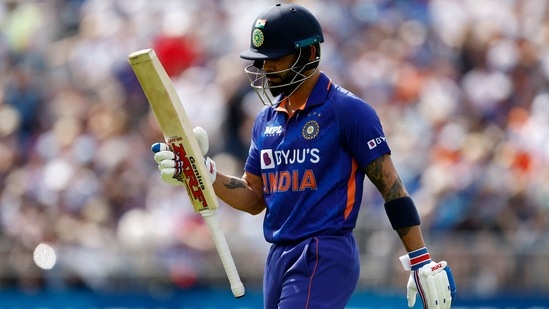
India's Virat Kohli walks after being caught out by England's Jos Buttler off the bowling of Reece Topley (Action Images via Reuters)
What went into making 2017 so special? On seven out of the 10 occasions India crossed 300 that year, at least one top-four batter scored a hundred, including Rohit Sharma’s massive 208 in an innings of 392/4 against Sri Lanka at Mohali. In the Champions Trophy, India posted totals of 319/3, 321/6, 193/2 and 265/1 before being shot out for 158 by Pakistan in a terribly one-sided final. Shikhar Dhawan topped that tournament with 338 runs, Sharma finished second with 304 runs and Virat Kohli fifth with 258 runs. That year, India’s top-four scored 31 fifties and 17 hundreds, comfortably their best yield in the two World Cup cycles since the 2015 semi-final loss to Australia.
But no batting line-up remains formidable forever. You have to factor in fading skills, strings of poor scores, phasing out of some batters and the subsequent disorder that follows. But what India’s ODI setup has been going through for three years now can’t be passed up as just a phase. Since India’s semi-final loss to New Zealand in the 2019 World Cup, their top 4 has scored eight hundreds, 31 fifties and averaged 41.82 in 30 ODIs. The World Cup cycle before that? Fifty five hundreds, 88 fifties and an average of 53.78 in 95 matches.
54.6%
That’s the top-four’s contribution in India’s team totals this year. Even though the number of matches is just nine, it’s their worst since the 2015 World Cup, and some distance from their best effort—a staggering 83.2% in 2018, a year when Sharma averaged 73.57, Dhawan 49.83 and Kohli an incredible 133.55. Ambati Rayudu, tipped to be India’s No 4 in the 2019 World Cup, was averaging 72.33. And even Dinesh Karthik, briefly considered for the same role, averaged 40.66 batting at No 4 in four matches.
By all accounts, 2017, 2018 and even 2019 possibly need to be treated as an aberration where India pretty much toyed with the opposition bowling attack and also because many factors went their way at different junctures.
Like in the 2019 World Cup, when Sharma was possibly in the form of his life, hitting a record five hundreds. Kohli, too, was in the middle of a purple patch. Even Yuvraj Singh’s 41.33 average at No 4 in 2017—his last international year—was just the backup needed for the top-three to go berserk.
This phase also happens to coincide with the most prolific phases of Dhawan (960 runs in 2017, 897 in 2018 and 583 in 2019), Sharma (1293 runs in 2017, 1030 runs in 2018 and 1490 in 2019) and Kohli (1460 runs in 2017, 1202 runs in 2018 and 1377 in 2019) in their careers.
But the scenario has changed drastically. Sharma’s last ODI hundred came before the pandemic, in Bengaluru on January 19, 2020. Kohli’s came in Port of Spain on 14 August, 2019. And Dhawan, despite his above 50 average in 2020-21, hasn’t scored a hundred since 9 June, 2019. The slide couldn’t have been more apparent when you consider the then and now averages, Kohli plummeting from 59.86 in 2019 to 21.87 in 2022, and Sharma going from 57.30 to 34.2. Shreyas Iyer (ave 45.25 in 13 innings) and Rishabh Pant (41.87 in nine innings) are the two batters India have tried the most at No 4 since the 2019 World Cup but even their runs haven’t been good enough to wipe out the massive deficit created at the top.
Everything that could have gone wrong has gone wrong simultaneously—Kohli’s struggle to get a hundred is nearing three years, KL Rahul is unavailable due to a sports hernia injury, Sharma hasn’t looked that fluent since his hamstring injury in 2021 and Dhawan’s strike rate has dipped from mid-90s to 72.36 this year. That pressure is slowly showing.
India may have won the ODI leg but concerning is how they achieved it. Dismissed for 146 chasing 246 in the second ODI, overhauling 260 in the decider riding Pant’s hundred at No 4 after they were reduced to 38/3, this wasn’t exactly an emphatic display from India’s vaunted batting. Pant’s maiden ODI hundred is a major gain but given his position is more of a floater, India’s top-four batting is still pretty much on notice.
Somshuvra Laha is a sports journalist with over 11 years' experience writing on cricket, football and other sports. He has covered the 2019 ICC Cricket World Cup, the 2016 ICC World Twenty20, cricket tours of South Africa, West Indies and Bangladesh and the 2010 Commonwealth Games for Hindustan Times.Read More


 Live Score
 Cricket Teams
 Cricket Players