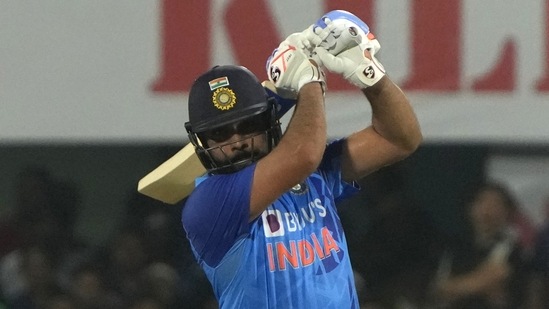
Since the 2021 T20 World Cup, India have scored 18 runs more per innings compared to the previous Cup cycle, but death bowling and fielding are concerns
Rohit Sharma-Rahul Dravid’s first big call as team management after taking over from Virat Kohli-Ravi Shastri following India’s early exit from last year’s T20 World Cup was on rest and rotation. Only 10 of the 29 players used have featured in more than 50% of India’s matches (35) in the past year. The move was fraught with risk. But the plan was to play all T20I cricket with an eye on the World Cup. Even as the players kept taking periodic breaks, the team attempted to embrace a more aggressive brand of cricket.
It’s only in the last two months that India have played with a squad close to the one in Australia (AP)
Did it yield results? For one, it didn’t affect India’s dominance in bilateral cricket—they won eight series and drew one. But India failed to qualify for the Asia Cup finals, adding to their poor showing at multi-nation events.
It’s only in the last two months that India have played with a squad close to the one in Australia. On that evidence, bowling is an area of concern. One doesn’t need to pore over excel sheets to discover that bowling at the death is the bigger worry.
BATTING GAINS
If experts still expect India to make the semi-finals it’s because of their batting. The batting group has outscored every other nation (Run Rate 9.32) since the last World Cup. They are scoring 18 runs more per innings than they did in the previous World Cup cycle, giving them an average score of 186 runs/innings.
Across phases, Indian batters have delivered spectacular numbers. In the powerplay, they score at the rate of 8.63, helping them move up to No 1 spot from No 5 in the last World Cup cycle. In the middle overs too, they have scored faster than every other team (RR 8.92), a big improvement from last time (RR 7.8). In the death overs, only South Africa score faster than India (RR 11.12); again, an improvement from the last WC cycle (RR 10.37).
“This is as good a batting line-up as India has ever had in T20 cricket,” former head coach Ravi Shastri said recently. “With Surya (Suryakumar Yadav) at No 4, Hardik (Pandya) at No 5, Rishabh/DK (Pant, Karthik) at 6, they’ve made a massive difference. It allows the top-order to play the way they are playing, which is tremendous—they’re taking the attack to the opposition. Where, if you’re two down in the power play, you still have the ammunition at the back to consistently take on the bowlers… which wasn’t the case for some time.”
Rohit Sharma embracing a high-risk game, KL Rahul showing a marked improvement in his batting tempo and Virat Kohli promising to make a V-shaped recovery in form are healthy signs. Yadav is acing 360-play in the middle-overs better than anyone else. Pandya is on a redemption curve after a forgettable 2021 World Cup. Dinesh Karthik has the potential to deliver match-changing cameos at the end.
‘DEATH’ PANGS
In bowling, numbers underscore informed estimates. India were the sixth least economical among the top 10 teams in the lead up to the last T20 World Cup (post 2019 ODI WC to T20 WC ‘21). Their rank and returns after the World Cup (Econ Rate 8 to 8.2) remain the same.
A closer look shows India’s swing bowlers have ensured they were nearly as economical in the powerplay as before the previous World Cup—29 more scalps brought the team’s collective bowling average down from 33.35 to 22.6. The middle-overs performance improved too (ER down from 8.08 to 7.69), wickets bringing the average down from 30.98 to 23.73 with the overall rank up from 10 to 6.
It's the death overs that are proving to be their Achilles’ heel. India concede 10.21 runs per over in the last five; only England, Bangladesh, West Indies and South Africa have done worse. This phase wasn’t a problem (ER 8.61) in the last World Cup cycle. But these numbers are an output from 17 bowlers tried in the year. Spearhead and now injured Jasprit Bumrah, who holds his own at the death (ER 7.36), played in only five of them. Can seven from the 15 chosen for the marquee event collectively plug the Bumrah-sized hole India are left with in Australia?
Among other teams, Australian bowling has done particularly well across phases (ER 7.84), which is why the defending champions will start among favourites at home. Afghanistan and Bangladesh bowlers have delivered good numbers in bilateral cricket too, but their sample size is smaller and their opponents not always strong.
On batting-friendly pitches that are expected in Australia, Indian batters can be destructive once they befriend the bounce. The question is do they have enough depth to sustain an all-out-aggressive approach and can the batting offset their inconsistent bowling and weak fielding.
Rasesh Mandani loves a straight drive. He has been covering cricket, the governance and business side of sport for close to two decades. He writes and video blogs for HT.


 Live Score
 Cricket Teams
 Cricket Players