Live Score
 Cricket Teams
 Cricket Players
India’s finger-spin route to Test success
Unlike in white-ball cricket, India have preferred finger spinners since Anil Kumble’s retirement


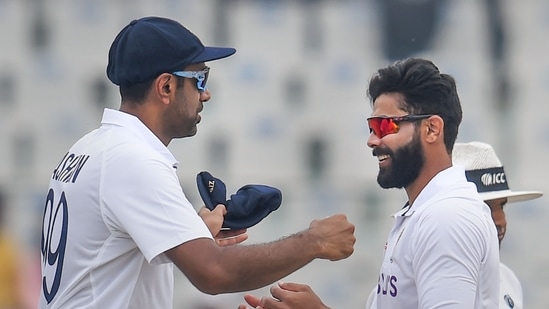
In a week where the late Shane Warne and his beguiling mastery of leg-spin were in focus, India’s finger spinners went about demolishing the Sri Lankan batting line-up in Mohali without breaking sweat. Ravichandran Ashwin and Ravindra Jadeja took 15 of the 20 Sri Lankan wickets to fall, wrapping the game in less than three days going into the second and final Test in Bengaluru.
ALSO READ | India vs Sri Lanka 2nd Test: Will Virat Kohli catch a break at second home Bengaluru?
They will most likely be joined by left-arm spinner Axar Patel at the M Chinnaswamy Stadium after he was drafted in place of left-arm wrist spinner Kuldeep Yadav. While the third spinner’s role in Mohali was undertaken by Jayant Yadav, there might have been a case for dropping the off-spinner and retaining Kuldeep in the squad just for the sake of variety. That India didn’t go down that route is entirely in sync with their preference for finger-spin in Tests ever since Anil Kumble’s retirement in November 2008.
Since January 1, 2010, India’s wrist spinners—namely Amit Mishra, Yadav, Karn Sharma and Piyush Chawla—have accounted for just 89 of the 1044 Test wickets taken by Indian spinners. Mishra took 55 wickets, Yadav has taken 26 while Sharma and Chawla claimed four apiece in the one Test that they each played. Mishra’s 20 Tests came in an eight-year span from 2008 to 2016. Yadav’s presence too has been intermittent, having played just seven Tests in the five years since making his debut against Australia in Dharamsala.
All this has led to the numbers skewed in favour of finger spin, perhaps like never before. In previous eras, India almost always had a wrist-spinner playing a big part. If the 1950s belonged to Subhash Gupte—he took 134 wickets in that decade—the 1960s and 70s witnessed BS Chandrasekhar bamboozle rivals with his devilish leg-breaks and googlies. There was a slump in the 1980s with Laxman Sivaramakrishnan and Narendra Hirwani enjoying only fleeting success, but Kumble’s entry in 1990 ensured soon enough that the tradition of wrist spin was carried forward even though he didn’t belong to the classical mould of leg-spinners.
Finger-spin doesn’t tend to evoke the same thrill as leg-spin, for the latter entails a high-risk-high reward strategy and is far more difficult to execute. But in terms of effectiveness, India’s finger spinners haven’t had any trouble in exerting their dominance. Ashwin and Jadeja have led the charge for most of the last decade, claiming 677 of the 1000+ wickets to fall to spin. Like Kumble and Harbhajan Singh in the 2000s, they simply haven’t allowed others to get much of a look-in.
“The thing is Ashwin and Jadeja have been doing so well that India haven’t needed to look at anybody else. That is why we haven’t seen a leg-spinner,” said former India left-arm spinner Maninder Singh. “I was hoping after Kumble goes that somebody will follow in his footsteps, but it hasn’t happened. In times to come, you might get a leg-spinner who could do well but probably not as well as what Kumble did. These are phases.”
It could have perhaps been a very different story provided the punt on Sharma had gone according to plan in 2014. In the first Test against Australia in Adelaide that year, Virat Kohli—standing in as captain for MS Dhoni—decided to drop Ashwin and bank on a rookie leg-spinner as his sole option. While Australian off-spinner Nathan Lyon took 12 wickets across the two innings to bowl his side to victory, Sharma returned match figures of 4/238 on debut. The experiment was duly binned, confining Sharma to just one Test appearance. His economy in that game—4.33 in the first innings and 5.93 in the second—is also perhaps a good indicator of why India haven’t gone down that route too often again.
Among the top seven Indian spinners since 2010, it’s telling that the only two with economy rates of over three are Mishra and Yadav. The left-arm wrist spinner seemed to have made the grade when he took a fifer against Australia in Sydney in 2019, but it was a false dawn as far as his Test career goes.
In white-ball cricket though, India have often resorted to wrist spin in recent times. They have multiple variations up their sleeve and tend to keep the batters guessing far more than conventional finger-spinners. It is reflected in the statistics as well. Since 2017, Yadav and Yuzvendra Chahal are leading the list of wicket-takers among Indian spinners in ODIs with 109 and 98 scalps in just 66 and 58 games respectively. The next best is Jadeja with 41 wickets in 42 games.
Yadav and Chahal established themselves after the 2017 Champions Trophy final against Pakistan, where both Ashwin and Jadeja struggled to make inroads through the middle stages. Their highs have been tempered by a few troughs since the 2019 World Cup, but they continue to hold great value with their ability to prise out wickets. It is why these two as well as leg-spinner Ravi Bishnoi featured throughout the recent limited-overs games against West Indies and Sri Lanka as India build towards this year’s T20 World Cup and the 2023 ODI World Cup. For the time being though, it is clear that India don’t see Chahal, Yadav or any other wrist spinner challenging the supremacy of their finger spinners in Tests.
 ABOUT THE AUTHORVivek Krishnan
Vivek Krishnan is a sports journalist who enjoys covering cricket and football among other disciplines. He wanted to be a cricketer himself but has gladly settled for watching and writing on different sports.Read More