Consistency is what India have been lacking in this World Cup. Five matches have seen two opening combinations and three different players bat at No 3.
The Australian women’s cricket team has now won 36 of the 38 ODIs they have played since the last ODI World Cup. This is a team that seems to have all the answers. In their first game of this tournament, they posted 310 against the defending champions, England. On Saturday, they chased 278 against India, the team that knocked them out of the last edition. In the process they broke the World Cup record for the highest chase. Pretty soon they’ll be called in to end the conflict in Europe. What chance do advancing armies stand against Ellyse Perry, after all?
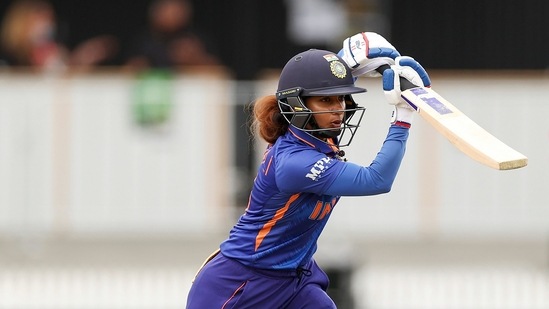
India's skipper Mithali Raj plays a shot during the ICC Women's World Cup 2022 match between India Women and Australia Women, at Eden Park, in Auckland on Saturday. (ANI )
If boring is beautiful, then Australia’s domination of this World Cup has been absolutely gorgeous. The standing wisdom is that someone needs to play really well and catch Australia on a bad day. We almost saw that on Saturday night at Eden Park.
India’s plans against Australia seemed to work for the first 50 overs. India had a left-right batting combination till the 32nd over, putting the Australian bowlers off their lines. Especially affected was Perry, who contributed the most to Australia’s 24 wides. Harmanpreet Kaur and Pooja Vastrakar provided the power at the end of the innings, and India posted 277. The only time India had scored more against Australia was when Harmanpreet blasted Australia out of the 2017 World Cup semi-final.
But an inconsistent opening spell from the bowlers, and a belligerent Alyssa Healy, was all Australia needed to negate India’s thrust. When the first wicket fell in the 20th over, Healy had 72 off 65 in an opening blitz of 121. Despite the Indian bowlers showing more discipline for the rest of the game, the damage had been done. Australia’s batters could stalk rather than sprint, and Meg Lanning’s 97 anchored Australia home. On paper, the game went down to the last over. In reality, Australia coasted.
The gap between Australia and India can be quantified statistically. Through wides, which indicate error and indiscipline. And the wides of the last few ODIs between these two teams tell a story.
In the final ODI of a three-match bilateral series played last year, India broke Australia’s 26-match winning streak, chasing Australia’s score of 264. Australia helped by conceding 31 runs through wides. India had come very close to winning the previous game too, posting 274, only for Australia to chase that total despite being 52/4 at one stage. That game too saw 17 wide runs from the Aussies. Over that three-match series, Australia bowled 67 wides. They were not at their best and India played some outstanding cricket, which put India in a position to win two games. The eventual scoreline though read 2-1 to the Australians. Even when they’re bad, they’re good.
The same narrative played out at Eden Park in Saturday’s game. The Australian bowling was not at its best. The 24 wide runs they conceded represent that. And the Indian batting took advantage. It needed a clinical, consistent performance from the Indian bowlers to shut Australia out of the game. But poor lines in the first hour, and some aggressive batting saw Australia do an Australia.
Consistency is what India have been lacking in this World Cup. Five matches have seen two opening combinations tried and three different players bat at No 3. India have scored their highest ever World Cup total and also been bowled out for their lowest since 2005. A six-bowler combination has given way to five bowlers. The team’s leading all-rounder, seemingly a sure starter, has been dropped from the XI.
All this instability and experimentation in the middle of a World Cup is hardly ideal. (So is not playing any cricket for a year amidst a pandemic, while all the other top women’s and men’s teams did.) Deepti Sharma’s exclusion has raised eyebrows, but is not totally unwarranted; with the ball, Deepti has averaged 44 runs per wicket since 2021, and with the bat has not achieved her potential. But by leaving her out and not using Harmanpreet as a bowler, India set themselves up for failure, going in with only five bowling options. On the best batting pitch the tournament has seen, against the deepest batting line-up, that was never going to be enough.
India still have their destiny in their hands. Up next is Bangladesh, and then in the last league game of the tournament, India will face South Africa, the only other team who are so far unbeaten. No one said it would be easy. And India need to ensure they don’t make it harder for themselves.


 Live Score
 Cricket Teams
 Cricket Players