


 Live Score
 Cricket Teams
 Cricket Players
Owner of Dukes ball-making firm arrives at Lord's after heavy criticism, controversy: ‘Players will have broken back…’
Dilip Jajodia, owner of British Cricket Balls Ltd., defended the Dukes cricket ball amidst criticism. He said various factors influence ball performance.

 Prefer HTon Google


Dilip Jajodia is in the eye of a storm right now, a storm not necessarily of his making but that has inexorably sucked him in. After all, he is the owner of British Cricket Balls Ltd., who manufacture the Dukes cricket ball which has been the object of much scrutiny, censure and ridicule over the last three weeks.
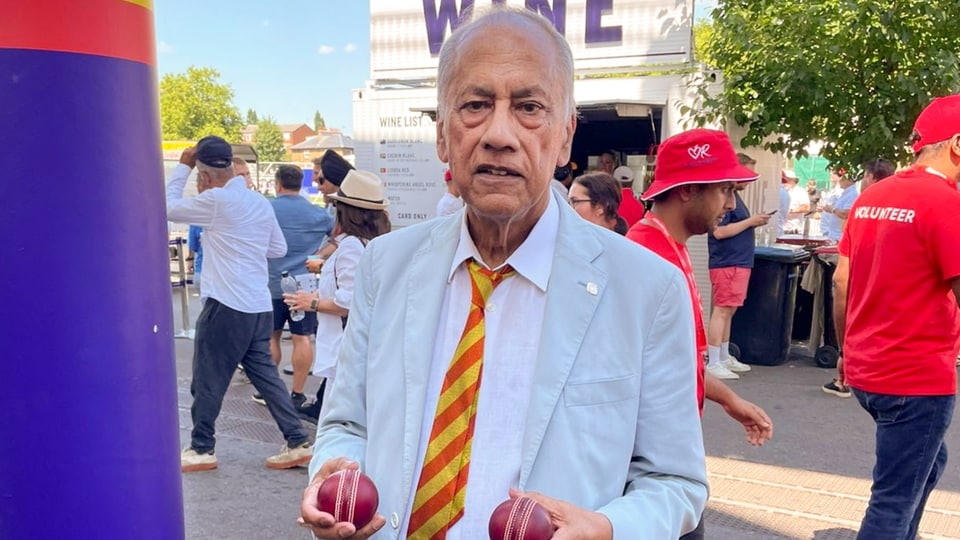
Jajodia, 81, is an alumnus of Bishop Cotton Boys’ School in Bengaluru, a city from where he has just returned to the English capital after exploring the possibility of an arrangement with the Board of Control for Cricket in India so that the Dukes can be used at a representative level in India too. He troops into Lord’s on Friday morning nattily dressed like a member of the Marylebone Cricket Club, which he is. He is also armed with a box of Dukes balls of various colours and degrees of wear-and-tear, as well as the Dukes rings – perhaps to answer Ben Stokes’ call for the Dukes ball to be tested through the hoop of the same make to determine if it has gone out of shape.
Acknowledging the recent furore over the object in question, Jajodia explains his stance matter-of-factly. “Obviously, we listen to comments and observations. But this (the ball going out of shape and getting softer) is not something unusual, it's been happening ever since cricket has been played. Not everything is static, it's not an engineered product in that sense,” he tells Hindustan Times. “Essentially, we make the balls to a standard. People often ask if the balls being made now are different from last year. No, we make the balls at a specification using the very best raw materials.
“What people must understand is that raw materials are natural. A hide, which is one cow, produces a maximum of 12 balls at Test level. A lot of cows are involved and they're not exactly the same. So, that's one essential problem. But our job is to try and select as close as possible the leather for the top-quality ball, which is what we do. And then, of course, you've got the human element (the Dukes is an entirely hand-stitched ball). The workers are not exactly the same. It's like handwriting; there might be slight variations. And that's the romance of cricket, that it's not exactly the same. We try to make it exactly the same, but it's never going to be exactly the same. Then you've got other interactions like the climate.”
Also Read | Shubman Gill slammed left and right for sparking ball-change controversy: ‘Why did he allow Siraj?’
Jajodia adds that improved bats and the harder, flatter pitches being used for the last few years for Tests in England also influence the character of the ball. “The balls are being hit harder, further, and therefore impacting things like pillars and seats and so on. All these have an impact on the ball. When you look at any ball objectively, it's a small round object and it's been battered all day. To expect that to be perfectly in shape all day is an impossibility. It can't be done, nobody can do it.
“Also, we are playing a lot of Test cricket in England on drier and harder pitches. In the good old days of English cricket where the pitches were green and moist, the gold would be on the ball after 50 overs, it would be beautifully protected. But those days are gone. And in any case, a cricket ball is supposed to go soft. You can't have a ball that stays exactly the same for 80 overs, it has to deteriorate gradually. We could produce a ball that stays hard throughout, but they (the players) will have broken fingers and broken backs.”
One of Jajodia’s suggestions is to have a new ball every 60 overs instead of the 80 in vogue. “That might be an answer -- maybe 60 or 65,” he says, though in this series especially, balls have gone out of shape after even 15 overs. “This year, the weather in England has been very unusual. And the balls might be expanding slightly. It's not about making excuses. It's a whole load of things that could influence what this small object is subjected to and could affect it.”
‘We don’t want to have our reputation tarnished': Dukes ball-making company's owner
Jajodia isn’t wishing the problem away, he insists. “I can assure you, we take this hugely seriously. We don't want to have our reputation tarnished because we're not making the product properly,” he adds. “We're making the product the best we can. And if there's an issue, there's a review at the end of the season. (But) I can't change course (now). The lead times are huge, you can't suddenly go to another batch and so on. The balls have been made. They're in the system.
“My job is to keep my head down and keep going because that's the best thing to do. The main thing is to assure people that I haven't casually put my feet up on my desk and said, ‘You know, we’ll make some rubbish this year because we're in the mood to do it’. We really do make a huge effort to get it right and it's very irritating when these problems happen.”
We tell him that the average runs per wicket in the first 30 overs this series is in the 40s, which mushrooms to the early 100s between overs 31 and 80. “I hadn't heard that statistic,” he concedes, “but all I can say is that I haven't made a ball that self-destructs at 30 overs. You can't deny the fact that it's happening. I would urge the players to be a bit patient and concentrate on what they're doing, what they're good at, and don't keep blaming something else.”
As if to buttress his point, he notes, “I supply balls in England for Test matches, country cricket, minor league cricket, universities, premier leagues, Army, Navy, all at the top end of the market. There are no compulsions, no contracts, nothing. That’s just because they want to use my product. I rest my case.”


