


 Live Score
 Teams
Teams Players
PCB vs ICC: Who pays the heavier price as Pakistan threatens world cricket with $500 million at stake?
Pakistan's boycott of the India-Pakistan match risks severe repercussions, including financial penalties and strained relationships.

 Prefer HTon Google


Pakistan didn’t just boycott a match. It effectively tried to pull a pin on the single most monetised fixture in the ICC ecosystem, the one game that inflates ad rates, hardens subscription forecasts, and props up sponsor decks across markets.
And that is why the financial plan is asymmetric. The ICC will take a commercial hit, yes, but it can spread the shock across a portfolio of matches and markets. The PCB, meanwhile, risks turning a political posture into an enforceable governance breach, with punishments designed to be sharp, precedent-setting, and painful.
The economy involved in India vs Pakistan matches
In cricket’s modern economy, India vs Pakistan is treated less as one of 55 games and more like an event asset with its own gravity. One widely circulated valuation frames the fixture at roughly $500 million (around INR 4,500 crore) when you bundle everything it triggers: incremental ad premium, sponsorship activations, ticketing value, shoulder programming and OTT acceleration.
Even if you strip away the grand umbrella number and look only at the cleanest layer, advertising alone is often pegged around INR 300 crore for an India-Pakistan World Cup clash. That figure matters because it’s the closest thing to cash on the table that vanishes the moment the match becomes a no-show.
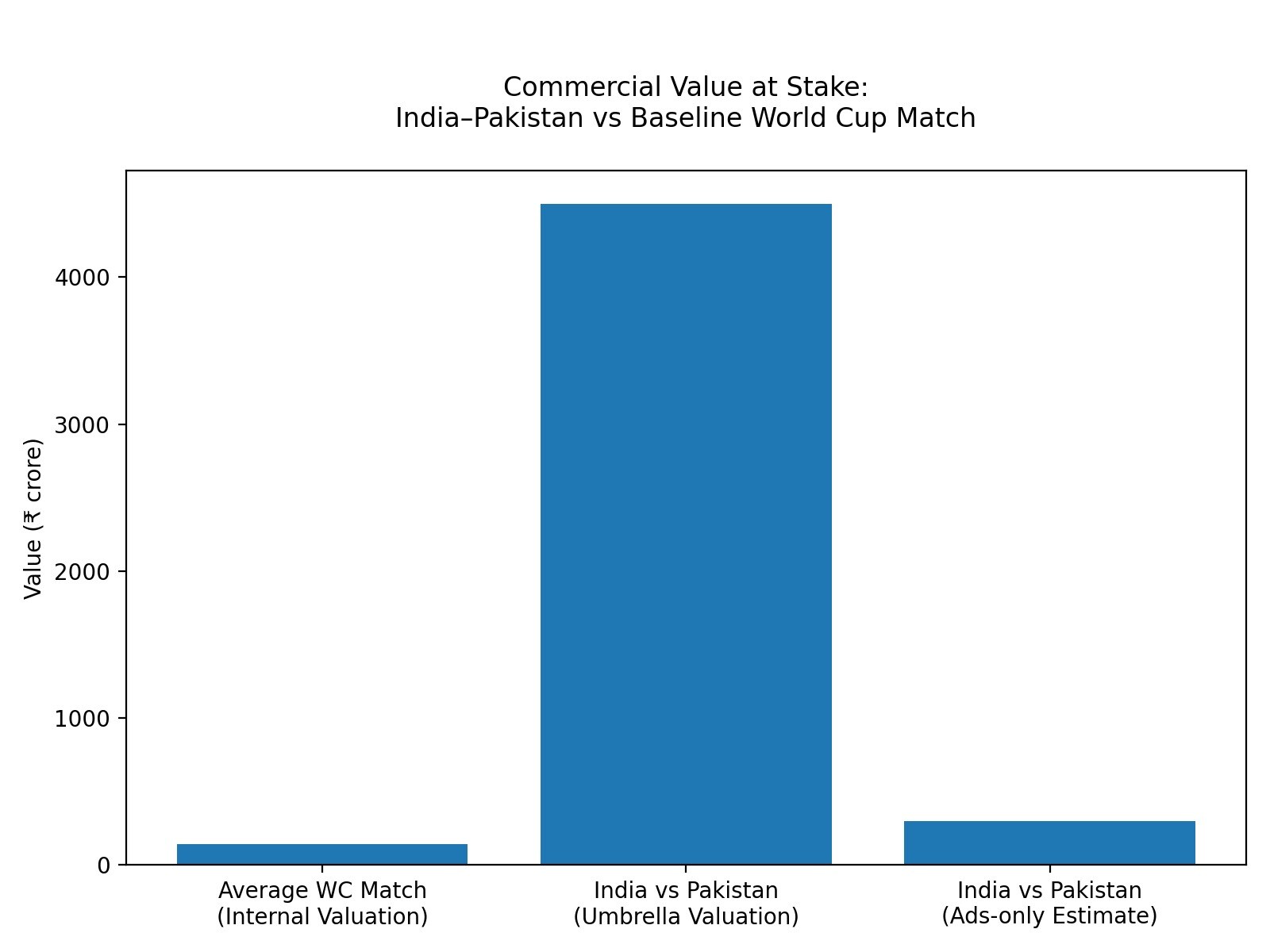
There is also a more institutional way rights-holders think about the tournament: internal match valuations. One estimate floating in the market puts the average match’s commercial value at about INR 138.7 crore, which immediately tells you what’s really happening here. If a regular match is worth roughly INR 139 crore on paper, India-Pakistan is not regular. It is the outlier that pulls the mean up - the blockbuster that subsides the boring, the spike that rescues the baseline.
So, yes the ICC loses a valuable asset if the game isn’t played. But whether it becomes an ICC crisis depends on the next question: can the ICC turn a missing blockbuster into a manageable make-good?
Also Read: Pakistan boycott India T20 World Cup match LIVE Updates: PCB maintains radio silence after government sends shockwaves
What the ICC actually loses and why it’s still survivable
The ICC’s loss is largely commercial compensation, not existential collapse.
First, broadcasters and sponsors will push for deliverable substitutions. You can’t recreate India-Pakistan, but you can redirect some of the premium inventory into India’s other games and knockouts. The ICC’s job becomes damage control: protecting long-term rights confidence while absorbing short-term rebate pressure.
Second, the ICC can still sell the tournament because India still plays. In a rights economy, the non-negotiable driver is Indian consumption. The ICC will package India momentum – group games, Super 8s, knockout scenarios and try to recapture a percentage of the missing spike through volume and storyline.
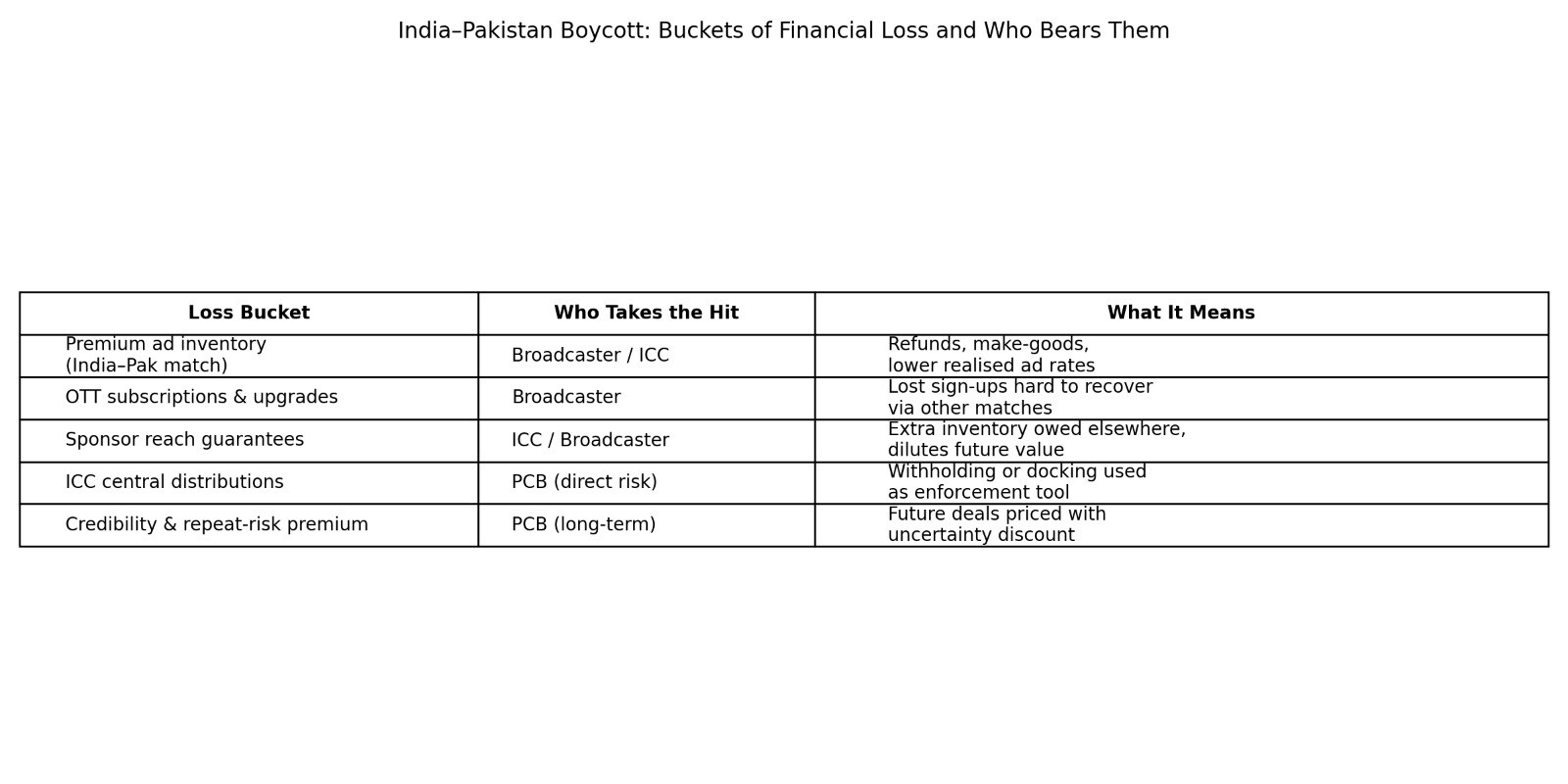
Third, the ICC’s pain is distributed. If the event takes a hit, it can be spread across future negotiations and global inventory. That is not painless. It is amortisable.
But here is the subtle problem ICC cannot ignore: if it lets a boycott go without teeth, it risks a repeat. And repeat risk is the true enemy of broadcast premiums.
What Pakistan risks - and why its structurally worse
For the PCB, the financial downside isn’t about losing one match day’s earnings. It is about triggering mechanisms that punish non-participation.
Start with central money, ICC distributions are lifelines for many boards, and the threat of withholding/docking isn’t symbolic; it is operational. Add the reputational risk: sponsors don’t like unpredictability, and boycotts are the definition of unpredictable. A brand can tolerate losing. It struggles to tolerate uncertainty.


