


 Live Score
 Cricket Teams
 Cricket Players
Virat Kohli, Rohit Sharma’s role reversal under Shubman Gill: Hitman slows down but India’s chase master hits a new gear
Rohit Sharma's ODI batting has undergone a transformation since Shubman Gill took over as India's captain. As has Virat Kohli's.

 Prefer HTon Google


Rohit Sharma’s ODI batting has always been defined by one instinct: take the game away early. For years, that intent wasn’t just visible in his shot-selection; it was measurable in his scoring rate. While he was India’s ODI captain, Rohit operated at a strike-rate of 111.97 — a number that fits his leadership-era template of powerplay dominance and relentless pressure.
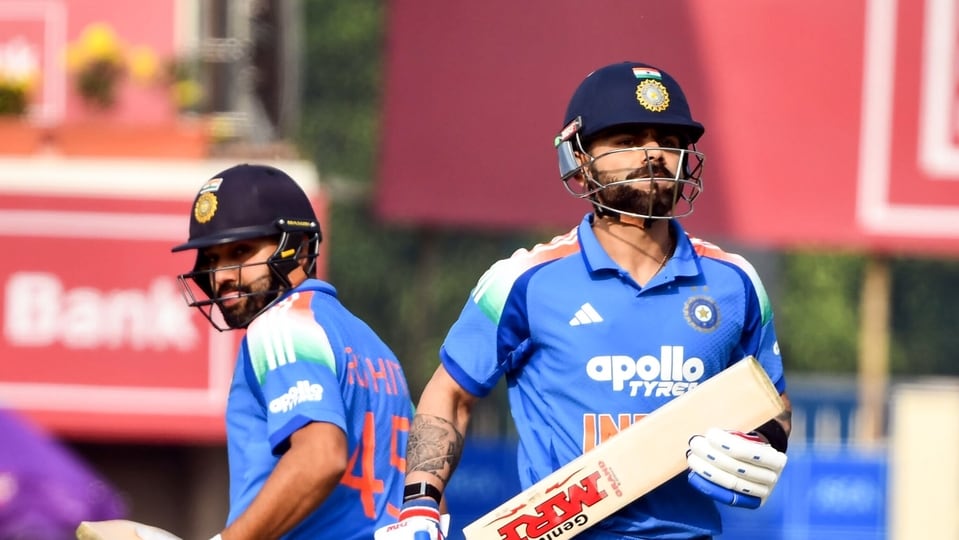
The trend since India’s ODI captaincy moved on, however, is not a simple form dip. It is a role and rhythm shift — and it shows up sharply when Rohit’s tempo is placed against Virat Kohli’s in the same post-handover window.
The numbers that frame the shift
When Rohit was ODI captain:
- Rohit Sharma strike-rate: 111.97
- Virat Kohli strike-rate: 94.67
After Rohit’s captaincy ended (Australia 2025 ODIs + South Africa 2025 ODIs + New Zealand 2026 1st ODI):
- Rohit: 374 runs off 397 balls = SR 94.21
- Kohli: 469 runs off 442 balls = SR 106.11
For Rohit, that’s a fall of almost 18 runs per 100 balls. For Kohli, it’s a rise of more than 11 runs per 100 balls relative to the Rohit-captain baseline. In ODI terms, those are not cosmetic differences; they indicate a meaningful change in how innings are being played and distributed.

Rohit’s post-handover innings: aggression has become conditional
Rohit’s strike-rate drop isn’t driven by a consistent slowdown every game. It is shaped by the kind of innings he has played when context demanded control.
The standout example is 73 off 97 in Adelaide — a classic ODI stabiliser innings that prioritises time at the crease over maximum tempo. That one knock alone pulls the aggregate down, but the bigger point is what it represents: a shift away from “default aggression” into a more situation-bound mode. Even the Sydney hundred, 121 off 125*, is commanding and chase-defining, yet built on sustained control rather than the high-octane powerplay blitz that often marked Rohit’s captaincy phase.
South Africa adds nuance rather than contradiction. Rohit still produced fast bursts — 57 off 51, 14 off 8, 75 off 73 — but the pattern remains: the aggression appears in phases, not as a constant opening mandate. The innings are more about ensuring India don’t lose the match early than about ending the contest early.
That is how strike-rate falls for a batter who hasn’t suddenly lost his range: it falls when responsibility shifts toward absorbing risk, batting longer, and responding to match state instead of imposing a single tempo every time.

Kohli’s post-handover sample: control has gained a sharper edge
Virat Kohli’s numbers are even more instructive because the post-handover window includes early failures in Australia. Two low scores should crush a small-sample strike-rate — yet Kohli still ends up at 106.11. That can only happen if the substantive innings are played at a genuinely higher pace.
The South Africa ODIs are central here. A hundred at 135 off 120 is not the old ODI Kohli template of “bat deep at 90 and cash in late”; it’s a quicker, more assertive scoring pattern through the middle overs. The follow-up 102 off 93 sustains that same intent. Most revealing is 65 off 45* — an innings that belongs to a finisher’s tempo, delivered by a batter historically associated with controlled chases.
Then the New Zealand opener reinforced the direction: 93 off 91, again above a run-a-ball in a long Kohli innings.
The comparison against the earlier baseline does the heavy lifting. During the Rohit-captain phase, Kohli’s strike-rate sat at 94.67. In the post-handover window, it is 106.11. The difference suggests not a personality change, but an evolution of method: Kohli remaining low-risk while pushing the scoring rate earlier and more consistently.
Also Read: Virat Kohli beats Kumar Sangakkara, only Sachin Tendulkar ahead: Why his scary consistency takes him beyond greats
What it suggests about India’s ODI innings allocation
The simplest reading is structural. When Rohit captained, India’s ODI blueprint often looked like a front-loaded attack: win the match by forcing the opposition into defensive fields early. Rohit’s 111.97 in that phase reflects both freedom and captaincy-era responsibility to set the tempo.
Since the handover, the evidence points to a redistribution. Rohit’s innings have leaned toward insurance value — absorbing pressure, stabilising, and shaping chases even if it costs strike-rate. Kohli, meanwhile, has increasingly become the tempo-carrying constant through the middle overs, with a stronger finishing bite than his Rohit-captain baseline implied.
In short: the data supports the thesis cleanly. Rohit has slowed materially after the captaincy moved on, while Kohli’s scoring rate has risen relative to the Rohit-captain baseline — most clearly across the South Africa series and the New Zealand opener.


