


 Live Score
 Cricket Teams
 Cricket Players
₹1.9 crore investment, ₹16.8 crore return: How an IPL 2009 investment delivered nearly nine times the payoff
A ₹1.9 crore IPL buy returned nearly ₹17 crore, with two matches alone worth more than his entire price. The numbers hid the real impact.

 Prefer HTon Google


There are IPL seasons remembered through mountains of runs, 25-wicket campaigns and awards collected at the end of a tournament. This was not one of them. The numbers beside one Rajasthan Royals all-rounder in 2009 looked almost ordinary: 243 runs, seven wickets and a team that failed to defend its title.
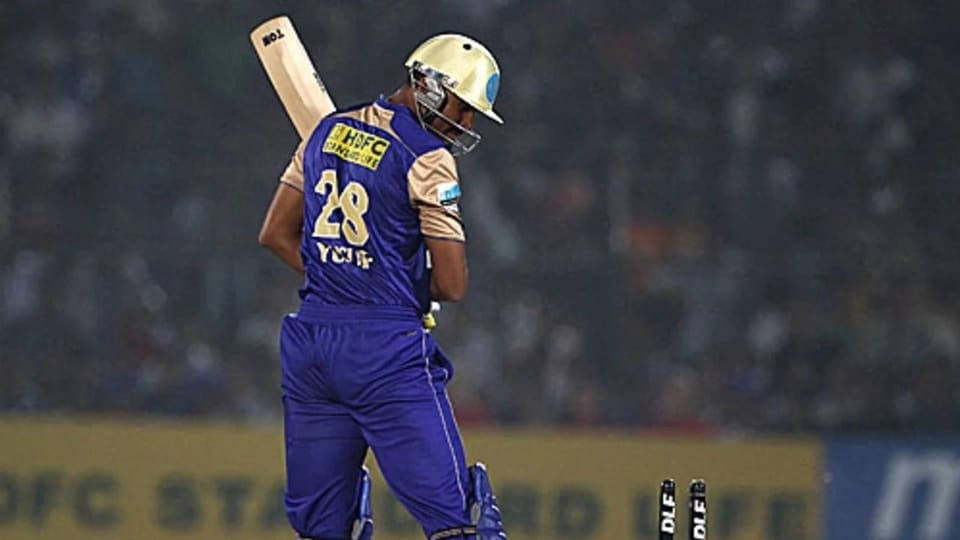
Yet hidden underneath those numbers was something extraordinary. Rajasthan had spent $475,000 on him at the inaugural IPL auction, approximately ₹1.9 crore at the exchange rate prevailing at the time, and a ball-by-ball reconstruction of his 2009 campaign using our IPL valuation model suggests that investment produced close to ₹17 crore in cricketing value.
More remarkably, there were two evenings when he appears to have produced, in a single match, more value than Rajasthan had paid for him for the entire season. The player was Yusuf Pathan, and perhaps the strangest part of his IPL 2009 story is that one of his most valuable contributions does not even exist in his official season run tally.
The four balls missing from 243
On April 23, Rajasthan Royals and Kolkata Knight Riders finished level at 150 in Cape Town. It produced the first Super Over in IPL history, with KKR scoring 15 from their six deliveries and leaving Rajasthan needing 16 to win.
Ajantha Mendis had the ball, and Yusuf had the strike. The next four deliveries went for six, two, six and four, allowing Rajasthan to finish the chase before a fifth ball was required.
Yusuf had already made 42 from 21 balls in Rajasthan's regulation innings before adding 18 from four deliveries in the Super Over. Those 18 runs, however, are not included in his official IPL batting aggregate, which is why his season record still reads 243 runs rather than 261.

Our model estimates the complete KKR performance at approximately 104.8 impact points. Once the significance of the performance is incorporated through our rating-based monetary framework, that one evening is valued at roughly ₹5.24 crore.
Rajasthan's approximate acquisition cost for Yusuf was ₹1.9 crore, which puts that performance into extraordinary perspective. The ROI model suggests that one night in Cape Town generated nearly 2.75 times the amount Rajasthan had invested in him for the entire season.
It could easily have been dismissed as a freak occurrence created by one of the IPL's most unusual finishes. Five days later, however, Yusuf produced another performance that crossed the same remarkable threshold.
Rajasthan were 64 for five while chasing 144 against Delhi Daredevils at Centurion, with the innings rapidly slipping away. Yusuf counter-attacked with an unbeaten 62 from only 30 deliveries and added an unbroken 83 with Graeme Smith as Rajasthan completed the chase with nine balls remaining.
Our reconstruction places that performance at around 101.3 impact points and approximately ₹5.07 crore in cricketing value. Those two matches alone therefore generated an estimated ₹10.31 crore of value for a player whose entire acquisition price was roughly ₹1.9 crore.
Yusuf Pathan's value came in violent bursts
That is what makes his 2009 campaign more interesting than the final numbers suggest. Yusuf was not relentlessly productive across all 13 appearances, and there were failures and quiet games in which the explosive hitter Rajasthan depended upon never truly arrived.
His value was instead concentrated in sudden interventions capable of transforming a match in a handful of overs. He was not consistently valuable in the conventional sense; when his influence arrived, it tended to arrive violently.
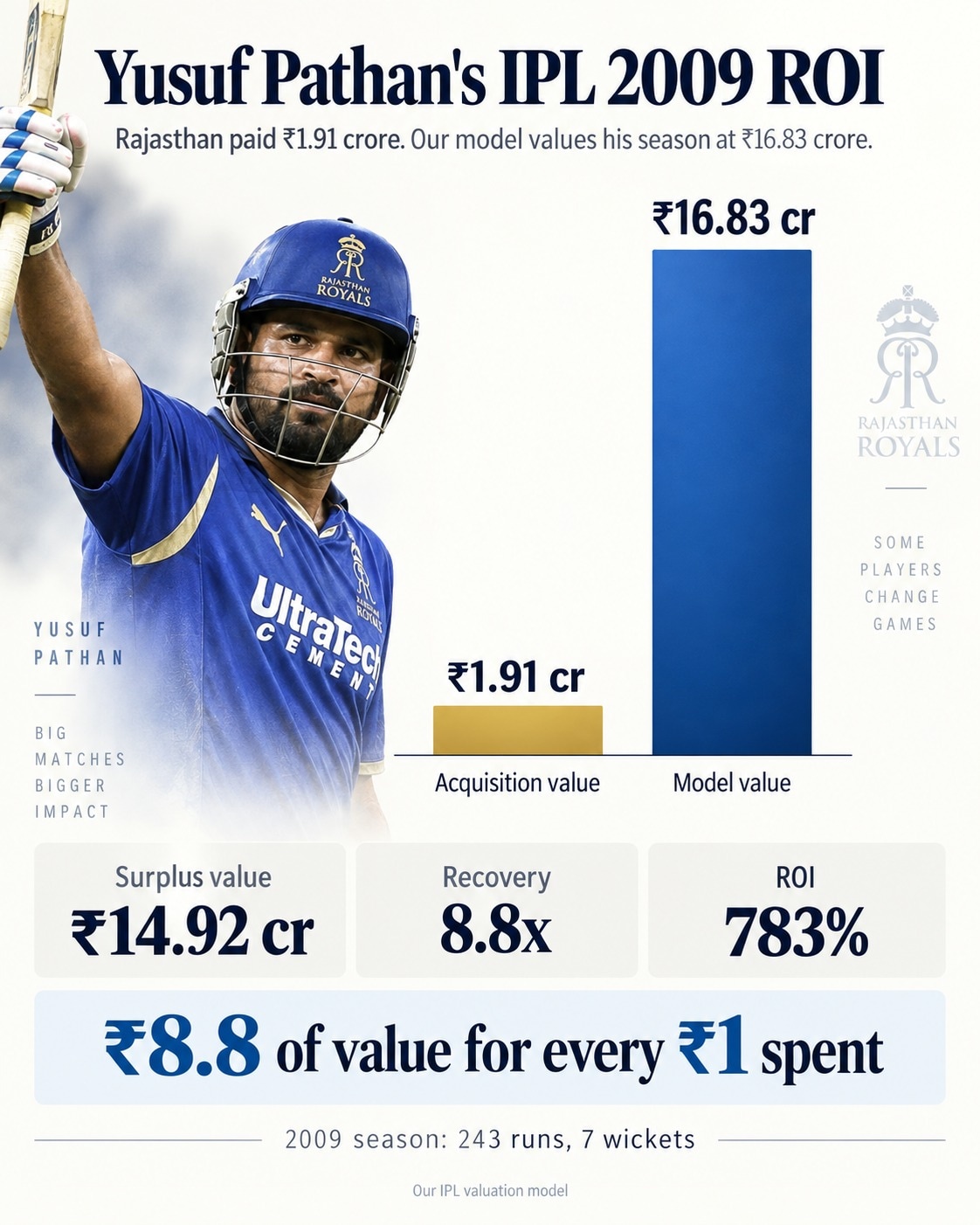
Against Chennai, 20 from 13 balls was accompanied by two wickets for 17 runs. Against Deccan Chargers, he conceded only 19 from four overs, dismissed Herschelle Gibbs and then struck 24 from 14 balls during a tense chase that Rajasthan eventually won by three wickets.
This model values that Deccan performance at approximately ₹2.13 crore. That means there were three separate matches during the tournament in which Yusuf's contextual value was roughly equal to, or greater than, Rajasthan's entire ₹1.9-crore investment in him.
Across the season, our reconstruction gives Yusuf approximately 478 impact points across batting, bowling and fielding. Converted through our monetary model, those contributions translate to approximately ₹16.83 crore of cricketing value.
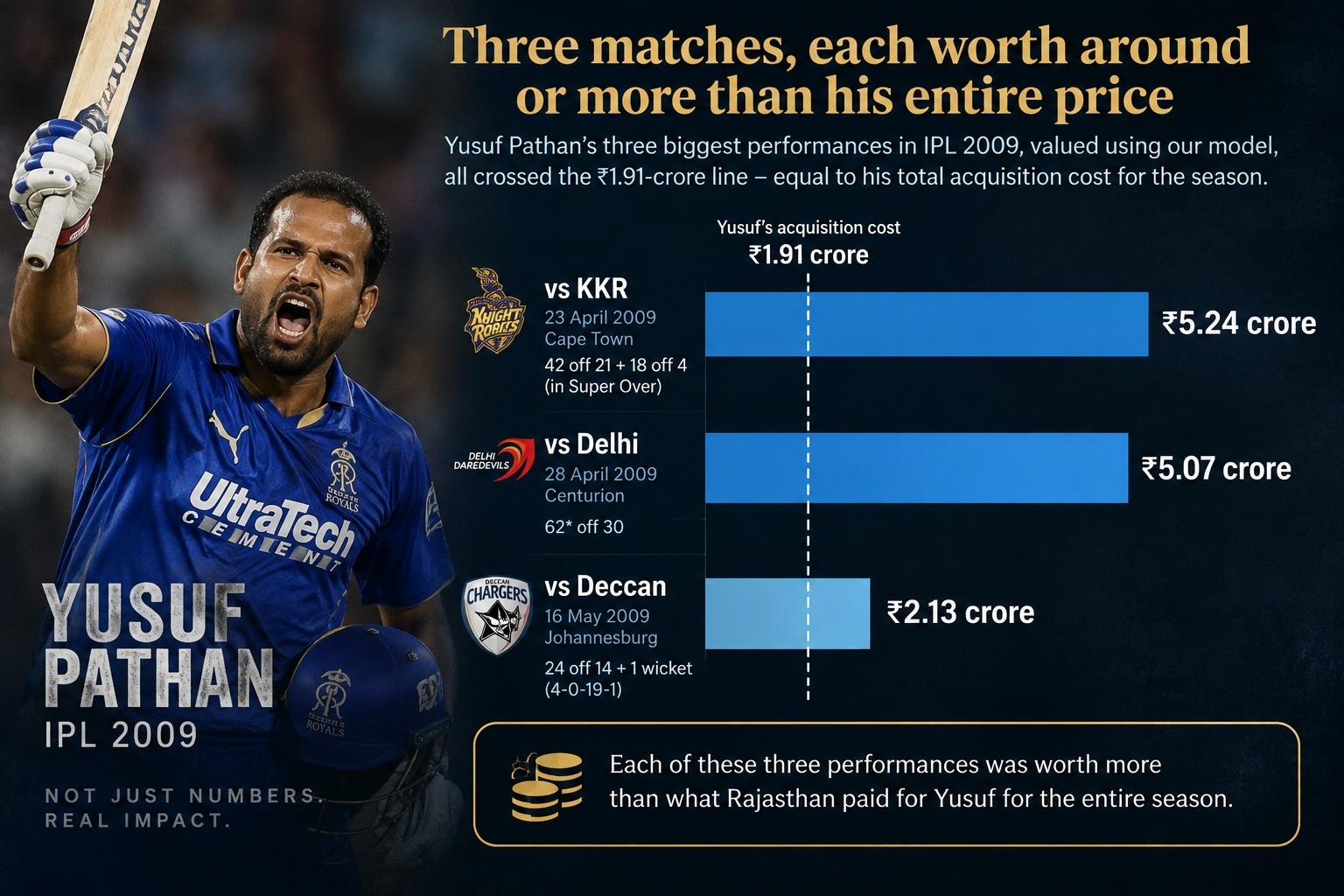
Against an acquisition value of roughly ₹1.91 crore, that leaves an estimated surplus of around ₹14.9 crore. Rajasthan received approximately ₹8.8 of cricketing value for every ₹1 invested, equivalent to an estimated return on investment of about 783 per cent.
What did ₹1.9 crore actually mean in the old IPL?
Looking at Yusuf's price through modern IPL economics can create a misleading impression. A ₹1.9-crore player today would ordinarily be viewed as a relatively modest investment, but the financial landscape of the inaugural IPL was dramatically different.
Each franchise operated with a $5 million player salary cap when the league began in 2008. Yusuf's $475,000 deal therefore represented approximately 9.5 per cent of the entire amount Rajasthan could spend on their players, meaning almost one dollar in every ten available under the cap had effectively been committed to him.
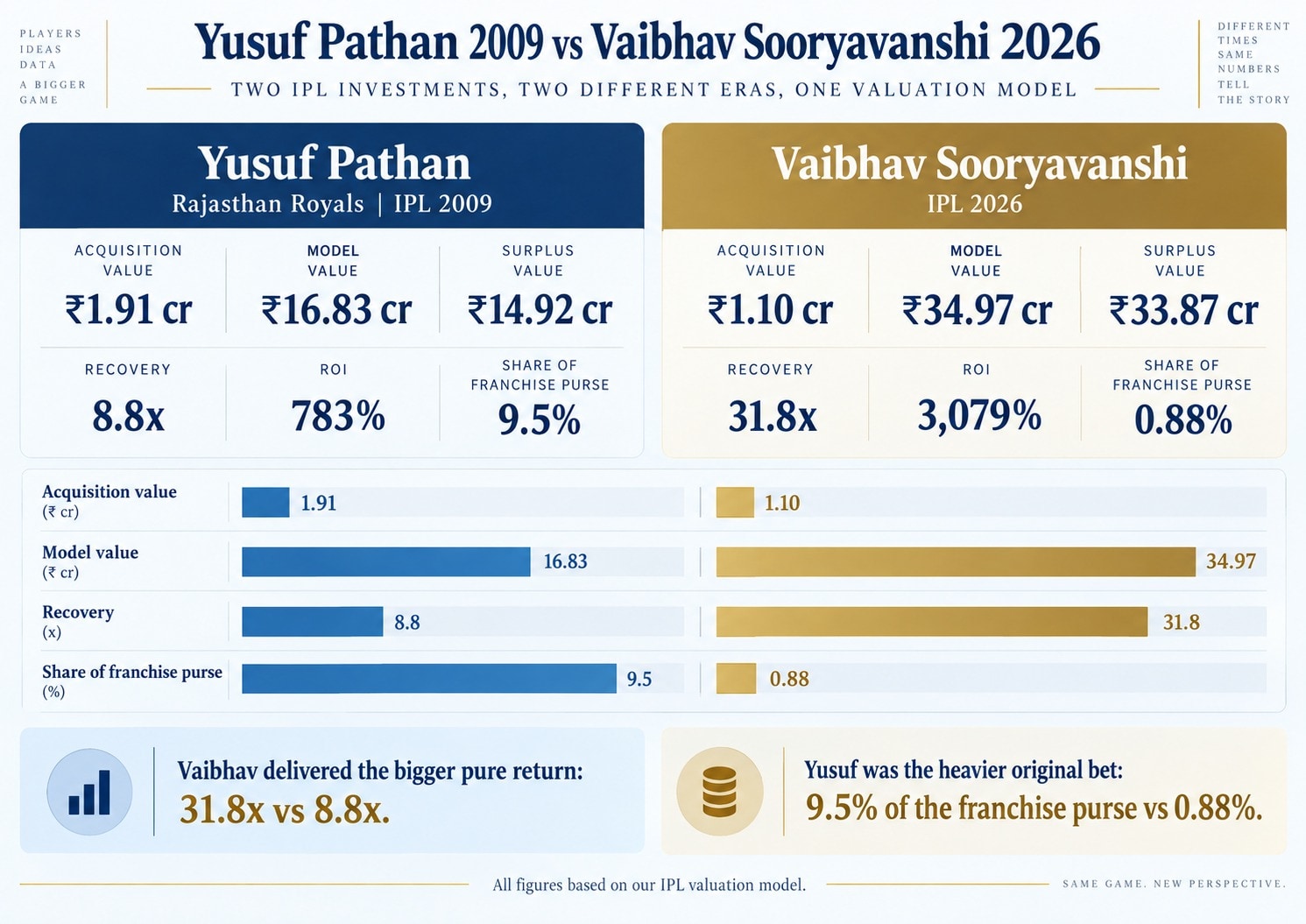
That makes a comparison with IPL 2026 useful. The auction purse had reached ₹125 crore by now, while Vaibhav Sooryavanshi's ₹1.10-crore contract represented only about 0.88 per cent of that spending power.
Our model values Vaibhav's 2026 campaign at approximately ₹34.97 crore against that ₹1.10-crore cost. That works out to around 31.8 times his investment, a considerably larger pure return than Yusuf's estimated 8.8-times recovery.
The comparison changes considerably, however, when the original investment is viewed relative to what the franchise could afford. Yusuf accounted for nearly 9.5 per cent of Rajasthan's player budget, while Vaibhav occupied less than one per cent of the modern purse, making Yusuf almost 11 times more expensive relative to the financial resources available to his franchise.
That distinction makes Rajasthan's return particularly striking. Yusuf was not a tiny speculative purchase who unexpectedly exploded; he represented a significant share of the franchise's available spending power, yet the model still estimates that the investment produced nearly nine times its value.
It also offers a useful warning when comparing IPL prices across eras. A ₹2-crore player from the league's earliest years cannot be treated as economically equivalent to a ₹2-crore player in 2026 simply because the number printed beside the name looks similar, because the proportion of a team's available resources could be radically different.
Strip away the context and Rajasthan still win
The ₹16.83-crore figure partly reflects the contextual element of the model. Match-changing performances in difficult situations receive more value per impact point than statistically similar contributions made when the direction of a contest has already been established.
There is, however, a simpler test that removes that layer entirely. Give each of Yusuf's estimated 478 impact points the model's neutral valuation of ₹2 lakh per point and his season is still worth approximately ₹9.56 crore.
That is around five times the ₹1.9 crore Rajasthan had invested in him. Even after stripping away the element most open to interpretation, Yusuf remains an exceptionally profitable piece of Rajasthan's 2009 squad.
It also explains why 243 runs and seven wickets tell such an incomplete story. A conventional season table records volume, but it cannot easily distinguish between runs made in a lost cause and runs that rescue a collapsing chase, while it also has no place in a player's official aggregate for four Super Over deliveries that directly decide a match.
Yusuf Pathan's 2009 campaign was not one of the biggest seasons the IPL has ever seen when judged purely by conventional totals. This method suggests, however, that its value was far greater than its statistical footprint would indicate, especially considering how substantial his price was within the economics of the original IPL.
Rajasthan spent roughly ₹1.9 crore on him and the monetary model puts the return at almost ₹17 crore. Perhaps the most fitting detail is that one of the sequences responsible for that enormous return never became part of his official 243 runs at all, because four deliveries against Ajantha Mendis disappeared from the season aggregate even though they decided the match: six, two, six and four.
These are modelled values rather than money actually earned by Rajasthan or Yusuf. Our model attempts to attach a monetary value to a player's influence on matches and compare that output with what his franchise paid to secure him, allowing performances from very different parts of a season to be viewed through the same value framework.


