


 Live Score
 Teams
Teams Players
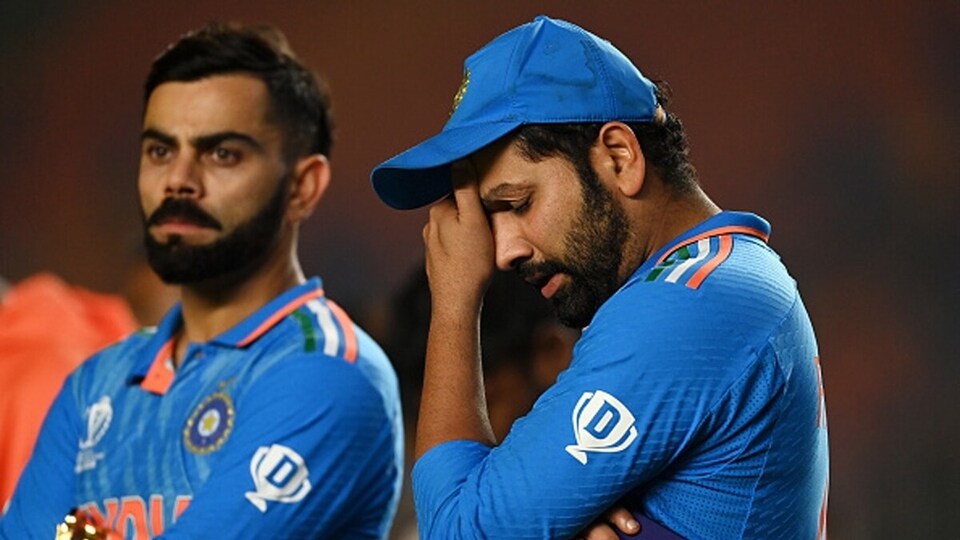
Four boundaries in 40 overs: Team India's worst nightmare comes true on the biggest day of their lives
Australia completed the formalities but they had essentially won the game between overs 11 to 50 of the Indian innings, where they conceded just 4 boundaries.

 Prefer HTon Google


It may not have been a 5/3 type of a collapse, but a capitulation of sorts nonetheless. As the entire nation plunges into disappointment, heartbreak, sombreness and collective grief following India's defeat in the final of the World Cup, scribes, including yours truly, will dwell into reasons behind this outcome. Was it the toss? Conditions? Dew? Rohit Sharma's shot? Virat Kohli's dismissal? Or KL Rahul's? No, the answer is primarily two numbers. Only four boundaries were scored in the final 40 overs of India's innings. And frankly, that right there marked the biggest point of no return.
Here's some trivia around it. Let this sink in. Of those four boundaries, Mohammed Shami and Mohammed Siraj hit two. It is the joint-fewest by India in a completed innings since July 2011. The last time they hit fewer boundaries after the 10th over of an ODI innings when they batted at least 40 overs in total was in 1999. There was no coming back. This may not exactly fall in the timid or the fearful category but it certainly wasn't the bravest either. After Pat Cummins won the toss and opted to bowl, Rohit knew it was advantage Australia, and that his 'we were looking to bat first' was nothing more than just a cover up. Simply put, the pitch behaved in three different ways throughout the contest. To put it into further perspective, it was as if India's innings began on a Day 3 Nagpur surface, ended on Day 5 approximately five hours later and then transformed into a whole other Day 1 Adelaide pitch when Australia batted.
Throughout India's innings, only one narrative did the rounds – on the commentary box and social media alike. If no dew, 240 is a competitive total. If no dew, Australia could be made to look chasing 300. Or how Kuldeep Yadav and Ravindra Jadeja would eat them up. Breaking news: Both spinners went wicketless and there was almost little to no dew. Yet Australia cantered home with seven overs to spare. In order to gauge the stark difference as to how the pitch behaved in the two innings, look no further than how Marnus Labuschagne kept dabbing balls around for singles, while Rahul couldn't. Every time the latter tried to give the ball direction, or tried to open his bat face, the ball went either uppish or straight to the fielder. At one point, it had become so irritating that even singles were being egged on like a Rohit pull shot for six.
I say Rahul, because Kohli's 54 came at the strike-rate of 85.71. As long as he was batting, even if the boundaries had dried up, Kohli kept hopes alive that at some stage, he would take off. Kohli's role in this World Cup had been that of an anchor, and with Rohit, Shubman Gill and Shreyas Iyer gone, the stage was set for him to play till the end of the innings. The frustrating wait grew. The overs progressed from 15 to 20… and then 25; without that damned boundary as the Ahmedabad crowd's decibel levels, which had reached a peak seeing Rohit on song, had gone, dropped incredibly. In the 29th, Kohli played on. Sucker punch.
Between over 11 and 40, Australia picked three wickets for 80 runs, India scored 117 at a run-rate of 3.90 as opposed to their mid-overs scoring rate of 5.72 throughout the tournament. And truth be told, it was game over by then. A lot of it should be attributed to Australia's freak fielding but then again, watching a team that has consistently posted substantial totals struggle to find boundaries or even milk singles as the run rate gradually came crashing down from seven an over to less than five, was extremely uncomfortable. Rahul's snail-paced innings was a bigger letdown. He has taken responsibility whenever India have lost early wickets but the version of him that turned up on Sunday was eerily similar to the what he so desperately has tried to move away from. He was rushed, looked unbalanced against Starc and Hazlewood and looking to play full 50 overs, entered the proverbial shell. Rahul is a fine batter against spin, doesn't fall for traps. He uses his feet to go square of the wicket, and in front of it. Yesterday, the little lapse in approach prevented all that from happening.
So, why this overcautiousness? Because contrary to the general belief, India's batting doesn't run as deep. Neither was it tested. Suryakumar Yadav is a misfit in ODIs – he batted for 12 overs, six with the tail – and Jadeja has been found wanting against quality spin and reverse swing. The vulnerability which after Hardik Pandya's absence was so well guarded until now, Australia exposed it. Hence, India's obsession with either a Shardul Thakur or an Axar Patel as a caution at No. 8. With neither around, nor Ashwin, Rahul was forced to take a more restrained course, which even spilled on to his wicketkeeping as he regularly struggled to contain byes.
Should Rahul and Kohli have shown more intent? In a perfect world, and more so on a perfect pitch, surely. But they were totally risk-free. 2021 T20 World Cup group stage, 2022 T20 World Cup semi-final. Time and again, it's the meek batting surrender that's killing this team. You can't expect to bat till 40 overs without a boundary and expect the opposite in the last 10. The negativity that set into Kohli, Rahul, Jadeja is inexplicable. They simply shut shop. It was tentative, underconfident and strange. It's been a problem that's been masked by Rohit's brilliance, and Kohli and Shreyas' ability to put up runs.
Besides, the sluggish and tacky Pitch 5, expected to play in India's favour, backfired. The home team has a say in deciding the kind of surface they want to play on, but in this case, the team management erred in its assessment. Given that batting is India's strength, the reason behind opting for a surface that encouraged a stop-and-wait route remains unclear and may never be known. When the dust settles and the players are able to put this result behind – and they will, because sport is about moving on – hopefully the guys won't beat themselves up over it. Nevertheless, they may just however reflect on those 40 overs of adversity in hindsight.


