


 Live Score
 Teams
Teams Players
Would Virat Kohli be fastest to 12k runs in another era?
Would Kohli have scored his 12,000 runs as quickly as he did if he played during Tendulkar’s time? One may never know for sure – but an HT analysis looks at the changing scoring patterns one-day internationals to try and answer the question.

 Prefer HTon Google


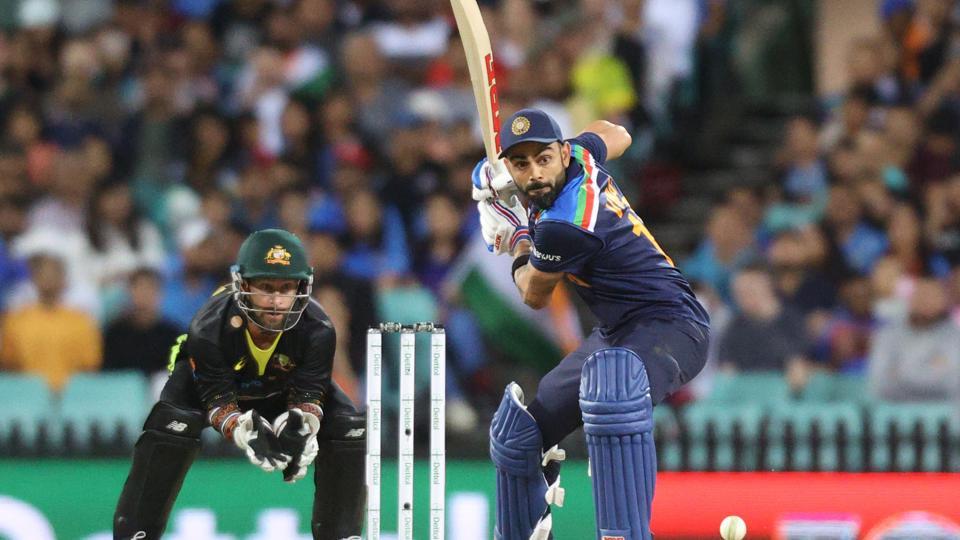
Earlier this month, India’s Virat Kohli became the fastest to cross the 12,000-run mark in One Day Internationals (ODIs), breaking a 17-year record held by Sachin Tendulkar. Kohli took 242 innings to reach the milestone whereas Tendulkar scored 12,000 runs in 300 innings. However, Tendulkar started playing ODIs in a different era – from 1989 to 2012. Kohli started playing ODIs in 2008. Would Kohli have scored his 12,000 runs as quickly as he did if he played during Tendulkar’s time? One may never know for sure – but an HT analysis looks at the changing scoring patterns one-day internationals to try and answer the question.
1. ODIs are more high-scoring in Kohli’s time than they were in Tendulkar’s
The first ODI was played on January 5, 1971 between England and Australia. It was a 40-over game, with each over consisting of eight balls. England were bowled out for 190 runs, and Australia scored 191/5 in 35 overs for an average inning score of 190.5. The average inning score of the first 100 ODIs (what was the 100th ODI? – give date and teams), including the first one, was 188.
The average score in an innings has increased sharply since then. The average innings score of the last 100 ODIs (from xxx date to Dec 2, 2020) was 241. At the time of Kohli’s first ODI innings (August 18, 2008), this number was 216. On December 18, 1989, when Sachin Tendulkar made his ODI debut, the average innings score of past 100 ODIs was 207.
See Chart 1: Average score of an ODI innings over time
These numbers suggest that changes in the format’s character over time have likely aided batsmen in scoring more runs. How do we then compare batsmen playing at different times? One way is to adjust the runs of all players for the average runs being scored at the time. For example, if someone scores a century today, they would be doing it at a time when the average innings score is much higher (241) than in the first 100 ODIs (188). By that calculation, a century score today would be roughly equivalent to (100 x 188/241) 78 runs during the first 100 ODIs.
2. Kohli drops slightly among top-scorers if changes in scoring pattern are taken into account
To compare batsmen playing at different times, HT has calculated the adjustment factor (as shown above) for all the 4,267 ODIs played since 1971. The numerator in the factor was the average innings score of the first 100 ODIs– 188 runs. The denominator was the average of the previous 100 ODIs up to the ODI for which the factor was calculated. We then used this factor to adjust the score of each of the 2,619 players in the ESPN Cricinfo database in each match.
To be sure, such a method does not account for the fact that the changes in cricket rules have not been uniform. Earlier, ODIs were of different lengths – 40 overs to 60 overs -- with each over consisting of eight to six deliveries. This would allow a batsman to bat longer in an innings. At the same time, the early ODIs also used only the red ball, were not played at night, and had no fielding restrictions, powerplays or free hits. As Chart 1 suggests, on a long time scale, all these effects seem to have added up to an advantage for batsmen.
Accounting for the changing scoring pattern, the top run-getters in ODIs – those who have crossed the 10,000 mark – remain the same 14 players, but their ranking changes a little. The top five scorers remain the same and in the same order: Sachin Tendulkar (1989-2012), Kumar Sangakkara (2000-2015), Ricky Ponting (1995-2012), Sanath Jayasuriya (1989-2011), and Mahela Jayawardene (1998-2015). Virat Kohli (2008-present) drops from 6th to 9th, his runs now amounting to 9,945. Sourav Ganguly (1992-2007), Inzamam-ul-Haq (1991-2007), and Jacques Kallis (1996-2014) – in the 11,000 club that Kohli has now left behind – end up ahead of him.
See Charts 2A and 2B: Top run-getters (recorded, and adjusted)
3. Yet Kohli remains one of the fastest scorers
Though this adjustment reduces Kohli’s cumulative runs until now, he remains a quick scorer -- the fastest to 6,000, and to every subsequent 1,000-run mark by a large margin. The adjustment, however, slows down his race to earlier milestones. By the adjusted calculation, former West Indies batsman Brian Lara is the fastest to the 4,000- and 5,000-run milestones -- a record also currently held by Virat Kohli.
On the other hand, accounting for the times he played in, accelerates Sachin’s early innings to get him into the top-four for every 1,000 (check).


