
 E-Paper



At 402, Delhi AQI breaches severe category again
India Meteorological Department said stubble burning incidents are now negligible but local pollutants accumulated in the atmosphere have not been able to disperse because of unfavourable weather conditions.

 Prefer HTon Google


Delhi’s air quality deteriorated to the “severe” category on Saturday with the city recording an Air Quality Index (AQI) of 402 at 8 am. The average AQI on Friday was 382. At least 17 of the 35 monitoring stations recorded “severe” category air quality from Friday evening.
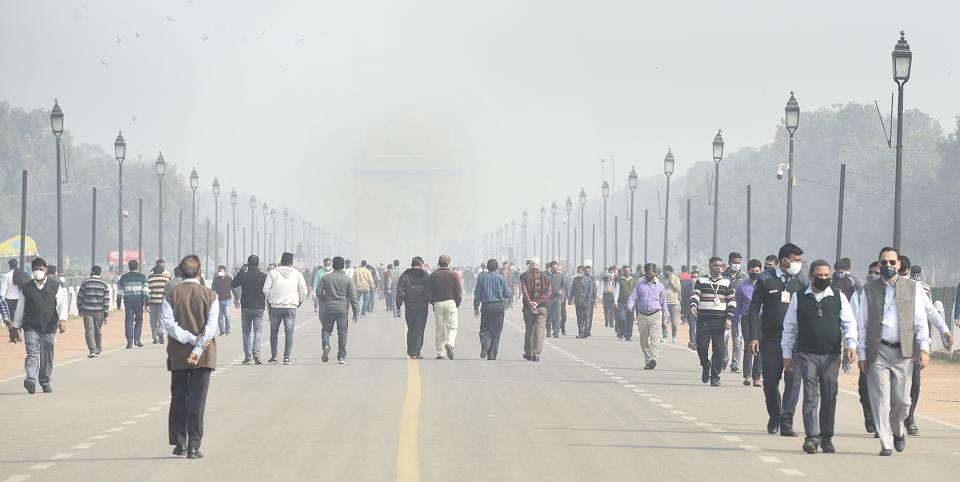
On a scale of 0-500, an AQI value between 301-400 is considered “very poor” while 401-500 is “severe”.
Government agencies had warned the air quality will deteriorate because of a change in wind pattern and slowing down of winds. The situation is likely to remain the same over the weekend.
India Meteorological Department (IMD) said stubble burning incidents are now negligible but local pollutants accumulated in the atmosphere have not been able to disperse because of unfavourable weather conditions.
“The wind direction changed to easterly from north-westerly. Whenever there is a change in wind direction, it impacts the air quality as winds turn calm for a while and do not allow dispersion. The night temperature is also below normal, which again is not favourable for dispersion. Also, there was increased moisture because of easterly winds, which further traps pollutants close to the ground resulting in deterioration in air quality,” said an IMD scientist.
He added any improvement is likely after December 7 when north-westerly winds are likely to return. “From December 7-9, there may be an improvement in air quality as winds speed is expected to remain on the higher side,” he said.
On Friday, Delhi recorded a minimum temperature of 8 degrees C, a notch below normal. The maximum settled at 28.8 degrees C, four notches above normal.
The System for Air Quality and Weather Forecasting and Research (SAFAR) said the share of stubble burning to the city’s PM 2.5 levels was just 1%. “The air quality is likely to deteriorate further over the next couple of days because of reduced ventilation and increase in moisture. However, it is likely to recover around December 6-7 with the return of good wind speed,” the SAFAR said.
After the annual peak pollution in November, which is mostly attributed to stubble burning, bad air episodes are seen towards December-end and early January. This is mainly because meteorological conditions are even more unfavourable during this time while the baseline pollution (local emissions from Delhi and neighbouring regions) stays the same. This includes local waste burning, industrial fumes, vehicular emissions and dust suspension.


