
 E-Paper



Covid test price capped at ₹2,400 in Delhi
The committee’s report, given to the union health ministry on Wednesday, has been sent to the Delhi government to implement the decision, which will bring down the rate of testing by ₹2,100, from the current ₹4,500. “The report has been sent to Delhi government for necessary action,” a ministry of home affairs (MHA) spokesperson said.


In a major decision, a high-powered committee formed by union home minister Amit Shah on Sunday under the chairmanship of Niti Aayog member VK Paul has decided that the rate for the RT-PCR tests for Covid-19 in Delhi should be fixed at ₹2,400 “to provide relief to the common man”.
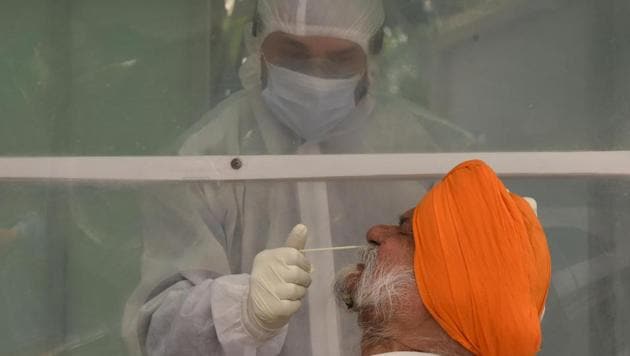
The committee’s report, given to the union health ministry on Wednesday, has been sent to the Delhi government to implement the decision, which will bring down the rate of testing by ₹2,100, from the current ₹4,500. “The report has been sent to Delhi government for necessary action,” a ministry of home affairs (MHA) spokesperson said.
In a meeting chaired by Shah on Sunday morning, which was attended by Delhi chief minister Arvind Kejriwal and union health minister Dr Harsh Vardhan, it was decided that the VK Paul-led committee will look into both—thethe rates of testing and the treatment of coronavirus disease (Covid-19) patients in private hospitals, who are being charged huge amounts.
It has also been decided that from Thursday, Covid-19 tests will be done via new the Rapid Antigen methodology approved by the Indian Council of Medical Research (ICMR). Delhi would receive these kits on “priority”; 169 centres have been set up across the national Capital for this purpose. The MHA spokesperson said this is in line with Shah’s directive to increase testing and deliver test results quickly in Delhi.
It was decided in the Sunday meeting that testing will be increased three-fold in the national Capital.
The home ministry said on Wednesday that following Shah’s intervention, Covid-19 testing has increased at least four times in Delhi.
It said that on June 15 and 16 alone, 16,618 samples were collected in Delhi for testing. This number varied between 4,000 and 4,500 before the Sunday meeting (June 14). The MHA spokesperson said that reports of 6,510 tests of the 16,618 have already been received, while the rest will be received by Thursday.
The decision to lower the price of RT-PCR tests in the Capital was based on the report of AIIMS Director Dr Randeep Guleria and NITI Aayog member Dr VK Paul. The committee had submitted its report on Monday after meeting with three private laboratories and four private hospitals where Covid-19 patients are treated on Sunday.
One of the representatives of a laboratory present in the meeting said, “This is unexpected. The committee had heard us out and was receptive to our suggestions. This rate is just not enough for a sample that we collect from home. There is so much ancillary cost involved and ₹2,400 just does not cover it.”
The representative of another lab present at the meeting with the committee said, “The government has to look at a differential pricing like the one currently in place in Delhi. The cost for testing a sample collected by Delhi government is low, but for the ones that we collect from homes, we charge ₹4,500. If the government reduces the cost of the samples provided by it to ₹2,400, we will be able to manage somehow, now that the cost of the kits and PPE has gone down. But, if this is the cost for the samples that are collected at homes as well, we will not be able to survive for long. Plus, if the government wants us to expand our testing capacity, we need to be able to recover money for the additional machines and manpower.”
The Delhi government has so far paid ₹2,200 for providing samples and kits to private labs, ₹3,500 for just the samples, and ₹4,500 for the samples that were collected by the private labs while they used their own kits.
Delhi begins rapid testing in containment zones on Thursday, results in 30 minutes
Delhi will ramp up testing on Thursday by using rapid testing kits to detect Covid-19 infection in the 242 containment areas of the city to quickly diagnose and contain cases in the community, according to officials from Delhi’s health department.
This antigen diagnostic test, which costs ₹450 and takes 30 minutes to produce results, was approved for use in India on Monday.
The RT-PCR tests take six hours to produce results in lab settings, which meant district authorities had to send samples to laboratories and wait for 24-48 hours to get the results.
The government has already received 50,000 of the 6 lakh kits ordered, which will be sent to the district teams by Wednesday evening.
The district teams in the city have been asked to identify testing centres within or around containment areas. So far, 169 such centres have been identified for testing. “The testing centres will be set up in community halls, dispensaries or mohalla clinics where the people from the community will be brought in for testing. We will know the report then and there,” said one district official, on condition of anonymity.
Four-member teams have been formed to collect the samples. “A nasal swab has to be collected for the antigen test as well, just like the samples collected for RT-PCR test. The test is quite simple, but it cannot be done door to door because a cold-chain has to be maintained for the kits,” said another district official. The kits have to be kept between 2 and 30 degrees Celsius.
The test can be interpreted between 15 and 30 minutes.
The ICMR on Monday gave a go-ahead to the point-of-care test kit of a South Korean company (manufactured in Manesar) to be used in containment zones and hospitals for speedier diagnosis.
In its evaluation, the ICMR said that the test has a high specificity (ability to detect tur negatives) but the sensitivity (or ability to detect true positives) is between 50.6% to 84%, depending on the viral load of the patient. So, those who test negative need to undergo a second confirmatory RT-PCR test, but those who test positive will be considered to be “true positive”.
ICMR recommends the test be used in containment areas for those with influenza-like symptoms or asymptomatic people who came in contact with a positive case between 5 and 10 days of exposure. In hospital settings, the test can be used for those who have influenza-like symptoms or on asymptomatic patients undergoing chemotherapy, who are immune-compromised, have cancer, are transplant patients, or the elderly. It can also be used for patients undergoing surgeries and procedures.
“At the community level, whatever test we do has to be highly sensitive, false positives are okay. The sensitivity of this test and that of RT-PCR is almost similar; the sensitivity of RT-PCR is about 67%. But, the antigen test is faster and cheaper, so we can test more people. This means that we will be able to detect more cases at an early stage and ask them to remain in isolation, thereby preventing further spread in the community,” said Dr Jugal Kishore, head of the department of community medicine at Safdarjung hospital.

Stay updated with all top Cities including, Bengaluru, Delhi, Mumbai and more across India. Stay informed on the latest happenings in World News along with Delhi Election 2025 and Delhi Election Result 2025 Live, New Delhi Election Result Live, Kalkaji Election Result Live at Hindustan Times.


