Until early Sunday, Delhi witnessed a mass exodus—thousands of migrant workers on their way back to villages and towns hundreds of kilometres away—either in buses arranged by other states or on foot.
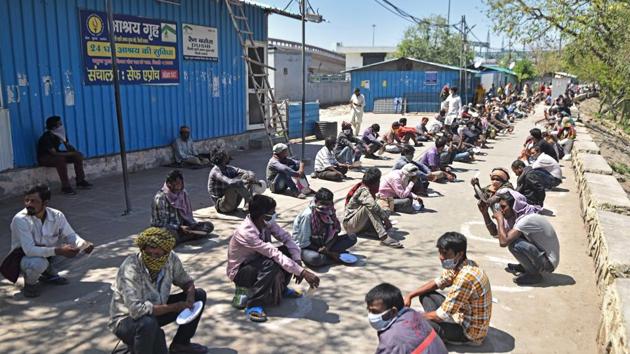
By 7am Sunday, the state borders were sealed and orders were issued by the central government directing states to screen all migrants including both groups, the one that was part of the exodus and the other that stayed back in government-run shelters.
The screening required thermal scanners—a device that accurately records and reflects a careful analysis of body heat, an indicator that can be used to test an individual for potential infection of Covid-19, the disease that has claimed thousands of lives across countries.
Click here for the complete coverage of the Covid-19 pandemic
“But, in Delhi, at such short notice, logistics are a problem,” a senior government official said.
So the 234 night-shelters in Delhi—which are currently occupied by around 8,000 homeless persons and 12,000 migrant workers who became homeless due to the 21-day lockdown imposed last week to prevent the spread of Covid-19—are currently managing with ordinary mercury thermometers for this purpose, a government official said.
{{/usCountry}}So the 234 night-shelters in Delhi—which are currently occupied by around 8,000 homeless persons and 12,000 migrant workers who became homeless due to the 21-day lockdown imposed last week to prevent the spread of Covid-19—are currently managing with ordinary mercury thermometers for this purpose, a government official said.
{{/usCountry}}Also Read: India’s coronavirus cases hit 3,000; two die in Delhi
“We have procured 1,200 thermometers so that each night shelter gets at least five. The teams supervising these shelters have been instructed to assess body temperatures only by putting the thermometers in the armpits of the inhabitants of the shelters, not their mouths. After each reading, the thermometer has to be disinfected,” Bipin Rai, member of the Delhi Urban Shelter Improvement Board, said.
Rai further said, “Thermal scanners may take time to reach the shelters considering logistic issues during the lockdown. We have asked the revenue department to provide us with at least one thermal scanner per night shelter. Till then, we shall have to use thermometers and maintain records.”
A senior official in the Delhi chief secretary’s office said: “Yes, logistics are currently a problem. But we are doing our best to provide thermal scanners in these shelters. Currently, the government quarantine centres have them.”
“Traditionally, body temperature has been measured using contact thermometers that are placed on the forehead or in the mouth, ear, armpit or rectum. Non-contact thermometers allow a person’s temperature to be taken with minimal (tympanic) or no (non-contact infrared thermometer [NCIT], thermal scanner) contact with the person. This means the temperature can be measured without the discomfort of having to sit still with a thermometer in the mouth, armpit, or rectum long enough to obtain a correct temperature reading,” Satender Singh, a doctor at Delhi government’s GTB Hospital, said.
Also Read: Lack of PPE, poor infection control put medical staff at risk of Covid-19
He further said: “The lack of contact also means the disinfection process of thermometers is minimal or unnecessary, allowing for easier and faster use when screening large numbers of people in settings such as airports or border crossings. The main types of non-contact thermometers are non-contact infrared thermometers, tympanic thermometers, and thermal scanners.”
“As far as accuracy is concerned, there is not much difference in case of a thermal scanner and a thermometer when placed in the armpit or below the tongue. It is only the rectal reading that provides a better assessment of core body temperature. But that would be immensely risky at this juncture,” Singh added.
While the price of an ordinary thermometer starts at ₹100, thermal scanners start from ₹600, said dealers contacted by HT on Thursday.
Stay updated with all top Cities including, Bengaluru, Delhi, Mumbai and more across India. Stay informed on the latest happenings in World News along with Delhi Election 2025 and Delhi Election Result 2025 Live, New Delhi Election Result Live, Kalkaji Election Result Live at Hindustan Times.
Stay updated with all top Cities including, Bengaluru, Delhi, Mumbai and more across India. Stay informed on the latest happenings in World News along with Delhi Election 2025 and Delhi Election Result 2025 Live, New Delhi Election Result Live, Kalkaji Election Result Live at Hindustan Times.