The level of Particulate Matter measuring less than one micron (PM1) — ultrafine particles that can reach your bloodstream when inhaled — is shooting up at least five times than what it usually remains on a day when air quality in Delhi remains satisfactory or moderate.
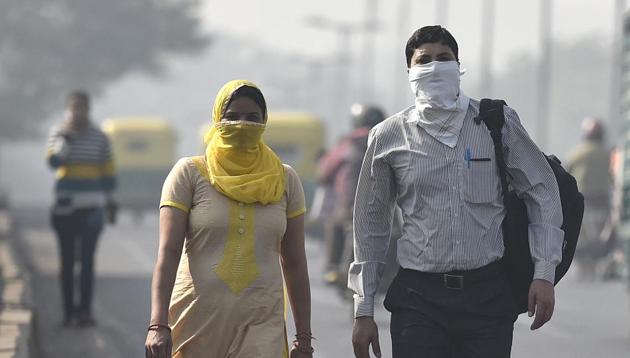
India’s most advanced air quality monitoring station, which was installed at the Town Hall in Old Delhi’s Chandni Chowk area in July this year, has thrown up this data. The station was set up by SAFAR, which comes under the Union ministry of earth sciences and is India’s official pollution forecasting system.
“The level of PM1 was recorded to be the lowest on July 27. It was just 10.02ug/m3. But on July 2, the level of PM1 had shot up to be 65.43ug/m3. Unlike other particulate matters, such as PM2.5 and PM10, the world is yet to come up with safe limits or permissible standards for PM1. Hence, it can’t be said how much above safe limits the level of PM1 had shot up,” said Gufran Beig, who heads SAFAR.
But to simplify things, experts said that the level of PM1 on July 27 (10ug/m3) could be considered as ‘safe’ because Delhi’s Air Quality Index was very close to ‘Good’ on that day. The AQI on July 27 was 50, which was in the ‘satisfactory’ range and just five notches above ‘Good’ quality air. The levels of PM2.5 and PM10 were both within their permissible limits of 60ug/m3 and 100ug/m3 on that day. On July 2, however, when PM1 was high, the AQI was 153 and levels of PM2.5 and PM10 were also above their safe standards.
{{/usCountry}}But to simplify things, experts said that the level of PM1 on July 27 (10ug/m3) could be considered as ‘safe’ because Delhi’s Air Quality Index was very close to ‘Good’ on that day. The AQI on July 27 was 50, which was in the ‘satisfactory’ range and just five notches above ‘Good’ quality air. The levels of PM2.5 and PM10 were both within their permissible limits of 60ug/m3 and 100ug/m3 on that day. On July 2, however, when PM1 was high, the AQI was 153 and levels of PM2.5 and PM10 were also above their safe standards.
{{/usCountry}}PM1 is considered to be more dangerous than PM2.5 and PM10 because of its smaller size. While PM2.5 is just around 30 times finer than the thickness of a human hair, PM1 is 70 times finer than the human hair. While PM2.5 can reach your lungs, PM1 can enter your bloodstream. The primary sources of PM1 are vehicular and industrial emissions.
“We are gradually moving from polluted fuels to refined fuels like BS-VI. The finer the fuel, the smaller and finer would be the pollutants emitted. And the finer the particles emitted the more toxic would they be. Their penetration power also increases with decreasing size of the pollutants. This makes PM1 one of the most dangerous pollutants,” said D Saha, former head of the CPCB’s air quality laboratory.
But till date there are not enough studies in the world on PM1. Neither the World Health Organisation nor the United States Environment Protection Agency or India’s Central Pollution Control Board has been able to set its standards.
“Its effect on health and its toxicity are still being studied by scientists across the world. Of late, US space agency NASA is planning to study the toxicity of particulate matter with the help of satellites. Only when scientists get enough details on its toxicity and evidence on its effect on human health, that we could hope to get some standards,” said Sagnik Dey, associate professor at Centre for Atmospheric Sciences in IIT Delhi.
Experts said that this calls for stricter emission standards as any laxity in emission standards would lead to more addition of these dangerous particles in the air.
“Even though there are no standards for PM1 but usually such ultrafine particles are products of combustion. We would need much stringent emission standards to tackle these pollutants at their source,” said Anumita Roychowdhury, head of Centre for Science and Environment’s Clean Air campaign.
This becomes all the more important because a recent study said that close to 15,000 people died prematurely in Delhi in 2016 from illnesses linked to fine particulate matter pollution. The study done by researchers from India, Singapore and Thailand, assessed pollution-related deaths in 13 megacities in Asia.
Stay updated with all top Cities including, Bengaluru, Delhi, Mumbai and more across India. Stay informed on the latest happenings in World News along with Delhi Election 2025 and Delhi Election Result 2025 Live, New Delhi Election Result Live, Kalkaji Election Result Live at Hindustan Times.
Stay updated with all top Cities including, Bengaluru, Delhi, Mumbai and more across India. Stay informed on the latest happenings in World News along with Delhi Election 2025 and Delhi Election Result 2025 Live, New Delhi Election Result Live, Kalkaji Election Result Live at Hindustan Times.