
 E-Paper



South Delhi shows way by charging for parking
The residential society found mention in a report submitted by the Environment Pollution Control Authority to the Supreme Court regarding Delhi’s parking policy on Friday.


Fights over parking space are unheard off, even during weekends, at Yamuna Apartments in South Delhi’s Alaknanda. It is one of the three residential neighbourhoods in Delhi where parking is charged and resident welfare association has imposed strict norms to manage stationary vehicles.
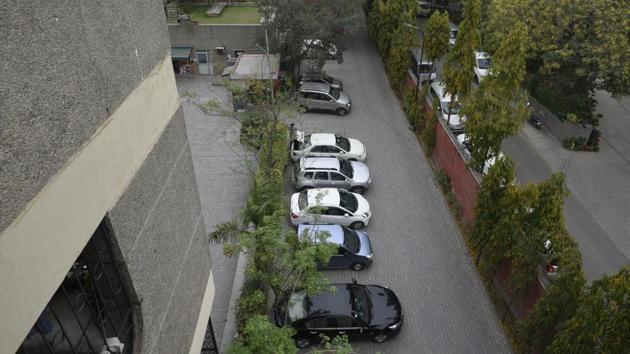
The residential society found mention in a report submitted by the Environment Pollution Control Authority to the Supreme Court regarding Delhi’s parking policy on Friday. The EPCA, a SC-appointed body, mentioned Anupam Apartment Complex in Saket, and Kaveri and Yamuna Apartments in Alaknanda — in south Delhi— as ‘model’ residential colonies while recommending parking be made chargeable in all residential areas.
On Saturday, HT visited three colonies to find out how they were managing parking, especially by charging colony residents. Making parking chargeable in residential colonies was a crucial provision recommended in the Delhi’s draft parking policy but was later dropped by the Delhi government.
The residents’ welfare associations in the three colonies have been charging for parking over the past three-four years. While Anupam Apartment Complex in Saket is a DDA Colony, Kaveri and Yamuna Apartments are cooperative group housing societies . Ashutosh Dikshit, chief executive of URJA, an umbrella network of RWAs in Delhi, said, “For cooperative societies, they are the owner of the land and have the freedom to take decisions and enforce them.On the other hand, for colony RWAs, the land is with the government. It is not possible to take such decisions or enforce them,” he said.
Mohan Narayanan, secretary of the Yamuna CGHS, said they levied a small fee on residents as way back as 1980 when the apartment building was completed and people started moving in.
“We used to charge Rs 100 a month per house. But with people buying more cars, it became a problem. A waiting list ensued for residents to park inside with remaining cars parked on the road minus security,” he said.
Three years ago, the society decided to raise the parking fee from ₹100 to ₹300. “The purpose was to discourage people from purchasing multiple cars or keeping old rusting cars inside the complex, by making the exercise expensive. We have a stringent policy of one car per flat,” Narayanan said.
Satish Padmanabhan, a resident of Yamuna Apartments, said, “I am happy with this arrangement as it promises me a fixed parking slot in an otherwise busy area.”
In its immediate neighbourhood, the welfare association of Kaveri Apartment has implemented ‘differential’ parking charges. “Parking for the first car is free. Residents have to pay Rs 150 and Rs 1,000, respectively, for a second and third car. We do not allow a fourth car,” Dr Saurabh Bhatnagar, secretary, Kaveri Apartments, said.
Bhure Lal, EPCA chairman, appreciated these measures, “This is the international practice be it New York, London or Washington. If we don’t force charges for parking in residential areas, there will be no space left for mobility,” he said

Stay updated with all top Cities including, Bengaluru, Delhi, Mumbai and more across India. Stay informed on the latest happenings in World News along with Delhi Election 2025 and Delhi Election Result 2025 Live, New Delhi Election Result Live, Kalkaji Election Result Live at Hindustan Times.


